

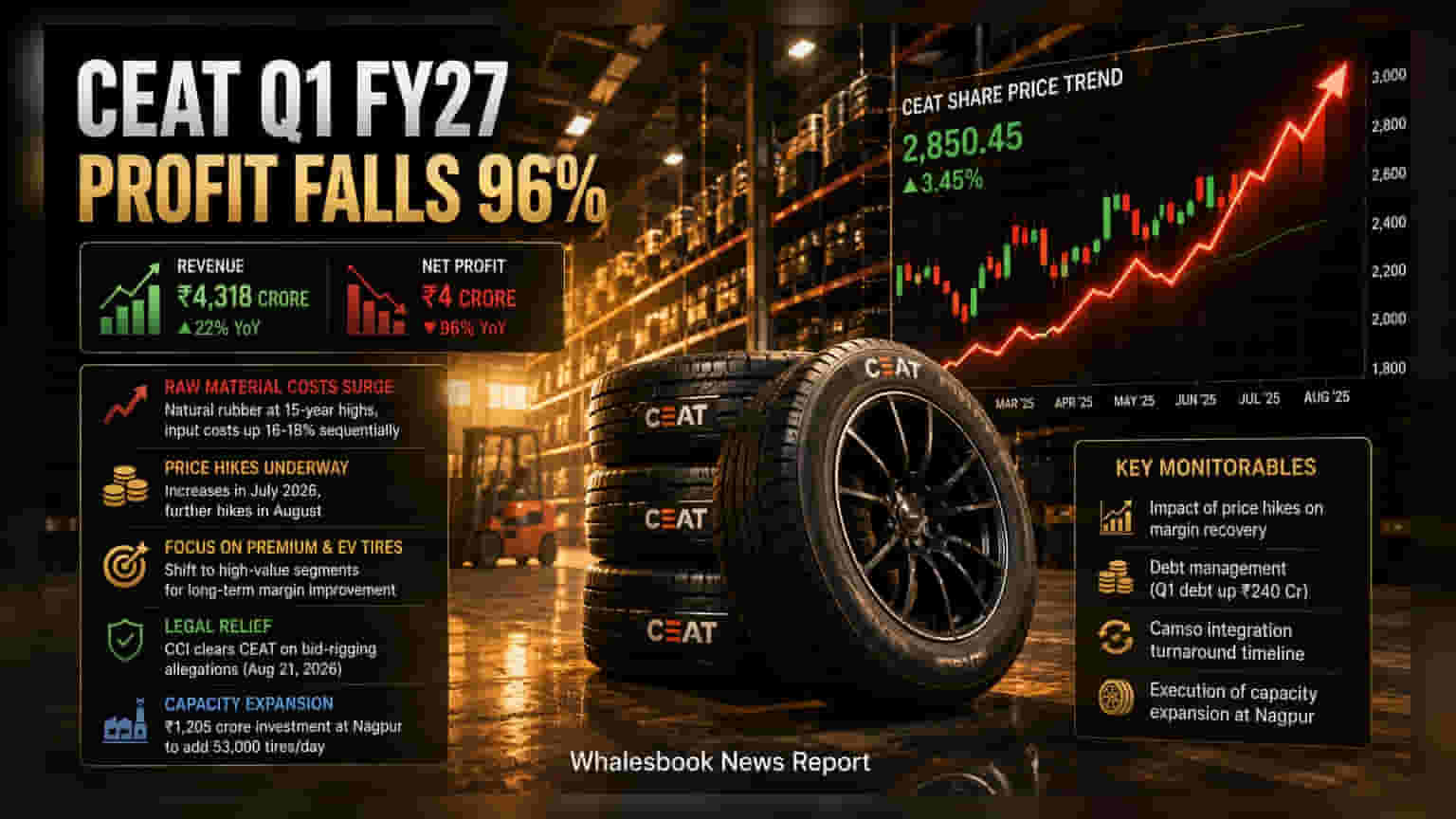
CEAT’s net profit dropped 96% to ₹4 crore in the first quarter of FY27, despite strong demand driving revenue up by 22%. High raw material prices, especially natural rubber, pressured margins significantly. The company is now counting on price hikes and a shift toward premium tires to recover profitability while continuing its major expansion projects.
CEAT Limited posted a challenging first quarter for FY27, where strong demand failed to prevent a sharp drop in profitability. While the company recorded a 22% jump in revenue to ₹4,318 crore, its net profit fell by 96% to ₹4 crore compared to the same period last year. This sharp decline highlights the difficulty the company is facing in managing the rising cost of raw materials.
Margin Pressure from Raw Material Costs
The primary reason for this struggle is the record-high price of natural rubber, which has hit 15-year peaks, alongside rising costs for crude-based ingredients. These input expenses rose by 16-18% sequentially, significantly hurting the company’s operating margins, which contracted to 8.5% from 10.97% in the previous year. To fix this, CEAT began increasing tire prices in July 2026, with further hikes expected in August to protect profitability.
Strategic Shifts and Legal Relief
Despite the margin pressure, the company is focused on its long-term strategy of selling higher-value, premium tires, such as 17-inch wheels and products for electric vehicles. This move is aimed at balancing the profit loss over time. Simultaneously, the company is managing the integration of the Camso business. This transition is currently adding to the company's overhead expenses, but management expects it to eventually become a source of earnings in the coming years.
In a major relief for the company, the Competition Commission of India cleared CEAT on August 21, 2026, regarding bid-rigging allegations related to 2019 state transport tenders. This decision resolves a long-standing legal risk that had been a point of concern for investors. Additionally, the company is pushing forward with a ₹1,205 crore expansion at its Nagpur facility to boost production capacity by 53,000 tires per day, reflecting its commitment to long-term growth.
Investors should monitor how effectively the recent price hikes can offset raw material inflation in the coming quarters. Other factors to track include the management’s ability to control debt, which saw a sequential increase of ₹240 crore in Q1, and how quickly the Camso business starts contributing positively to the company's earnings.