 Whalesbook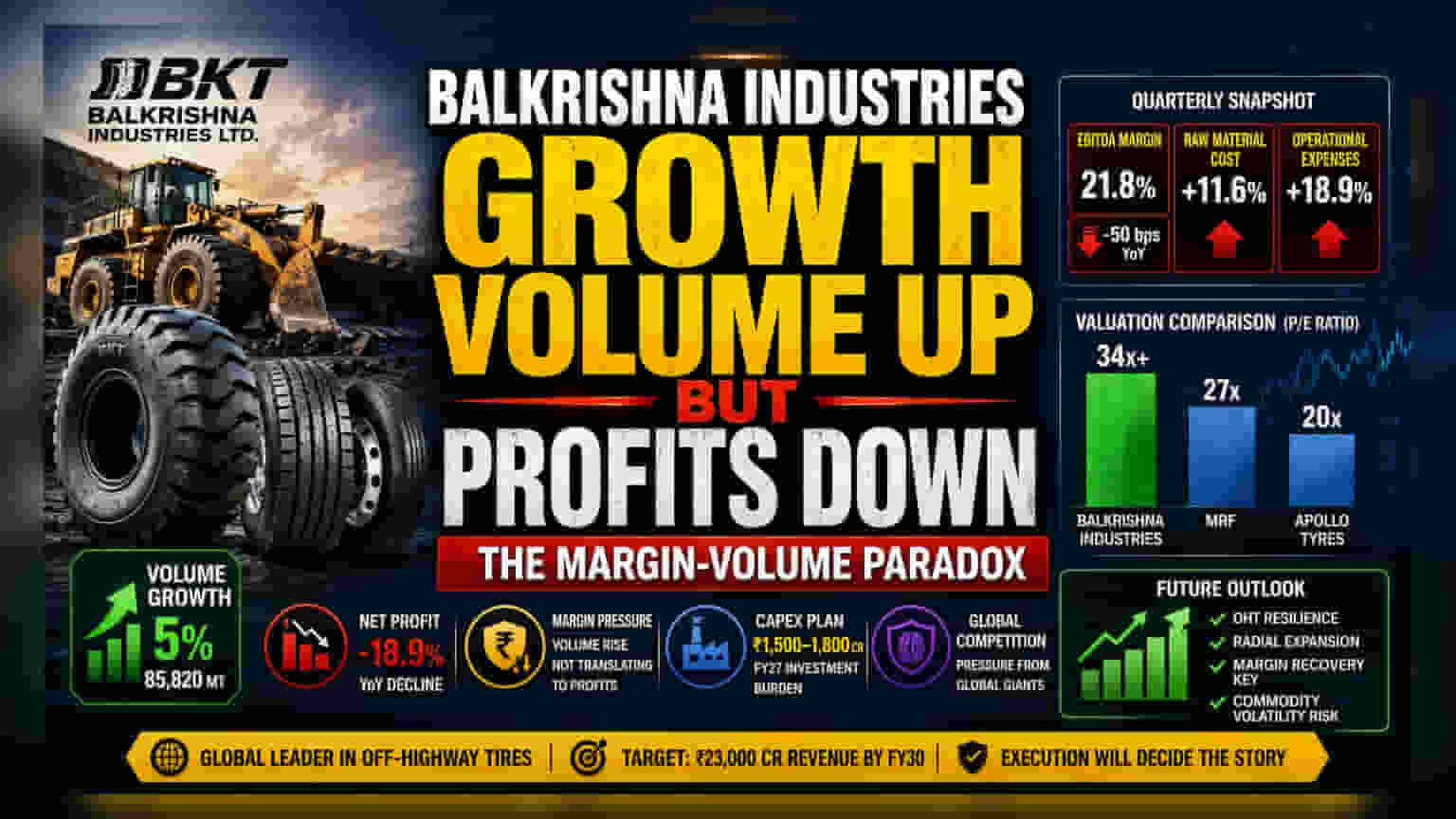


The Margin-Volume Paradox
Balkrishna Industries' recent quarterly performance reveals a widening gap between top-line expansion and bottom-line stability. While the company successfully drove a 5% increase in sales volume—reaching 85,820 metric tons—this operational success was largely eclipsed by significant margin erosion. EBITDA margins tightened to 21.8%, a 50-basis-point contraction from the previous year, as the company grappled with an 11.6% surge in raw material expenses and a sharp 18.9% spike in broader operational costs. This disconnect between volume growth and profitability highlights the company's current struggle to pass on inflationary pressures to its global customer base in the off-highway tire (OHT) segment.
The Analytical Deep Dive
When viewed against industry peers, the company’s valuation appears stretched. Trading at a P/E ratio exceeding 34x, Balkrishna Industries commands a premium that some market observers argue is difficult to justify given its recent return on equity (ROE) of approximately 11.6%. In contrast, traditional tire manufacturers like MRF trade at significantly lower earnings multiples, creating a comparative valuation gap. The company's strategic push into passenger car radial (PCR) and truck-bus radial (TBR) segments represents a bold attempt at diversification, yet this transition into highly competitive domestic markets carries inherent risks. Historical performance indicates that while the company has been a long-term compounder, its current reliance on export-heavy OHT demand leaves it vulnerable to shifts in European agricultural and construction machinery cycles.
The Forensic Bear Case
From a risk-averse perspective, the company’s ambitious capital expenditure program—earmarking ₹1,500–₹1,800 crore for FY27—is a double-edged sword. While necessary for its long-term vision of reaching ₹23,000 crore in revenue by FY30, the immediate impact is a drag on free cash flow and a rise in capital intensity. Furthermore, the firm faces a competitive disadvantage against global giants like Michelin and Bridgestone, which possess deeper R&D pockets and established premium distribution networks. Regulatory compliance costs and the complexity of supply chain management amid geopolitical tensions further threaten to compress margins. Critics also point to the company’s recent earnings performance, where net profit fell by nearly 19%, as evidence that volume growth is not currently translating into shareholder value.
The Future Outlook
Looking forward, management maintains confidence in the resilience of its core specialty tire business and the potential of its new radial tire categories. Brokerage sentiment remains polarized; while some analysts retain a bullish stance based on the company's global niche dominance and expected normalization of rubber prices, others emphasize the need for sustained margin recovery above the 23–25% threshold. Whether the upcoming capacity expansion acts as a catalyst for growth or a burden on returns will depend heavily on the company's ability to maintain pricing power in a volatile global commodity environment.