

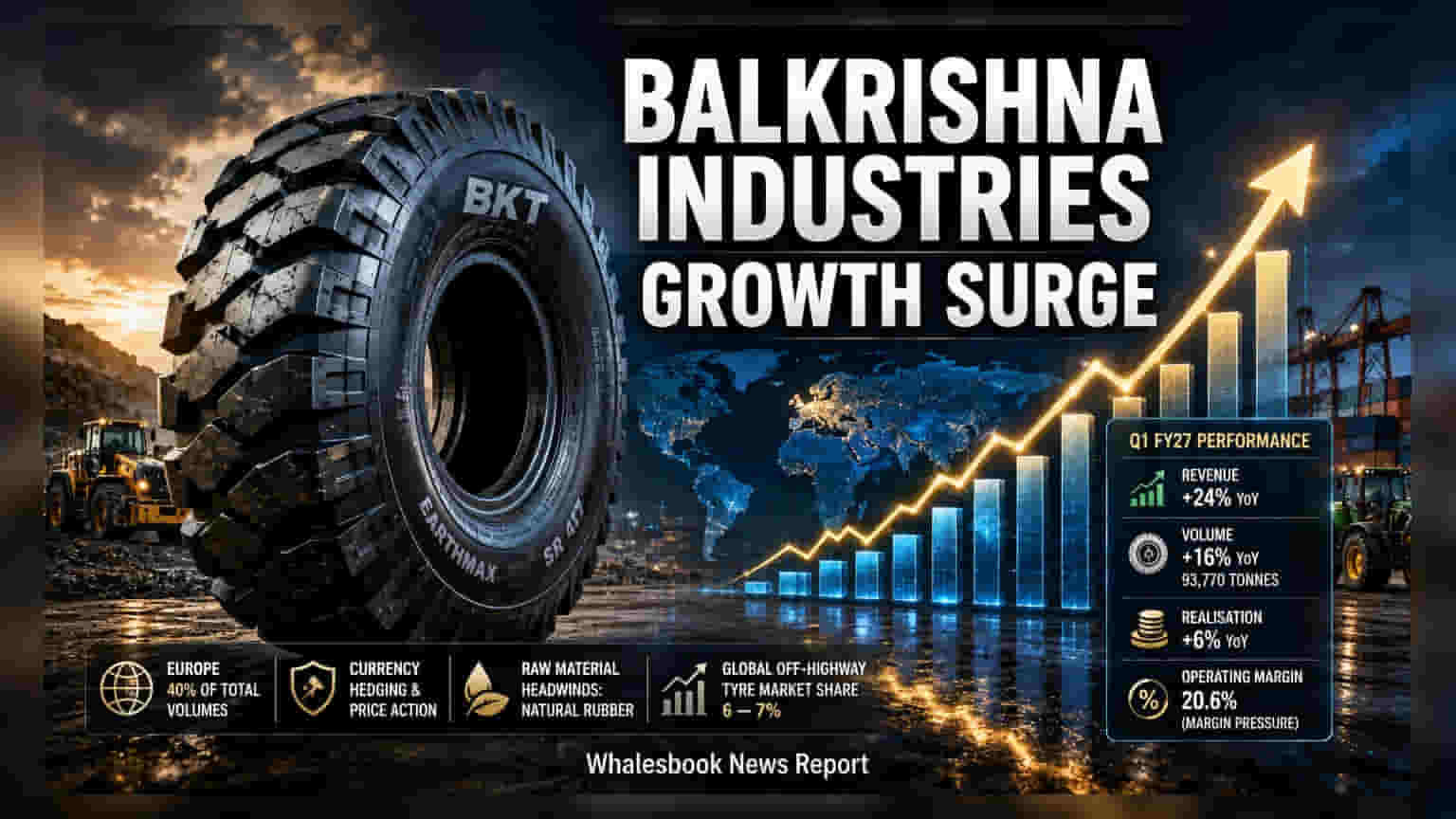
Balkrishna Industries reported a 24 percent year-on-year revenue increase for the first quarter of fiscal 2027, largely driven by strong volume growth. While the company outperformed domestic peers like Apollo Tyres and MRF, rising input costs and freight expenses squeezed operating margins to 20.6 percent. Investors should track commodity price trends and regional demand shifts.
Balkrishna Industries (BKT) reported a strong financial start to fiscal year 2027, with standalone revenue climbing 24 percent year-on-year for the June quarter. This growth outpaced major domestic tyre manufacturers, with Apollo Tyres reporting a 16 percent increase and MRF recording 10 percent revenue growth during the same period. The company’s performance was supported by a 16 percent rise in sales volumes, totaling 93,770 tonnes, and a 6 percent improvement in per-unit realisations.
Europe continues to be a crucial revenue driver for the company, accounting for 40 percent of total volumes. A steady 16 percent growth in European demand helped the company offset a 16 percent decline in sales within North America. To support its strategic initiatives, the company’s finance committee approved a fund-raising plan through non-convertible debentures on August 18, 2026, and the board declared a first interim dividend of ₹4 per share for the fiscal year.
Margin Headwinds and Input Costs
Despite the double-digit revenue growth, profitability faced significant pressure. The company’s operating margin contracted to 20.6 percent, compared to higher levels in previous periods. This squeeze is primarily linked to rising costs, specifically the inflation in natural rubber prices and increased freight expenses. Additionally, higher employee-related expenditures impacted bottom-line margins.
Management is navigating these headwinds through active currency hedging and price adjustments. However, the company remains exposed to broader sector risks. Persistent raw material cost inflation, particularly in rubber, poses a challenge to sustaining or improving margins in the coming quarters. Furthermore, the company continues to manage geopolitical and trade-related risks, such as ongoing import duties in certain regions, which can impact volume growth and operational efficiency.
Future Market Strategy
Balkrishna Industries currently occupies a 6 to 7 percent share of the global off-highway tyre market. The company’s core strategy involves deepening its presence in existing markets and diversifying its product offerings across agriculture and non-agriculture segments. For investors, the most critical monitorable will be the company’s ability to stabilize profit margins as commodity prices fluctuate. Additionally, tracking the demand cycle in the construction and agricultural equipment sectors in Europe and North America will be key to understanding future volume trends. The company’s ability to maintain its market share momentum amidst potential competitive pressures in the off-highway tyre segment will also be a primary area for long-term observation.