 Whalesbook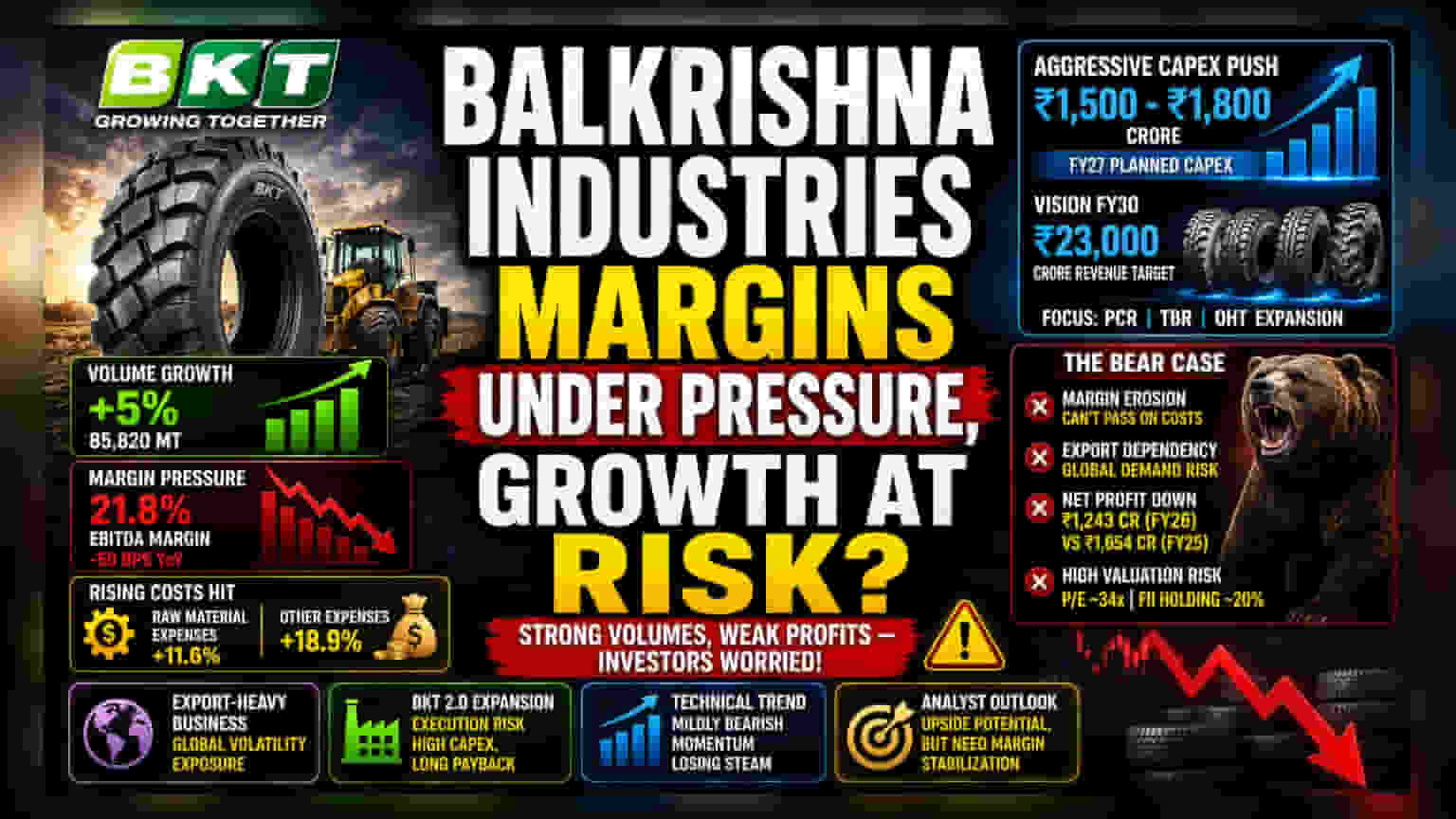


The Margin-Volume Paradox
Balkrishna Industries' recent quarterly performance reveals a widening gap between top-line expansion and bottom-line stability. While the company successfully drove a 5% increase in sales volume—reaching 85,820 metric tons—this operational success was largely eclipsed by significant margin erosion. EBITDA margins tightened to 21.8%, a 50-basis-point contraction from the previous year, as the company grappled with an 11.6% surge in raw material expenses and a sharp 18.9% spike in broader operational costs. This disconnect between volume growth and profitability highlights the company's current struggle to pass on inflationary pressures to its global customer base in the off-highway tire (OHT) segment.
Strategic Capex vs. Current Reality
Management’s aggressive stance on future growth is evident in its planned capital expenditure of Rs 1,500 crore to Rs 1,800 crore for FY27, part of a broader vision to reach Rs 23,000 crore in revenue by FY30. This push includes significant investments in passenger car radial (PCR) and truck-bus radial (TBR) segments. However, the market's reaction suggests skepticism regarding the immediate payoff of these capital-intensive projects. Trading at a trailing P/E of approximately 34x, the stock carries a valuation premium that assumes a rapid earnings rebound—a scenario that remains dependent on favorable raw material prices and a sustained recovery in the European agricultural and construction machinery markets.
The Forensic Bear Case
From a risk-averse perspective, the company’s structural health warrants scrutiny. Unlike peers such as MRF, which operate with different capital allocation priorities, Balkrishna Industries faces a dual threat: the volatility of international exports—which represent the vast majority of its revenue—and the inherent execution risk of its "BKT 2.0" expansion strategy. Furthermore, recent financial disclosures show a decline in annual net profit, with FY26 consolidated net profit falling to Rs 1,243 crore from Rs 1,654 crore in the prior fiscal year. Institutional selling risk remains elevated, with foreign institutional investors holding roughly 20% of the equity; any shift in global risk appetite could trigger disproportionate volatility given the stock's current premium valuation. The company also faces pressure from competitors pushing deeper into its niche OHT stronghold, potentially capping future pricing power if global demand for specialized tires fails to materialize as projected.
Future Outlook
Brokerage sentiment remains polarized. While some analysts maintain a bullish outlook based on the long-term potential of the company's new tire segments, others point to the technical trend, which has shifted to a mildly bearish footing. The consensus 12-month targets suggest room for growth, yet investors are increasingly looking for signs of margin stabilization above 23-25% before viewing the stock as a compelling entry point in the current volatile interest rate and commodity environment.