

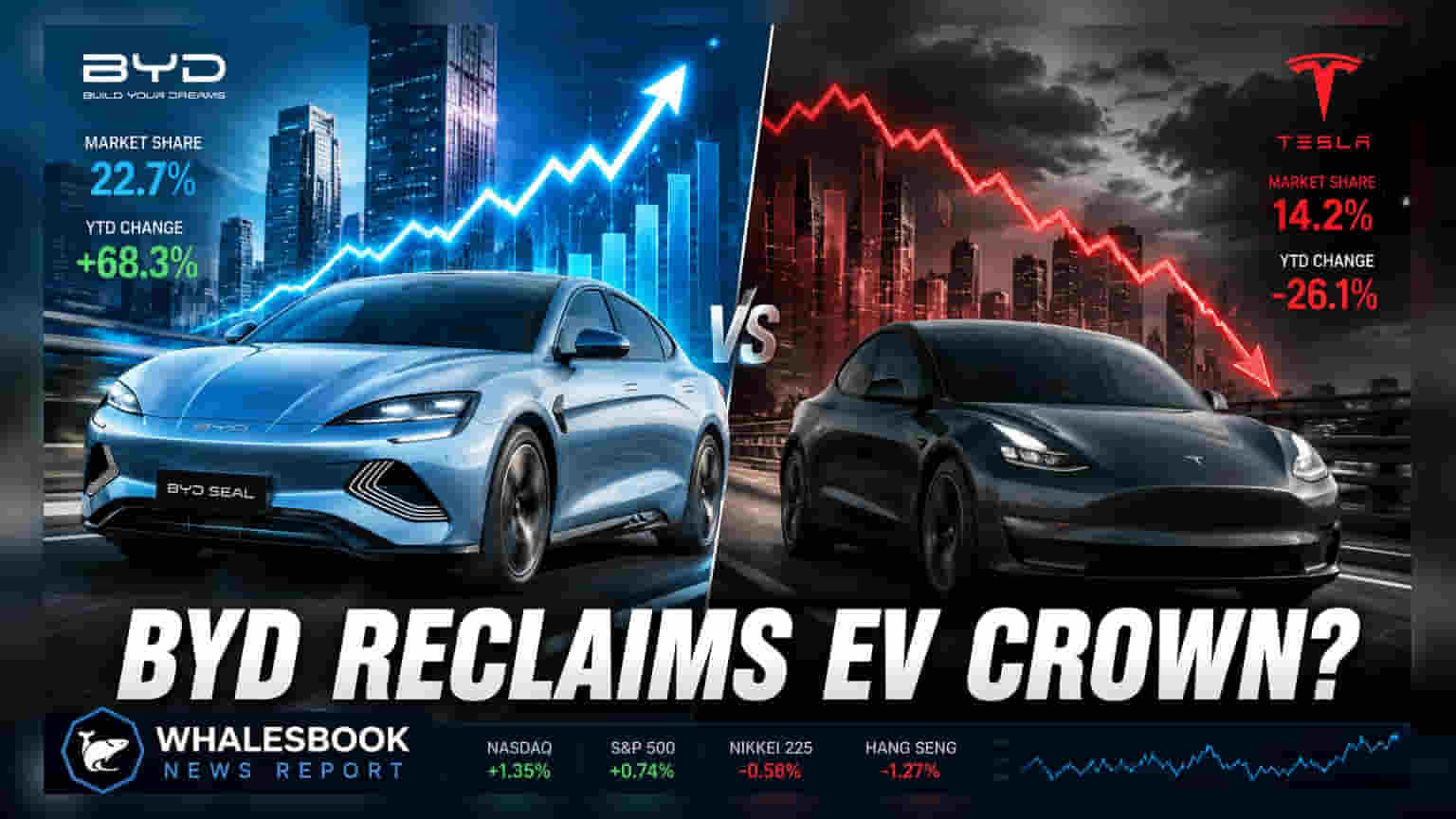
BYD has reported 557,090 EV deliveries for the second quarter of 2026, potentially retaking the global lead from Tesla, which posted approximately 396,500 units. While international expansion is fueling this momentum, BYD continues to face a fierce price war in its domestic Chinese market. For investors, the company's focus on overseas markets and new technology upgrades remains a critical monitorable for long-term growth.
What Happened
BYD Company has moved closer to reclaiming the top spot in global electric vehicle (EV) sales. For the quarter ending June 2026, the Chinese automaker reported 557,090 battery-electric vehicle sales. This performance puts it ahead of Tesla, which recorded approximately 396,500 deliveries for the same period. Following the announcement, BYD's shares rose by about 8.4% in Hong Kong trading, reflecting investor relief at the strong volume figures despite the company's recent challenges.
Why International Sales Matter
The surge in BYD's quarterly numbers is largely driven by its aggressive international strategy. Overseas markets now account for 43% of the company's monthly sales volume. This global pivot is a deliberate effort to reduce reliance on the domestic Chinese market, which has been embroiled in a relentless price war for the past year. As growth slows at home due to market saturation and weaker consumer confidence, the ability to scale in Europe, Southeast Asia, and Latin America has become a vital cushion for the company's revenue.
The Tech Bet
Beyond sales volume, BYD is attempting to differentiate itself through technological upgrades. The company recently unveiled its Xuanji A3, an in-house 4nm chip designed for autonomous driving, and is accelerating production of its next-generation Blade Battery 2.0. These investments are part of a broader strategy to move beyond price-based competition and position itself as a premium technology player. However, the market response to these announcements has been mixed, as investors remain cautious about the long-term impact of high capital spending on margins during a period of intense global price competition.
Risks and Market Context
While the sales surge is positive, BYD faces significant headwinds. Domestic profit margins have been squeezed by the ongoing price war in China, where automakers are sacrificing profitability to maintain market share. Additionally, the company’s push into international markets is not without hurdles, as it navigates complex regulatory environments and geopolitical tensions that could impact supply chains and market access. The company's recent financial results also showed pressure on net income, indicating that volume growth alone does not guarantee higher profitability in the current cost environment.
What Investors Should Track
For investors, the key monitorables will be the sustainability of international demand and the company’s ability to protect profit margins. Tracking the adoption rate of its new autonomous driving features and the production efficiency of its updated battery systems will be essential to understanding if these technologies can provide a competitive edge. Furthermore, management commentary on future overseas sales targets and the severity of the domestic price war will be important for assessing the company’s earnings outlook in the coming quarters.