

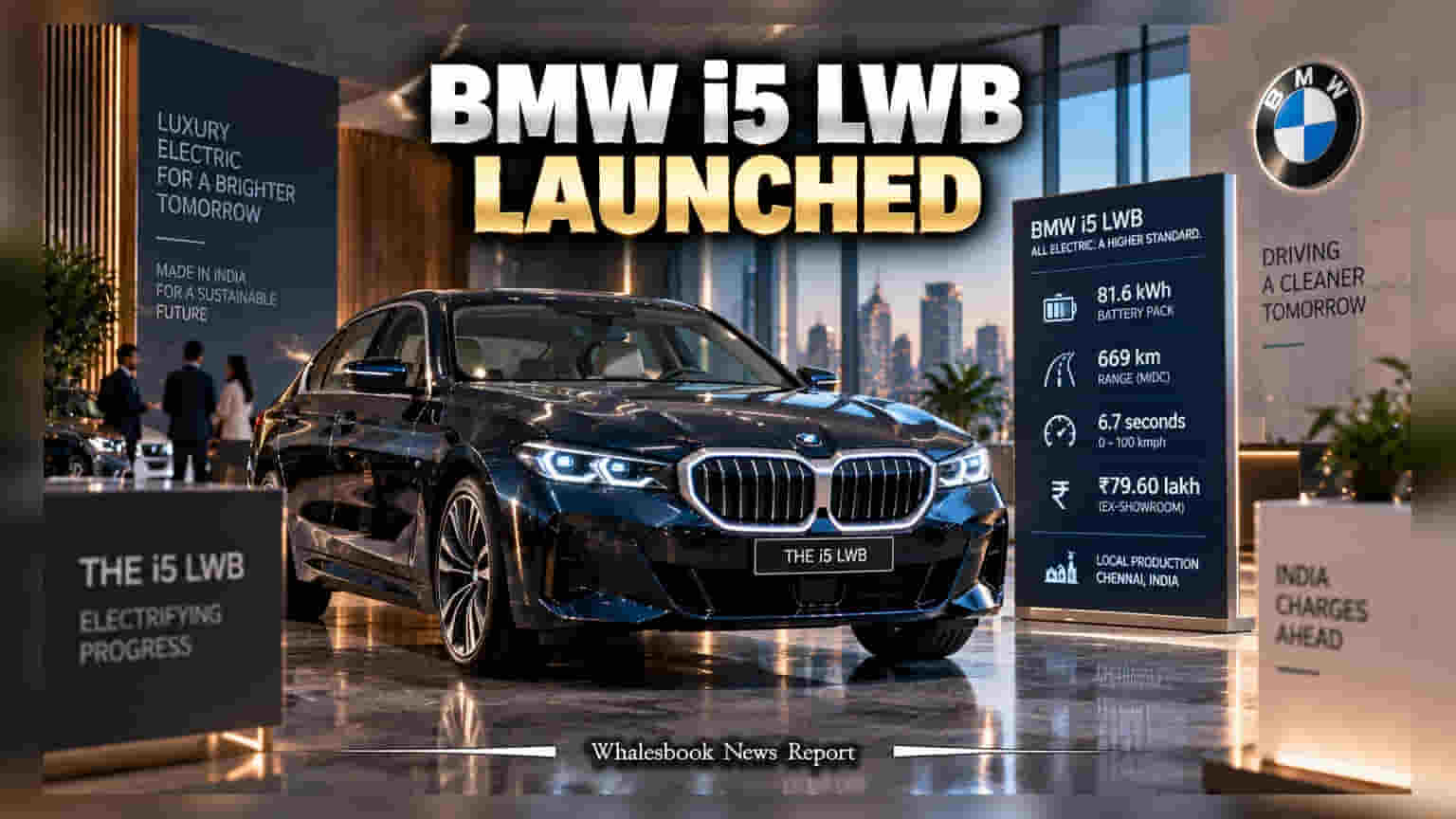
BMW India has launched its locally assembled i5 Long Wheelbase electric sedan at ₹79.60 lakh. Produced at its Chennai facility, the move reflects the automaker's strategy to grow its EV portfolio. While domestic demand is rising, investors are tracking global margin pressure and currency volatility that could impact overall financial stability.
BMW Group India has expanded its electric vehicle lineup in the domestic market with the launch of the locally manufactured i5 Long Wheelbase (LWB) electric sedan. Priced at ₹79.60 lakh (ex-showroom), the vehicle is assembled at the company’s Chennai facility. This development follows a successful pre-launch phase where the limited-run 'First Edition' variant, consisting of 99 units, was completely sold out.
The i5 LWB is designed to cater to the growing demand for premium, tech-forward electric mobility. It comes equipped with an 81.6 kWh battery pack, which supports a claimed range of up to 669 km on a single charge based on the MIDC cycle. Performance metrics include a 0-100 kmph acceleration time of 6.7 seconds, positioning it within the competitive luxury electric segment.
Sales Performance and EV Growth
The launch comes at a time when BMW India is seeing solid traction in the domestic market. In the first half of 2026, the company delivered 9,075 vehicles, marking a 17% increase compared to the same period in the previous year. Electric vehicles have become a significant pillar of this growth, now contributing 26% to the company's total volume. Sales of electric models saw a sharp rise of 78% year-on-year, reaching 2,359 units in the first six months of 2026.
Global Financial Context and Risks
Despite the positive sales momentum in India, the broader BMW Group faces financial challenges. Recently, the parent company lowered its global EBIT (earnings before interest and taxes) margin guidance for 2026 to a range of 1-3%, down from the previously estimated 4-6%. This downward revision is largely attributed to market weakness in China and various geopolitical headwinds that are affecting vehicle demand and profitability.
In the Indian context, the automotive industry continues to deal with persistent cost pressures. Factors such as currency volatility—specifically the depreciation of the rupee against the euro—along with rising costs for raw materials, logistics, and energy, have forced the company to implement periodic price hikes. For instance, BMW India increased vehicle prices in April and July 2026, each by approximately 2%, to offset these inflationary pressures.
For investors and market observers, the key monitorable remains how effectively the company can balance its growth in the Indian EV segment with these rising operational costs. While local production at the Chennai plant helps in mitigating some supply chain complexities, the company's ability to maintain profit margins amid global sector pressure and local currency fluctuation will be central to its financial outlook in the coming quarters.