

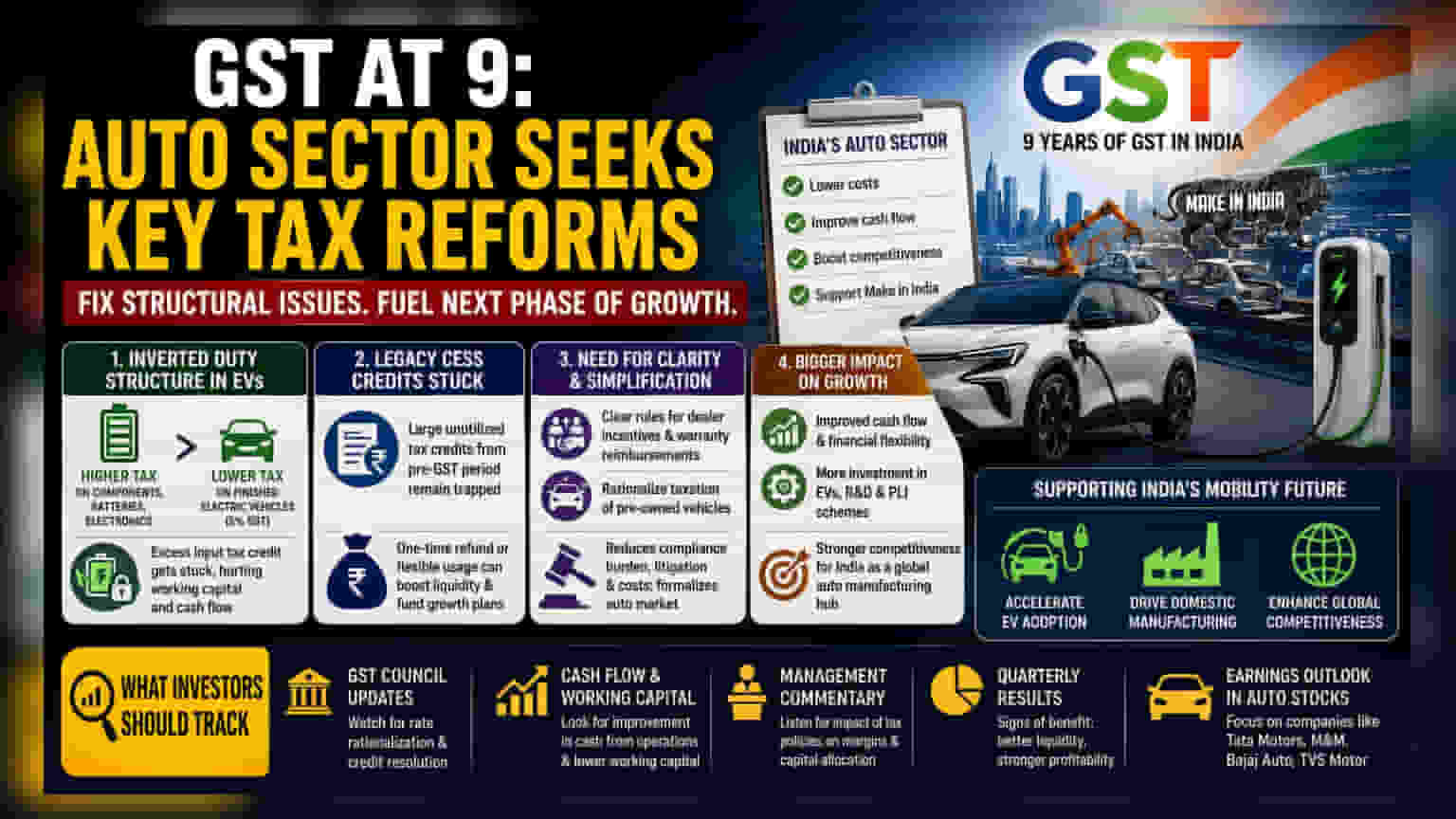
India’s auto industry is urging the government to address GST challenges like inverted duty structures and pending tax credits. For investors, potential reforms could improve cash flow and working capital for manufacturers, especially those scaling up electric vehicle production and advanced manufacturing.
What Happened
As India’s Goods and Services Tax (GST) regime completes nine years, the automotive sector is calling for specific policy adjustments to support its next phase of growth. Industry representatives have approached tax authorities to address structural issues that currently hamper operations. The requests center on fixing the inverted duty structure in electric vehicles (EVs), clearing legacy tax credits, and simplifying rules for modern mobility models like fleet operations. These changes aim to lower the cost of doing business and support the government's push for India to become a global hub for automotive manufacturing.
The Inverted Duty Challenge
One of the primary concerns for auto manufacturers is the 'inverted duty structure.' In the current tax system, electric vehicles often attract a lower GST rate (5%) compared to the taxes paid on various components, batteries, and power electronics used to build them.
When the tax on raw materials and components is higher than the tax on the finished product, companies accumulate excess tax credits that they cannot easily use. This locks up valuable working capital. For investors, this matters because it impacts the cash flow of companies. Resolving this would allow manufacturers to recover these funds faster, potentially improving their financial flexibility for other investments.
Legacy Credits and Cash Flow
Beyond current tax rates, the industry is also seeking resolution for 'legacy compensation cess' credits. Many companies still hold significant unutilized tax credits from the period before the current GST rules fully matured. These funds are essentially trapped on company balance sheets.
If the government allows for a one-time refund or provides more flexible ways to use these credits, it could provide a one-time liquidity boost to balance sheets. This would be particularly helpful for companies undertaking heavy capital spending projects, such as setting up new EV plants or investing in R&D to meet the requirements of the government's Production Linked Incentive (PLI) schemes.
Impact on the Business Environment
Beyond tax math, the industry is pushing for greater clarity on business operations. Current ambiguities regarding dealer incentives, warranty reimbursements, and the taxation of pre-owned vehicles lead to compliance burdens and litigation.
Simplifying these rules is seen as a way to formalize the auto market further, especially in the used vehicle segment. For shareholders, regulatory certainty is a positive. It reduces the risk of sudden tax demands and lowers the legal costs associated with interpreting complex tax laws.
What Investors Should Track
While these requests are under discussion, the immediate impact on stock prices is indirect. Investors should keep a close watch on future meetings of the GST Council. Any official notification regarding the rationalization of tax rates for EV components or a mechanism to release stuck tax credits would be a material update.
Additionally, monitor management commentary in upcoming quarterly earnings calls. Leaders at major auto firms (like Tata Motors, Mahindra & Mahindra, Bajaj Auto, and TVS Motor) often discuss how tax policies impact their capital allocation and profit margins. Watch for whether companies mention an improvement in 'cash from operations' or a reduction in 'working capital requirements' in future results, as these would be the tangible signs that such policy changes are benefiting the business.