 Whalesbook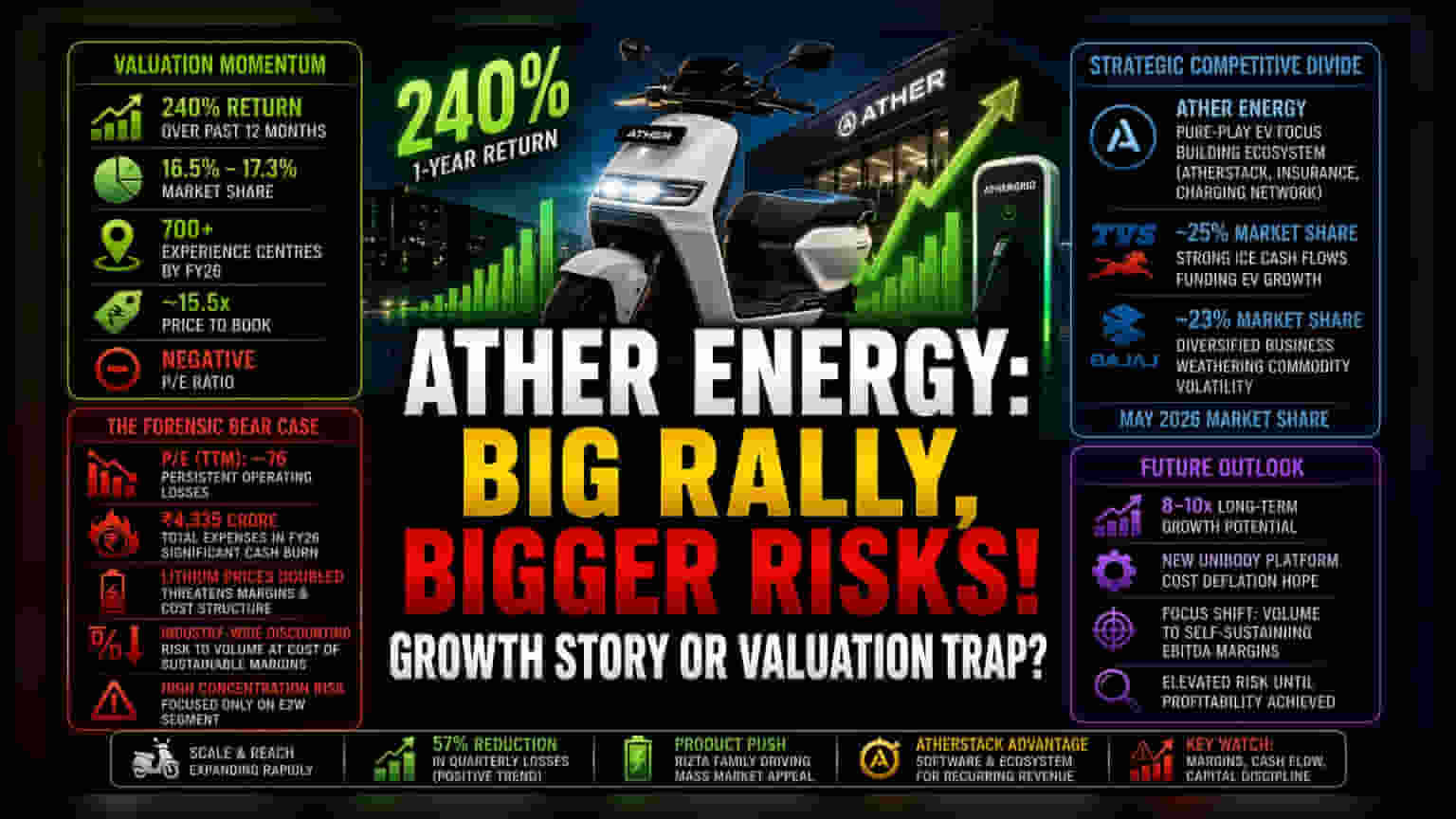


The Valuation Momentum and Reality Check
Ather Energy’s equity performance has been nothing short of aggressive, with the stock delivering a 240% return over the past twelve months while the broader market retreated. This divergence is rooted in a fundamental pivot: the transition from a niche, sporty brand to a broader market competitor via the Rizta family scooter. By securing a 16.5% to 17.3% market share, the company has proven its ability to scale distribution, ending FY26 with 700 experience centers. Yet, the rally faces a reality check. Trading at approximately 15.5 times book value, the company continues to carry a negative P/E ratio, reflecting a business that is currently trading on future growth promises rather than present-day profitability.
The Strategic Competitive Divide
Unlike traditional automotive giants currently dominating the electric two-wheeler space, Ather operates as a pure-play EV entity. While TVS Motor and Bajaj Auto leverage the deep, consistent cash flows of their internal combustion engine businesses to subsidize their EV ventures, Ather remains reliant on operating leverage and market sentiment. In May 2026, TVS and Bajaj maintained strong leads with roughly 25% and 23% market shares respectively. The structural advantage for these incumbents is their ability to weather commodity price volatility without the same urgency for external capital injections. Ather’s expansion into insurance services and a widening charging ecosystem suggest a push for long-term recurring revenue through its AtherStack software, but these initiatives remain secondary to the immediate challenge of unit economics.
The Forensic Bear Case
The bull thesis rests on the assumption of scale-led cost reduction, but the bear case is anchored in structural constraints. The firm’s trailing-twelve-month P/E of approximately -76 underscores the persistent drag of operating losses. Despite a 57% reduction in quarterly losses, Ather burned significant cash in FY26, with total expenses hitting ₹4,335 crore. Furthermore, the company is highly sensitive to raw material fluctuations, particularly the doubling of lithium prices, which directly threatens margin expansion. Unlike diversified manufacturers that can absorb cost spikes across a broader product mix, Ather’s concentration in the E2W segment leaves it exposed. Analysts have also flagged the risk of aggressive discounting, common across the industry, which may improve short-term volume metrics at the expense of long-term sustainable margins.
Future Outlook and Analyst Sentiment
The consensus remains divided between the potential for 8-10x long-term growth and the immediate risk of earnings misses. While some institutional targets project upside based on potential cost deflation from a new unibody platform, the company’s inability to turn an annual profit keeps the risk profile elevated. For the quarters ahead, market participants are shifting focus from volume growth to clear evidence of self-sustaining EBITDA margins, as the grace period for cash-burning growth strategies typically narrows as interest rates and capital costs remain fluid.