

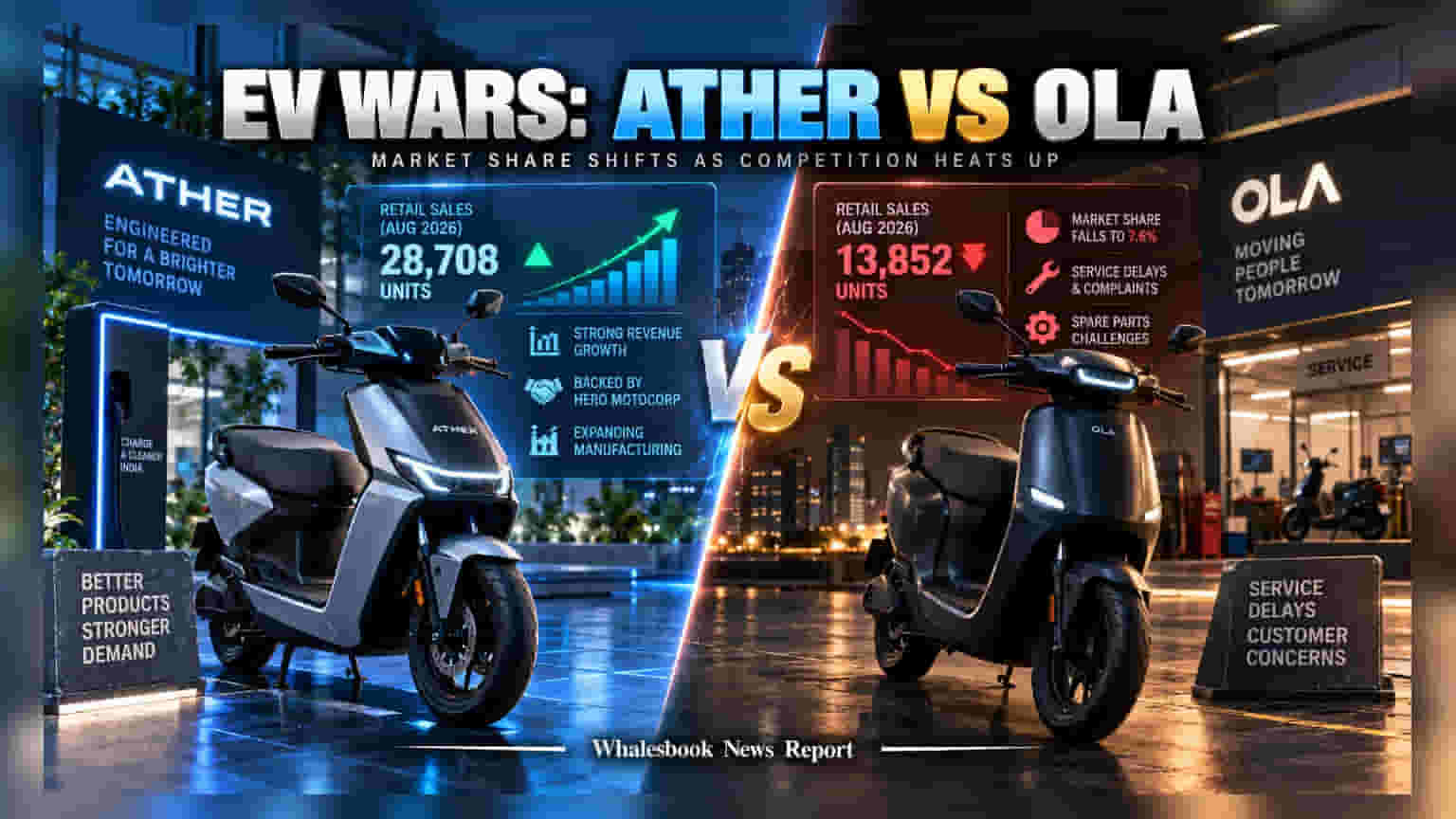
In August 2026, Ather Energy saw retail sales rise to 28,708 units, significantly outperforming Ola Electric, which recorded 13,852 units. This shift highlights a widening gap in market performance, as Ather strengthens its financial and strategic footing while Ola struggles with declining market share and service-related challenges. Investors are closely watching the contrast between Ather’s growth and the pressure on Ola’s stock, which remains well below its IPO price.
The Indian electric two-wheeler landscape has witnessed a sharp turn in momentum as of August 2026. New registration data reveals that Ather Energy has captured a significantly larger share of the market, recording 28,708 retail sales compared to Ola Electric’s 13,852 units. This divergence marks a notable shift in the industry, where market leadership has become increasingly contested as consumer preferences evolve.
Financial and Strategic Backing
Ather’s recent performance is underpinned by strong financial and strategic milestones. In the first quarter of the current financial year, the company reported a revenue of ₹1,216.9 crore, marking an 89% increase compared to the previous year. A major pillar of this stability is the deepening partnership with Hero MotoCorp, which recently increased its stake in Ather to approximately 32.8% through a secondary investment of ₹1,758 crore. This backing provides the capital necessary for large-scale projects, including upcoming manufacturing capacity expansion in Maharashtra. By focusing on engineering quality and consistent product rollouts, the company has managed to maintain demand even as the broader sector faces intense competition.
Operational Hurdles for Ola
In contrast, Ola Electric is managing a significant decline in its market position. Its market share in the electric two-wheeler segment fell to 7.6% in August 2026, a steep drop from the 17.7% share it held during the same period a year earlier. Beyond the sales figures, the company is addressing operational challenges, including a high volume of consumer complaints regarding service delays and the availability of spare parts. These hurdles have impacted investor sentiment, with the company’s stock price currently trading at roughly half of its August 2024 IPO valuation.
Rising Competition in the Sector
Both companies are operating in an increasingly crowded environment where legacy manufacturers, including TVS Motor and Bajaj Auto, are aggressively scaling their electric portfolios. These incumbents are leveraging their established service networks and decades of manufacturing experience to capture market share, forcing pure-play electric manufacturers to prove their ability to provide reliable after-sales support. This environment has raised the bar for what consumers expect from electric scooter brands.
For market observers, the next several months will be critical for determining the long-term trajectory of these players. Ather Energy is focused on scaling its production capacity to meet rising demand, while Ola Electric is in the midst of a turnaround effort aimed at stabilizing its operations and restoring market confidence. The primary monitorables for the sector will be the ability of these companies to maintain profitability, resolve service-related friction, and defend their market share against both new and legacy competitors.