

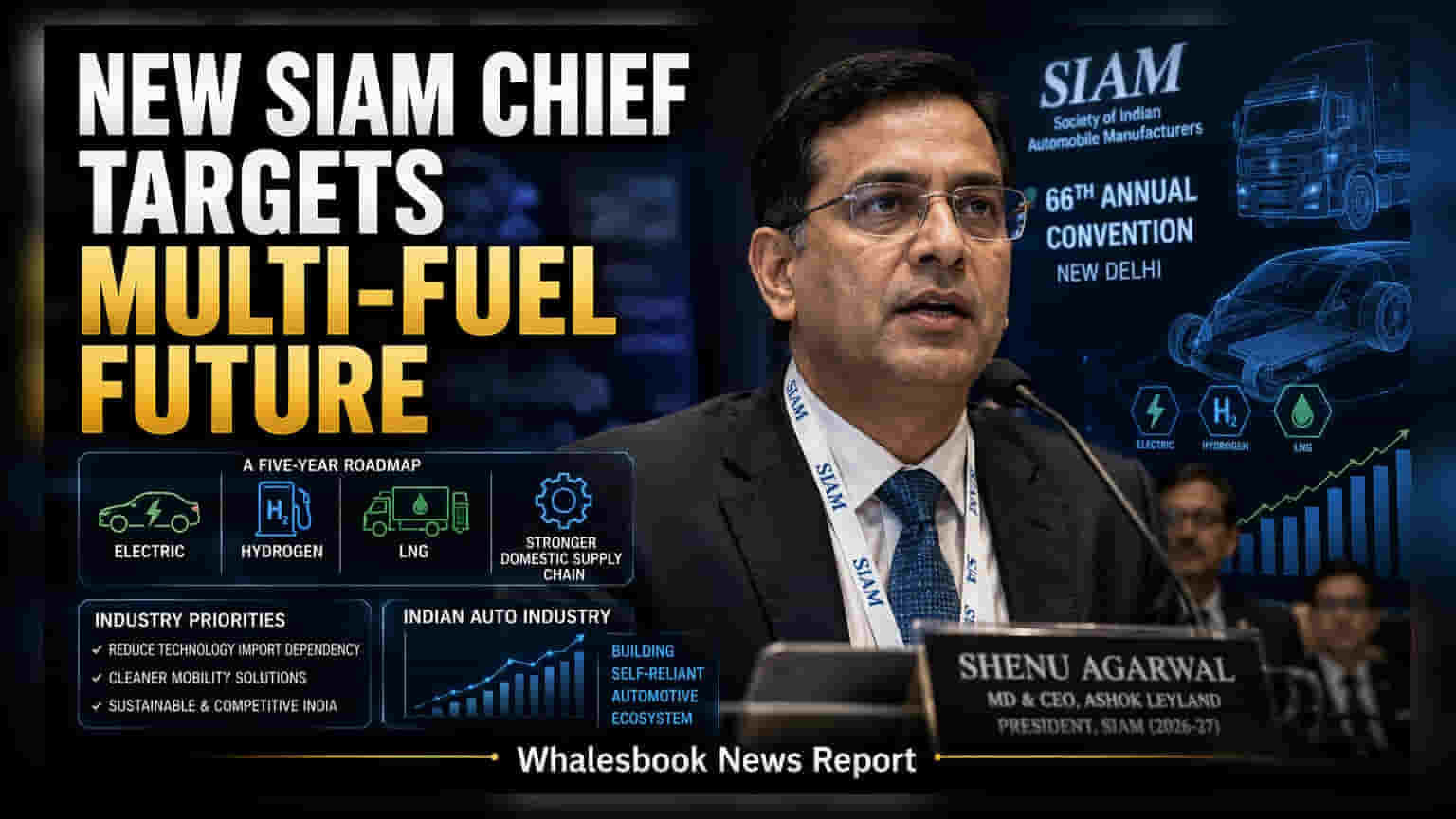
Ashok Leyland MD & CEO Shenu Agarwal has been elected President of the Society of Indian Automobile Manufacturers (SIAM) for 2026-27. He plans to lead a five-year roadmap for multi-fuel technology and local manufacturing to reduce import reliance. The appointment comes as the automotive sector navigates a complex transition toward new-age powertrain systems.
Shenu Agarwal, the Managing Director and CEO of Ashok Leyland, has been elected as the President of the Society of Indian Automobile Manufacturers (SIAM) for the 2026-27 term. This leadership change was announced during the organization’s 66th Annual Convention held in Delhi, where Agarwal succeeded Shailesh Chandra, the MD & CEO of Tata Motors Passenger Vehicles. Alongside him, the industry body also appointed K.N. Radhakrishnan from TVS Motor Company as Vice President and Santosh Iyer from Mercedes-Benz India as Treasurer.
Focusing on a Multi-Fuel Roadmap
In his new role, Agarwal has outlined a five-year roadmap intended to align the Indian automotive industry with a multi-fuel future. The strategy emphasizes a transition toward cleaner power sources, including electric, hydrogen, and liquefied natural gas (LNG). A central theme of his agenda is to reduce the country’s dependence on imported technology. As the industry shifts to advanced power electronics and battery cells, Agarwal aims to strengthen the domestic supply chain to ensure that manufacturers remain competitive while avoiding the pitfalls of replacing traditional fuel dependency with technological import reliance.
Financial Context for Ashok Leyland
For investors, the appointment places a spotlight on the company's own ability to navigate this transition. Ashok Leyland has maintained a steady operational rhythm, reporting a revenue of ₹9,634.35 crore for the first quarter of FY27, which marks a 10.43% increase compared to the same period last year. Net profit stood at ₹609.11 crore, showing a modest rise of 2.5% year-on-year. Despite these revenue gains, the company, like many in the sector, has faced pressure on operating margins, which came in at 10.1% due to rising material costs. As of September 3, 2026, the company’s share price was trading at approximately ₹166.71.
Sector Challenges and Monitorables
While the industry explores new fuel types, the commercial vehicle segment remains heavily tied to diesel for the near term. The primary challenge for the sector will be balancing the heavy capital spending required for new infrastructure with the need to keep operational costs efficient. Investors may track how the new SIAM leadership addresses policy alignment to support these investments without hurting profitability. The ability to localize production of critical components like battery cells will be a key factor in determining if the industry can successfully execute this transition without facing significant cost overruns or execution delays.