

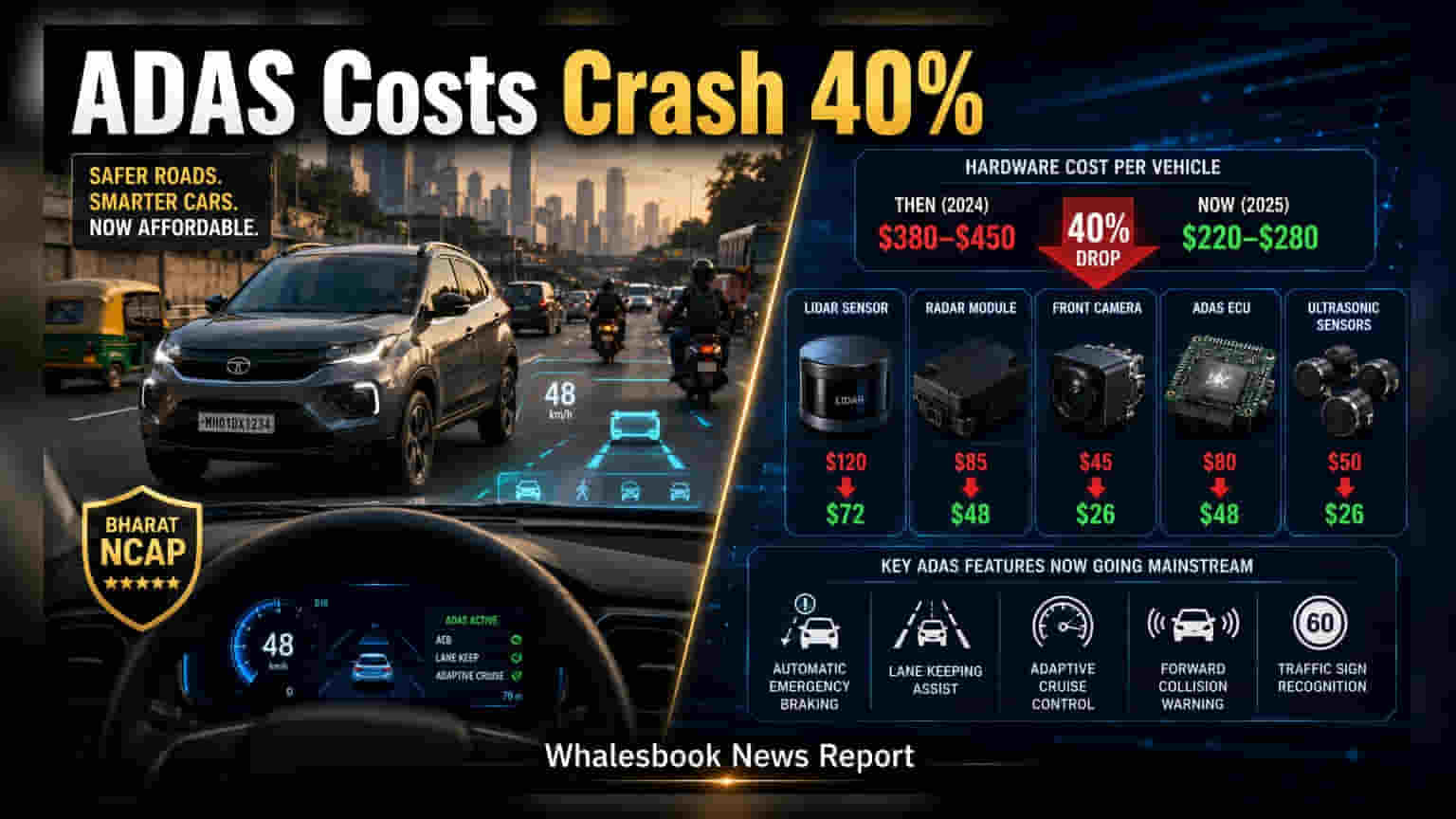
The cost of advanced driver-assistance hardware has fallen by 40% over the past year, making features like automatic braking affordable for mass-market vehicles in India. While this shift helps automakers aim for top Bharat NCAP safety ratings, the industry faces a significant challenge in gaining consumer trust amid India’s complex traffic conditions.
The automotive industry in India is undergoing a rapid transformation as the cost of Advanced Driver-Assistance Systems (ADAS) becomes accessible for mainstream vehicles. Over the past year, the hardware expenses for these safety suites have decreased by approximately 40%. The cost per vehicle has dropped from a range of $380-$450 to between $220-$280, a shift that is allowing manufacturers to transition these technologies from luxury models to the mass-market segment.
The Bharat NCAP Catalyst
The primary driver of this trend is the Bharat NCAP program. As Indian consumers increasingly prioritize safety and automakers compete for 4- and 5-star safety ratings, the demand for active safety features has surged. Technologies that were once considered premium—such as automatic emergency braking, lane-keeping assistance, and adaptive cruise control—are now being integrated into mid-level and budget trims for SUVs and compact cars.
Key technology providers, including global players like Mobileye and Valeo, are actively customizing their platforms to meet these new requirements while keeping costs low. For component suppliers, the business model is shifting; while margins per unit may compress due to lower hardware costs, the sheer increase in volume and the integration of more sensors per vehicle are helping offset the decline in per-unit profitability.
Challenges in the Indian Traffic Context
Despite the economic viability of these systems, their effectiveness on Indian roads remains a critical topic for both manufacturers and regulators. The country's traffic environment, characterized by inconsistent lane markings, heavy monsoon weather, and high density of two-wheelers, presents a severe test for existing ADAS architectures.
Industry experts note a significant "trust deficit" among consumers. A recent market survey indicates that while awareness of these safety systems is high, roughly 70% of potential buyers remain skeptical about their reliability in real-world, unstructured traffic conditions. Automakers are currently at a strategic crossroads: they must decide between offering lower-cost, vision-only systems that may struggle in poor weather and lighting, or investing in more expensive, sensor-redundant architectures that combine cameras, radar, and LiDAR for greater accuracy.
What Investors Should Monitor
Moving forward, the success of ADAS adoption in India will depend on more than just hardware cost. Investors should track how quickly major original equipment manufacturers (OEMs) can successfully integrate these systems into their high-volume models without significantly hiking vehicle prices.
Another key monitorable is the evolution of regulatory standards. As the Ministry of Heavy Industries continues to refine safety protocols, the R&D burden on smaller OEMs will likely increase, potentially leading to consolidation among technology suppliers. The ultimate test will be whether these systems can deliver consistent performance in India's unique driving conditions, as successful real-world execution will be the deciding factor for mass-market adoption.