 Whalesbook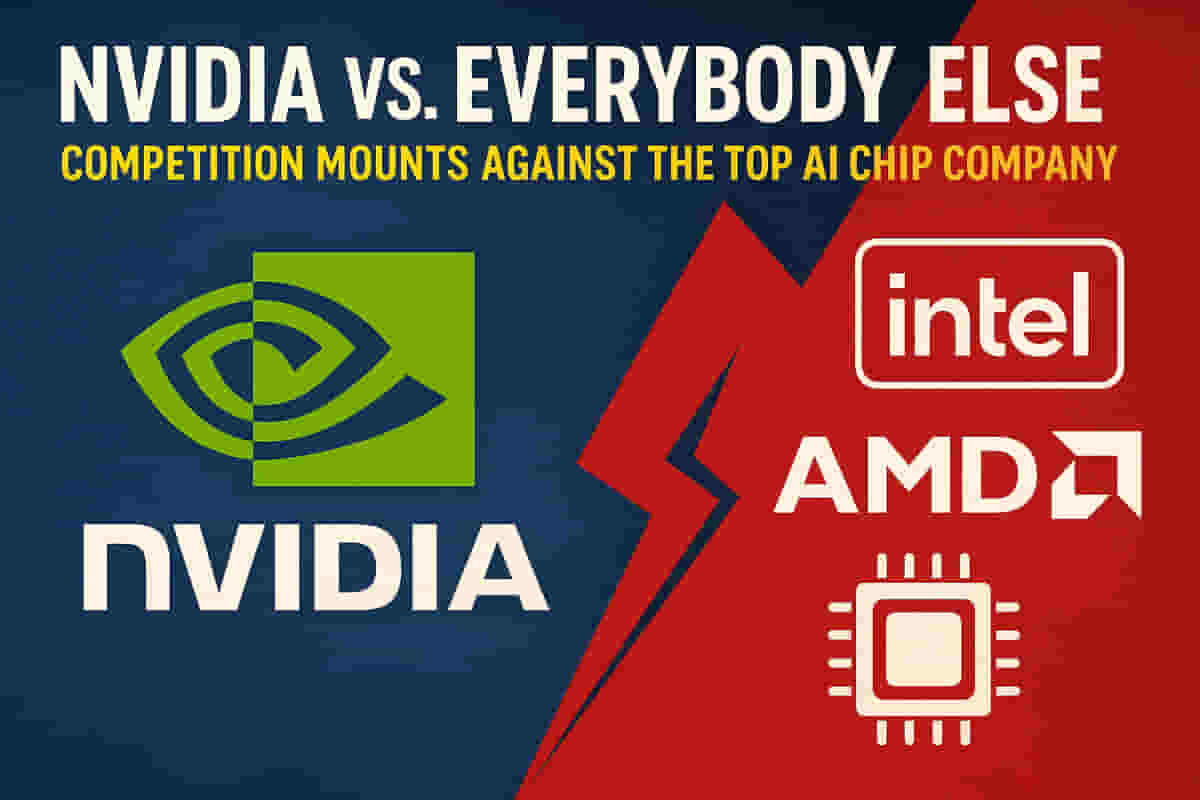
Nvidia's AI Chip Dominance Challenged
For ten years, Nvidia has been the undisputed leader in advanced computer chips essential for machine learning and artificial intelligence. Leveraging its cutting-edge graphics processing units (GPUs) and the manufacturing prowess of Taiwan Semiconductor Manufacturing, Nvidia became synonymous with AI processors. However, this stronghold is beginning to crumble.
Emerging Competition
New entrants and existing rivals are making significant moves. Google and Amazon are stepping into the market to sell their own advanced AI chips to external clients, directly competing with Nvidia's offerings in power and efficiency. Smaller but potent competitors like Advanced Micro Devices, Qualcomm, and Broadcom are sharpening their focus on AI data-center computing, introducing products designed to capture market share.
Customers Design Their Own Chips
Perhaps the most significant challenge comes from Nvidia's own major customers. Companies like ChatGPT-maker OpenAI and Meta Platforms are increasingly designing custom chips tailored to their specific needs. While a mass exodus from Nvidia is unlikely, this trend towards supplier diversification could curb the company's previously extraordinary sales growth.
Nvidia's Position
Nvidia has been a powerhouse, with its AI computing dominance making it the world's most valuable company at times. The company reported selling $147.8 billion worth of chips and hardware between February and October, a substantial increase from the previous year. Its founder and CEO, Jensen Huang, has become a celebrity figure in the tech world. Nvidia describes its business as 'AI factories' and offers 'rack-scale server solutions,' emphasizing its comprehensive approach beyond just silicon.
Key Players in the AI Chip Race
- Nvidia: Remains the leader, but faces pressure. It recently launched its Grace Blackwell series, which sold out instantly, indicating continued strong demand for its most advanced hardware.
- Advanced Micro Devices (AMD): CEO Lisa Su reoriented the company around AI, leading to a significant market cap increase and major deals with clients like OpenAI and Oracle.
- Broadcom: Has become a formidable competitor through mergers, producing custom chips (XPUs) and networking hardware for data centers.
- Intel: Investing heavily to regain its footing in advanced data-center processors after missing early AI opportunities.
- Qualcomm: Known for mobile chips, it recently launched new AI accelerator chips (AI200 and AI250) focusing on high memory and energy efficiency.
- Alphabet (Google): Offers its Tensor Processing Units (TPUs) to third-party customers, seeing increased demand for training and running AI models.
- Amazon Web Services (AWS): Expanding its data-center cluster with its own Trainium chips and launching broader sales of energy-efficient alternatives to Nvidia's GPUs.
The Rise of Custom Silicon
Many AI firms are moving towards Application-Specific Integrated Circuits (ASICs) – chips co-designed for highly specific tasks. OpenAI's partnership with Broadcom for custom chips, Meta's acquisition of Rivos for in-house chip development, and Microsoft's increased reliance on its own accelerators highlight this trend.
Importance of the Event
The market for AI chips is rapidly expanding. Competition is intensifying, forcing established players to innovate and new entrants to carve out their niches. This dynamic landscape will shape the future of artificial intelligence infrastructure and the companies that build it.
Impact
This news signals a significant shift in the high-stakes AI chip market. While Nvidia is unlikely to lose its leading position entirely, increased competition and the trend toward custom silicon could lead to slower growth for Nvidia and create new opportunities for rivals. Investors may see shifts in market valuations and strategic investments as companies diversify their AI hardware strategies. The overall pace of AI innovation could accelerate due to this increased competition.
- Impact Rating: 9/10
Difficult Terms Explained
- GPU (Graphics Processing Unit): A specialized electronic circuit designed to rapidly manipulate and alter memory to accelerate the creation of images in a frame buffer intended for output to a display device. In AI, they excel at parallel processing for complex calculations.
- Machine Learning: A type of artificial intelligence that allows computer systems to learn from data without being explicitly programmed, improving their performance over time.
- Artificial Intelligence (AI): The simulation of human intelligence processes by machines, especially computer systems, including learning, reasoning, and self-correction.
- Contract Fabricator: A company that manufactures semiconductor chips based on designs provided by other companies.
- Parallel Computing: A type of computation in which many calculations or the process of calculation can be carried out simultaneously. GPUs are designed for this.
- Ecosystem: A complex network or environment where hardware, software, and services interact, often creating lock-in for users (like Nvidia's CUDA).
- ASIC (Application-Specific Integrated Circuit): A microchip designed for a particular use rather than for general-purpose use.
- Data Centers: Facilities that house computer systems and associated components, such as telecommunications and storage systems. They are crucial for cloud computing and AI.
- TPU (Tensor Processing Unit): Google's custom-designed hardware accelerator for machine learning, optimized for neural network workloads.