

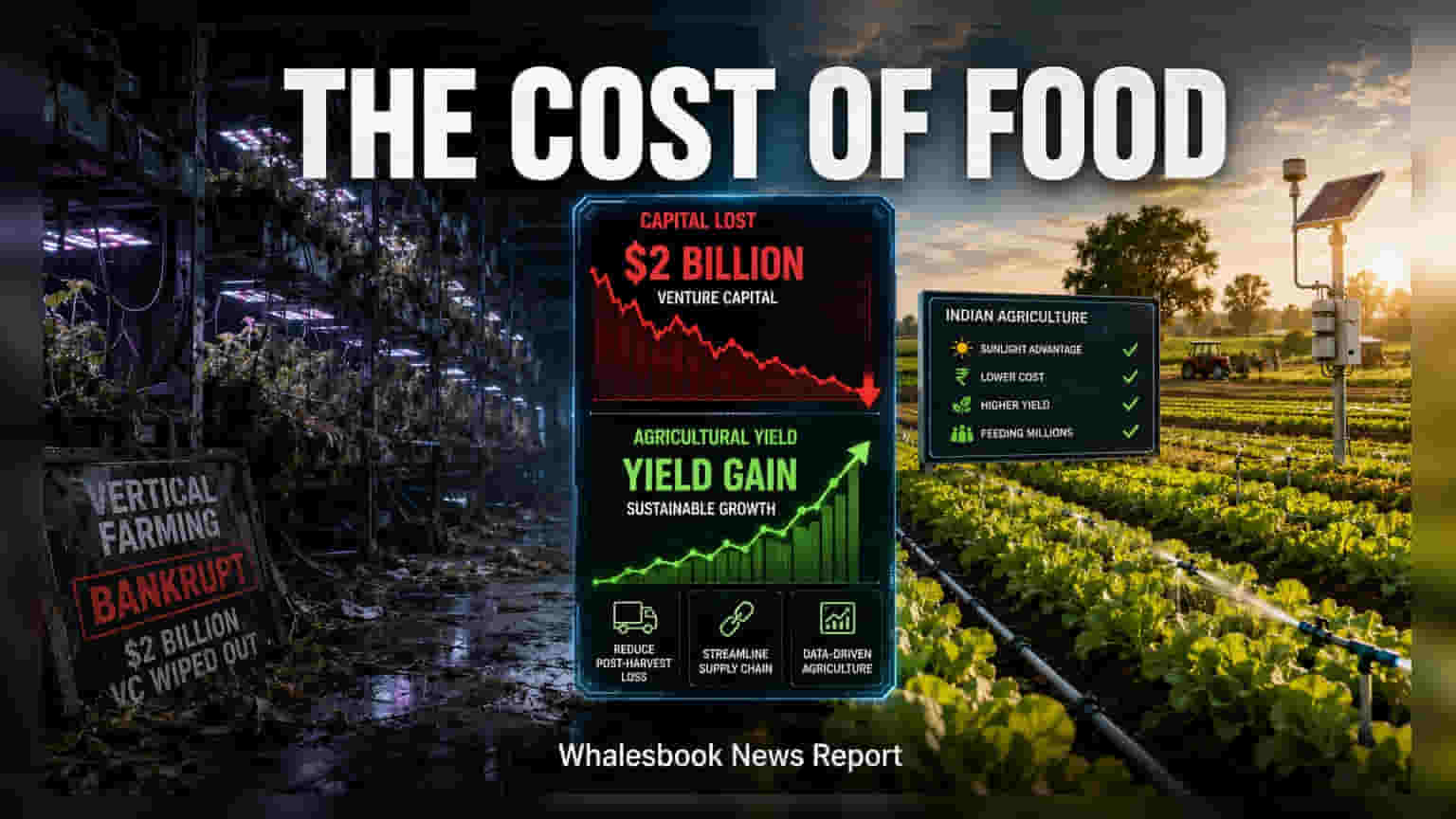
Global vertical farming firms have seen billions in capital evaporate due to high operational costs and unsustainable models. For Indian investors and entrepreneurs, this serves as a critical lesson: the path to profitable agtech lies in solving India’s massive ₹1.53 lakh crore supply chain waste rather than replicating costly, energy-intensive indoor growing setups.
The rapid rise and subsequent struggle of major global vertical farming companies have provided a sobering case study for the agricultural technology sector. In the last year, approximately $2 billion in venture capital has been wiped out as high-profile firms like AeroFarms and Bowery Farming faced bankruptcy or closed operations. The failure was rarely about the technology itself—the crops grew, and the systems worked—but rather about the economics of the business model.
The Economics of Failure
The fundamental flaw in the Western vertical farming model was the decision to trade free, natural resources for expensive, man-made infrastructure. By moving farming indoors, these companies shouldered massive costs for electricity, climate control, and complex automation. To survive, they were forced to price their produce for premium, niche markets. When economic conditions tightened, consumers proved unwilling to pay the inflated prices required to keep these capital-intensive, energy-hungry facilities running.
For investors in India, this collapse highlights a recurring trap in the agtech space: the desire to import 'high-tech' solutions that do not fit the local reality. India does not suffer from a lack of sunlight or growing space; it faces a massive logistical challenge.
The Real Opportunity in India
Unlike Western markets where vertical farming was pitched as a way to grow food in cold, sun-deprived climates, India’s primary agricultural hurdle is post-harvest loss. Official estimates suggest that nearly ₹1.53 lakh crore worth of produce is lost annually due to inefficient supply chains and inadequate cold storage. This is where the true ‘efficiency’ opportunity lies.
True industrial efficiency, often compared to the Toyota production system, is about eliminating waste and streamlining processes to make quality affordable, not about building complex infrastructure that artificially replicates natural processes at a high cost. Investors should look for agtech companies that focus on:
Supply Chain Digitization: Technologies that connect smallholder farmers directly to markets, reducing the multiple layers of middlemen who currently drive up costs and drive down farmer income.
Logistics and Cold Chain Infrastructure: Practical, low-cost solutions to store and transport perishable goods without the need for energy-guzzling indoor farms.
Data-Driven Planning: Using data to coordinate planting cycles with market demand, ensuring that farmers grow what the market needs, thereby reducing gluts and price crashes.
Investor Monitorables
When evaluating agtech startups or related listed companies, investors should prioritize execution over novelty. A company that claims to be 'disrupting agriculture' through high-tech indoor growth should be scrutinized for its energy costs and target customer base. Can the product scale to serve the masses, or is it destined to remain a high-cost luxury niche?
The sector’s future in India will likely be defined by those who can bridge the gap between farm output and consumer delivery, rather than those who try to reinvent the farm itself. The most sustainable business models will be those that empower the existing agricultural base with better data, logistics, and market access, ultimately turning the country's massive agricultural output into a more reliable and profitable system.