

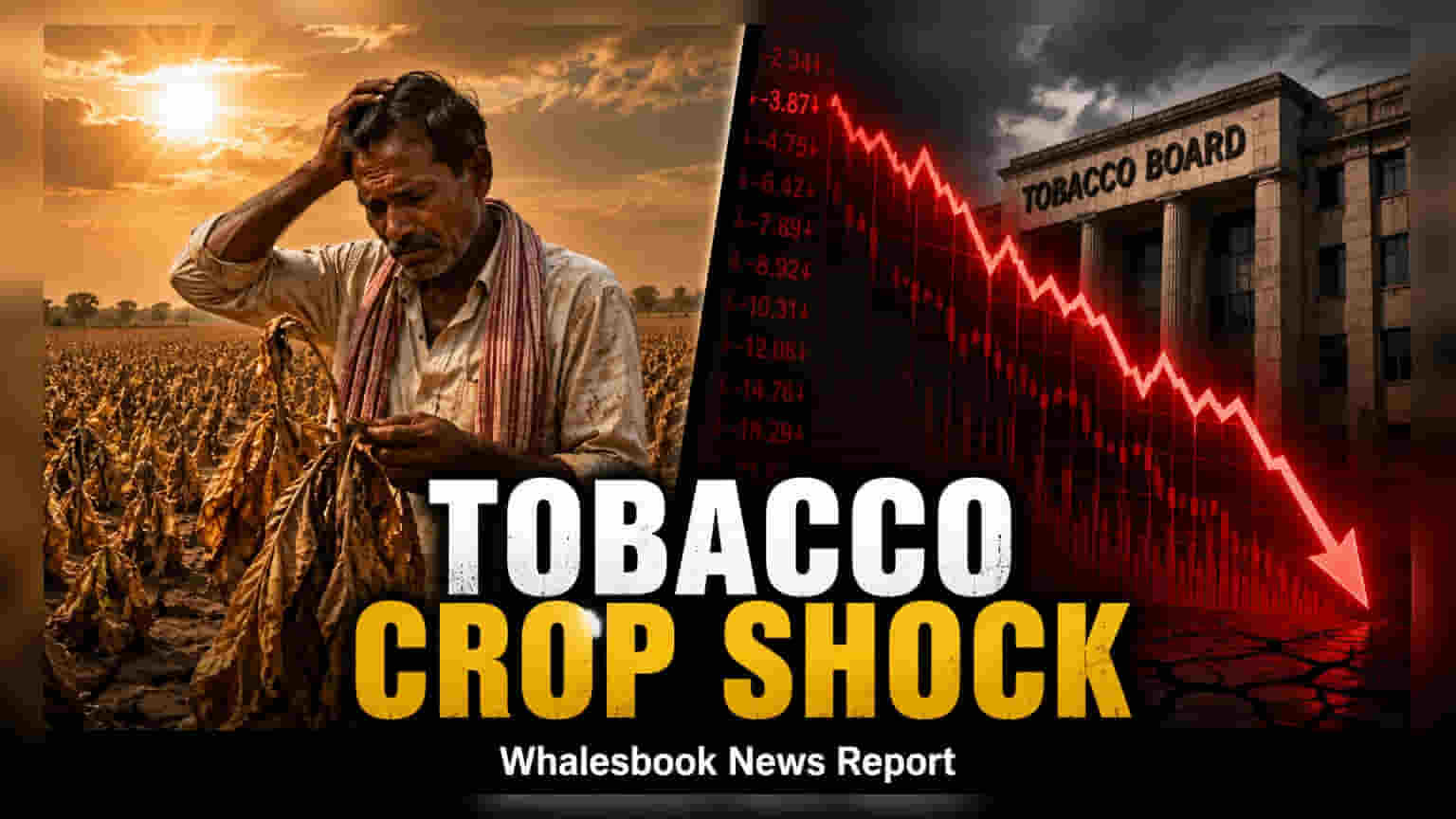
The Tobacco Board has reduced the authorized Flue-Cured Virginia (FCV) tobacco crop size by 43% for the 2026-27 season, citing the need for market stability. The Federation of All India Farmer Associations (FAIFA) warns this sharp cut will cause financial distress, as farmers face high fixed costs for curing infrastructure despite the reduced production quotas.
The Tobacco Board has officially cut the authorized production size for Flue-Cured Virginia (FCV) tobacco by 43% for the upcoming 2026-27 season. This decision establishes new production limits at 81 million kg for Andhra Pradesh and 51 million kg for Karnataka. While the Board aims to balance supply with market demand, the significant reduction has triggered concerns among farmers regarding their financial viability.
The policy change effectively forces a reduction in output per curing barn to 2,000 kg, down from the previous limit of 3,600 kg. For farmers, this does not mean a proportional drop in expenses. Essential infrastructure, including curing barns, labor, and maintenance, carries high fixed costs that remain largely unchanged even when production volumes are lowered. According to the Federation of All India Farmer Associations (FAIFA), this dynamic threatens to make small-scale farming operations economically unfeasible.
Financial strain is a primary concern for growers already struggling with accumulated debt and unsold inventory from previous cycles. FAIFA representatives note that many farmers cannot simply transition to alternative crops. The specific agro-climatic conditions and low rainfall patterns in major FCV-growing regions severely limit viable agricultural alternatives that offer comparable and reliable returns.
Beyond production limits, the sector faces broader challenges including intense competition from global producers like Brazil, Zimbabwe, Malawi, and Zambia. Domestic farmers are also navigating the impact of high taxation, which effective February 2026 has added to industry costs, alongside competition from the illicit and unregulated tobacco trade. FAIFA argues that production controls should ideally be paired with financial aid and market expansion strategies rather than relying on drastic output cuts alone.
For stakeholders in the agricultural and tobacco value chain, the next phase will be to monitor how these quotas affect farm-gate prices and whether the government introduces any support mechanisms to ease the transition. The long-term impact on supply consistency, the potential shift of acreage to other crops, and the overall stability of the legal tobacco market remain key areas to track as the season progresses.