

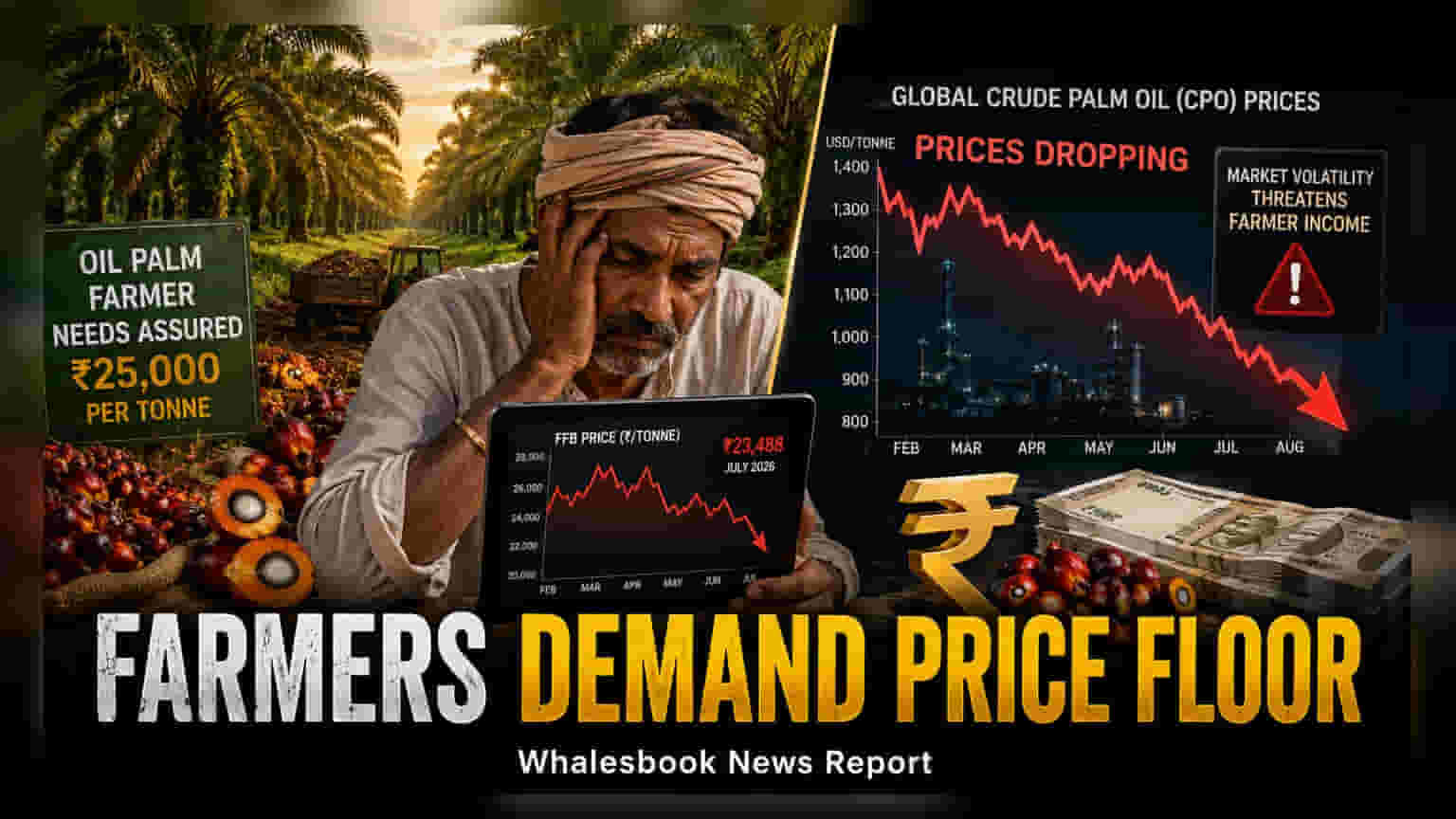
Telangana’s Agriculture Minister Tummala Nageswara Rao has urged the Union government to set a floor price of ₹25,000 per tonne for oil palm Fresh Fruit Bunches (FFB). The move aims to protect farmers from global price fluctuations and compensate for high initial cultivation costs. This price support is critical for states expanding oil palm acreage to reduce India's dependence on edible oil imports.
The Telangana government has formally requested the Union government to implement an assured floor price of ₹25,000 per tonne for Fresh Fruit Bunch (FFB) of oil palm. Agriculture Minister Tummala Nageswara Rao presented this proposal to Union Home Minister Amit Shah during the 31st Southern Zonal Council meeting held in Mahabalipuram, Tamil Nadu, on August 20, 2026.
This demand highlights the economic challenges faced by farmers transitioning to oil palm. Unlike traditional seasonal crops, oil palm requires a long gestation period, often taking several years before farmers begin to see significant returns. Minister Rao emphasized that given the high capital investment required during these initial years, a guaranteed price mechanism is essential to protect farmers from the volatility of international market rates.
Oil palm prices in India are largely linked to global crude palm oil (CPO) prices. As of July 2026, procurement prices for FFB in Telangana have been hovering around ₹23,488 per tonne. The government’s proposal for a ₹25,000 floor price seeks to create a safety net, ensuring that fluctuations in international commodity markets do not erode the income security of domestic producers.
The initiative is part of a broader push by southern states, including Telangana and Andhra Pradesh, to expand oil palm cultivation as a means to diversify agriculture and reduce India’s heavy reliance on edible oil imports. Minister Rao also sought support from Andhra Pradesh Chief Minister N Chandrababu Naidu to collectively advocate for this policy change with the central government.
From an investor and economic perspective, this proposal introduces complex dynamics. While a floor price offers stability to farmers, it also puts pressure on the processing value chain. If the floor price is fixed significantly higher than market-driven rates, processing companies may face margin pressure unless there is a corresponding adjustment in import duties on crude palm oil. Currently, the sector operates under an import duty structure of approximately 16.50%, which acts as a key lever for domestic price stability. Any change in this structure or the introduction of a mandatory floor price could impact the financial viability of private and state-run processing plants.
Investors and stakeholders in the agriculture and edible oil sector should monitor the Union government's response to this proposal. Key monitorables include potential changes to national edible oil procurement policies, trends in global crude palm oil pricing, and any upcoming adjustments to import duty structures that could influence the domestic price of fresh fruit bunches.