 Whalesbook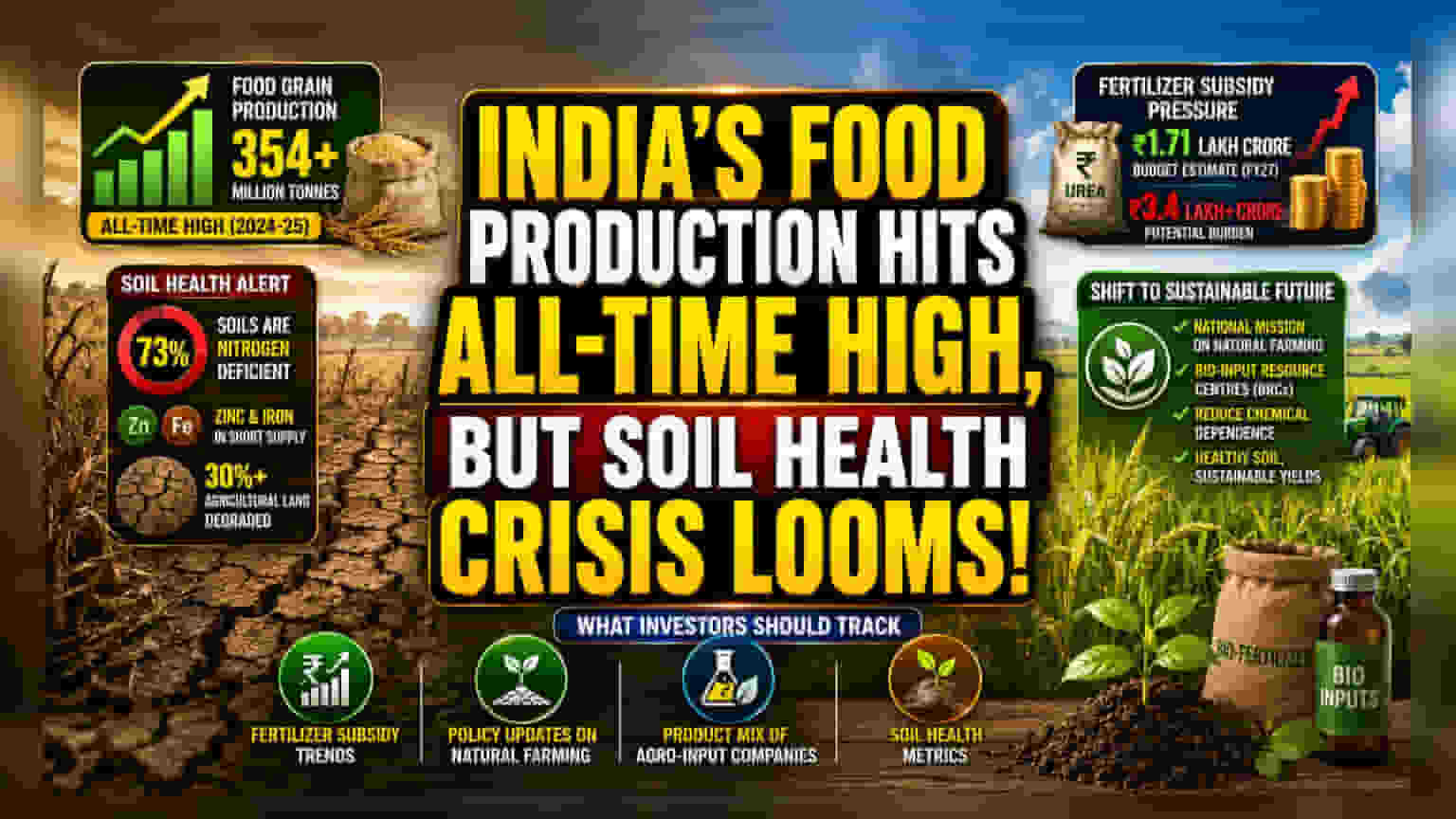


India’s agricultural sector faces a paradox: record food grain production is putting long-term strain on soil fertility. With rising fertilizer subsidy burdens and a government pivot toward natural farming, investors are watching how the agricultural input industry balances conventional fertilizer demand with sustainable farming shifts.
What Happened
India recorded an all-time high in food grain production of over 354 million tonnes for the 2024-25 period. However, a parallel, critical challenge is emerging: the steady degradation of the country’s soil health. Recent assessments highlight that decades of intensive, mono-cropping practices and an over-reliance on nitrogen-based fertilizers have left a significant portion of Indian agricultural land nutrient-deficient.
Data from the 2025-26 period indicates that nearly 73% of tested soil samples are nitrogen-deficient, while critical micronutrients like zinc and iron are also in short supply. This degradation is not merely an environmental concern but an economic one, as soil organic carbon (SOC) levels—which are essential for water retention and nutrient cycling—have plummeted in several major agrarian states like Punjab and Haryana. With official reports indicating that over 30% of India’s agricultural land is currently degraded, the focus is shifting toward the long-term sustainability of the existing high-input agricultural model.
Why This Matters For Investors
For investors, the primary concern lies in the escalating costs of the current agricultural model. The Indian government’s fertilizer subsidy bill is under intense pressure due to volatile global supply chains and the need to keep urea affordable for farmers. While the 2026-27 Union Budget estimated the fertilizer subsidy at approximately ₹1.71 lakh crore, government officials have indicated that supply shocks could potentially double this burden to over ₹3.4 lakh crore.
This fiscal strain, combined with falling nutrient efficiency in the soil, is forcing a policy shift. The government is actively promoting the 'National Mission on Natural Farming' (NMNF). With a budgetary outlay and a target to bring millions of hectares under chemical-free or natural farming by 2031, the government is incentivizing a move away from the traditional, chemical-intensive Green Revolution model. This represents a strategic pivot that could alter the future demand mix for agrochemical companies and fertilizer manufacturers.
The Shift Toward Sustainable Practices
Agricultural policy is gradually diversifying. The NMNF, along with other initiatives like the 'Pradhan Mantri Annadata Aay Sanrakshan Abhiyan' (PM-AASHA), aims to reduce farmer dependence on chemical inputs while maintaining or boosting yields through crop diversification and organic replenishment. As of early 2026, thousands of clusters have been formed to train farmers in natural farming, and Bio-input Resource Centres (BRCs) are being established to provide alternatives to chemical fertilizers.
While chemical fertilizers still command an overwhelming 85% share of the market, the sustained push toward precision farming, bio-inputs, and sustainable soil management suggests that agro-input companies may need to adapt their product portfolios. Companies that invest in soil-health-positive products, such as specialty nutrients, micronutrients, and bio-stimulants, may find themselves better positioned for this long-term policy environment.
Potential Risks and Challenges
Investors should consider the transition risks inherent in this shift. Conventional fertilizer companies face a dual challenge: the pressure of fluctuating global raw material costs—which impact profitability—and the long-term structural risk of government policy favoring lower chemical use to manage the subsidy burden and restore soil health.
Furthermore, 'diminishing returns' on fertilizer usage mean that simply applying more chemicals is failing to drive proportional yield growth. This inefficiency increases the cost of cultivation for farmers and the fiscal cost for the government, creating a 'vicious cycle.' For the fertilizer industry, success in the coming years will likely depend on their ability to offer value-added, high-efficiency products rather than relying solely on the volume of standard NPK (nitrogen, phosphorus, and potassium) sales.
What Investors Should Track
- Fertilizer Subsidy Trends: Monitor the actual expenditure against the budget estimates for FY27, as significant overruns may signal the need for further fertilizer pricing or distribution reforms.
- Policy Updates on Natural Farming: Track the scaling of the National Mission on Natural Farming (NMNF) and its impact on the procurement and adoption of bio-inputs.
- Product Mix of Agro-Input Companies: Watch for shifts in revenue contribution—whether companies are increasing their share of specialty chemicals, bio-fertilizers, and micronutrients compared to traditional urea and DAP.
- Soil Health Metrics: Any government or independent updates on soil organic carbon levels or the success rate of crop diversification programs will provide a barometer for long-term agricultural productivity.