

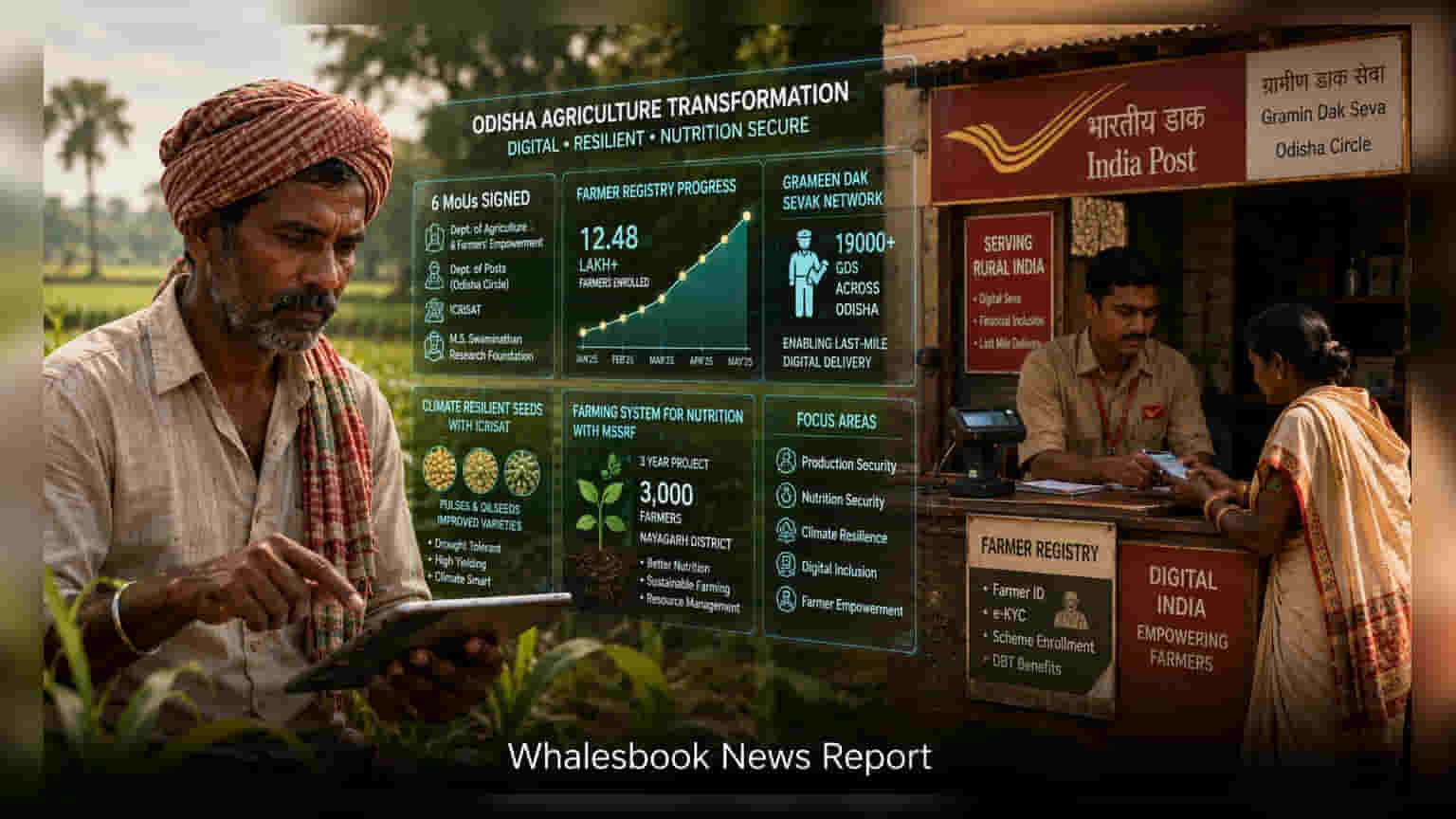
The Odisha government has signed six memoranda of understanding with the Department of Posts and research institutions to digitize agricultural administration and boost crop resilience. The initiative utilizes the rural post office network to fast-track farmer registries, e-KYC, and ID generation. This project aims to streamline welfare distribution and enhance the production of climate-resilient pulses and oilseeds.
The government of Odisha has taken a significant step toward digitizing its agricultural sector by signing six memoranda of understanding (MoUs). These agreements involve a strategic collaboration between the state's Department of Agriculture and Farmers' Empowerment, the Department of Posts (Odisha Circle), and two key research institutions: the International Crops Research Institute for the Semi-Arid Tropics (ICRISAT) and the M.S. Swaminathan Research Foundation (MSSRF).
This initiative is designed to address the challenges of last-mile service delivery in rural areas. By partnering with the Department of Posts, the government plans to leverage the extensive network of Gramin Dak Sevaks to perform essential digital tasks at the village level. This includes enrolment for the Farmer Registry, generation of unique Farmer IDs, and compliance with e-KYC requirements for various government schemes. The primary goal is to decentralize these administrative processes, reducing the need for farmers to travel to urban administrative centers and improving the accuracy of data used for agricultural planning.
Beyond administrative digitisation, the MoUs place a strong emphasis on production and nutritional security. The collaboration with ICRISAT focuses on developing and distributing climate-resilient varieties of pulses and oilseeds. By incorporating advanced seed system technologies and speed breeding, the state aims to help smallholder farmers adapt to shifting climate conditions. Simultaneously, the partnership with the M.S. Swaminathan Research Foundation will implement a three-year 'Farming System for Nutrition' project. This pilot, targeted at 3,000 small and marginal farmers in the Nayagarh district, seeks to improve nutritional outcomes by integrating better farming techniques with resource management.
For the agricultural sector in Odisha, the success of these initiatives will depend heavily on the actual adoption rate among the farming community. While digital infrastructure is being upgraded, the effectiveness of these welfare programs relies on consistent stakeholder engagement and the ability of rural residents to utilize these new digital tools. Additionally, despite the focus on climate-resilient crops, agricultural productivity remains vulnerable to unpredictable weather patterns and environmental stressors, which can affect harvest yields regardless of technological advancements.
Investors and stakeholders in the agricultural supply chain will likely monitor the implementation timeline and the scalability of these digital delivery models. The next important updates will include the progress of the seed distribution projects, the coverage of the digital registry enrollment across various districts, and the measurable impact of the nutrition-focused projects on local crop production levels.