

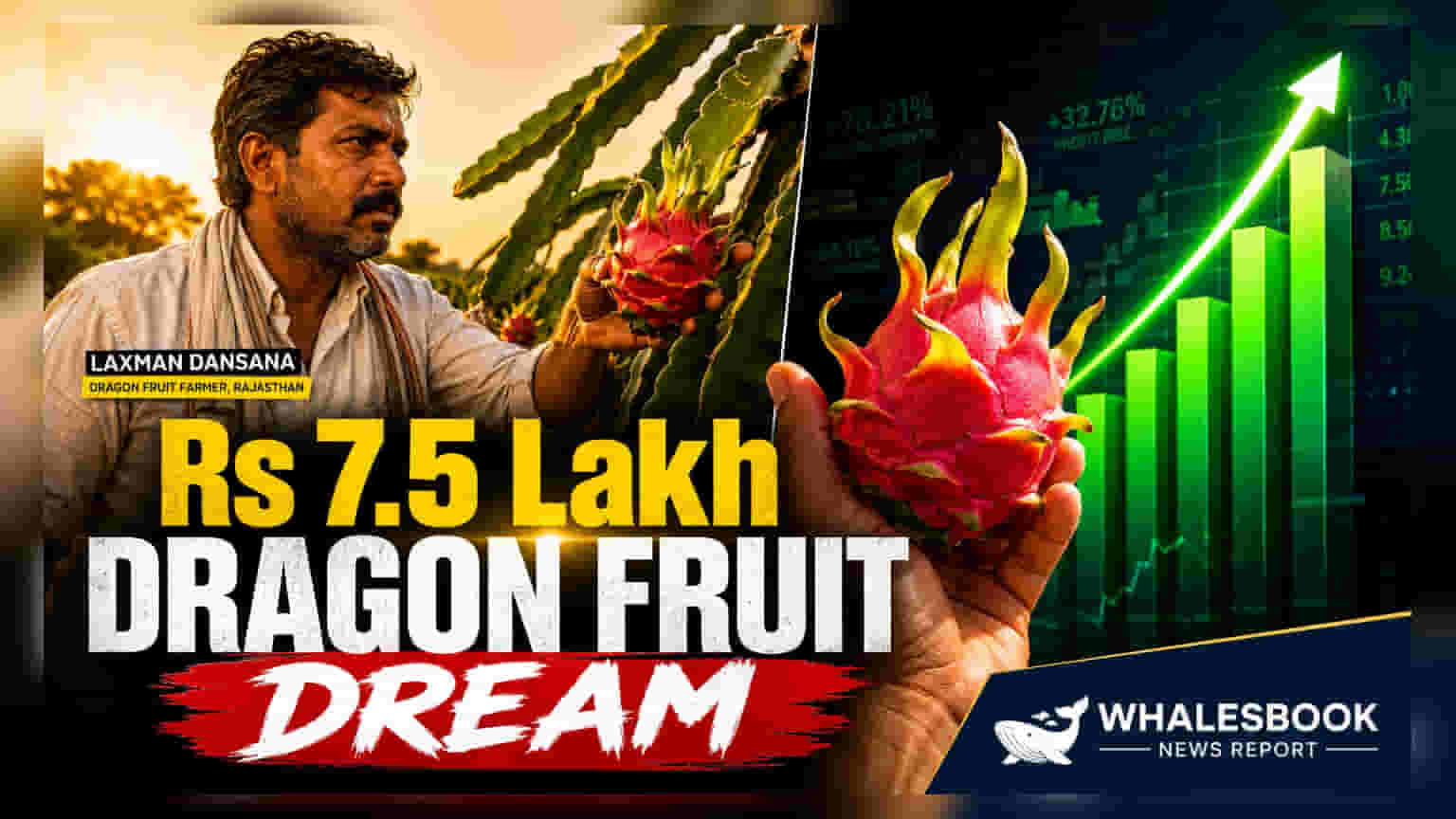
Former Mumbai worker Laxman Dansana generates ₹7.5 lakh annual income from a small dragon fruit orchard in Odisha. His success highlights the financial potential of specialized, high-value crop cultivation and integrated farming models on limited land holdings.
What Happened
Laxman Dansana, a resident of Odisha, has transformed a 0.25-acre plot into a profitable agricultural enterprise. After returning from his work as a tile mason in Mumbai, Dansana invested ₹1.5 lakh of his personal savings in 2021 to establish a dragon fruit orchard. By 2026, the farm has become a model for high-density agricultural productivity, generating an annual income of ₹7.5 lakh. This total includes ₹5 lakh from fruit sales and an additional ₹2.5 lakh from a specialized sapling nursery, showcasing how targeted crop selection can maximize returns on small land parcels.
Business Model and Productivity
Dansana’s success relies on maximizing land utilization and managing operational costs. By using a combination of ring-pole and trellis systems, he accommodates 700 plants on a quarter-acre plot. The farm produces high-quality 'Siam Red' dragon fruits, which are carefully managed to achieve an average weight of 450-500 grams per fruit. A key factor in his profitability is the low maintenance cost; by using organic inputs like cow dung, Jeevamrit, and compost, his annual input cost is restricted to approximately ₹20,000. This low-cost structure provides a significant margin compared to conventional high-input farming.
Diversification as a Risk Hedge
Beyond the core dragon fruit revenue, Dansana has implemented a multi-layered farming approach to mitigate financial risk. He cultivates intercrops such as sweet corn, brinjal, turmeric, and ginger between the dragon fruit rows. Furthermore, his recent expansion into strawberry farming demonstrates a strategy of diversifying into different seasonal products. The nursery business, which sells saplings to other farmers in Odisha, provides a stable, secondary cash flow that is less dependent on the volatility of seasonal fruit harvests.
Operational Support and Infrastructure
His progress was aided by government support, specifically through the Odisha Horticulture Department and the Water Resources Department, which helped reduce initial infrastructure expenditures like borewell installation and drip irrigation. Access to such schemes is a critical factor for smallholder farmers aiming to transition from subsistence farming to commercial-grade production. The use of modern protective measures, such as green shade nets, has been essential to protect the crop from extreme summer temperatures exceeding 45 degrees Celsius in the Balangir region.
What Investors Should Track
The model adopted by Dansana represents a growing trend of high-value agriculture in India. For observers of the agricultural sector, the monitorables include the scalability of such intensive farming practices, the availability of specialized saplings, and the reach of local supply chains that connect small-scale farmers to larger urban markets in Bhubaneswar and Cuttack. Investors watching the agribusiness space may note that profitability in this sector is highly dependent on managing logistics, maintaining crop quality through protective measures, and creating integrated revenue streams to offset seasonal demand fluctuations.