

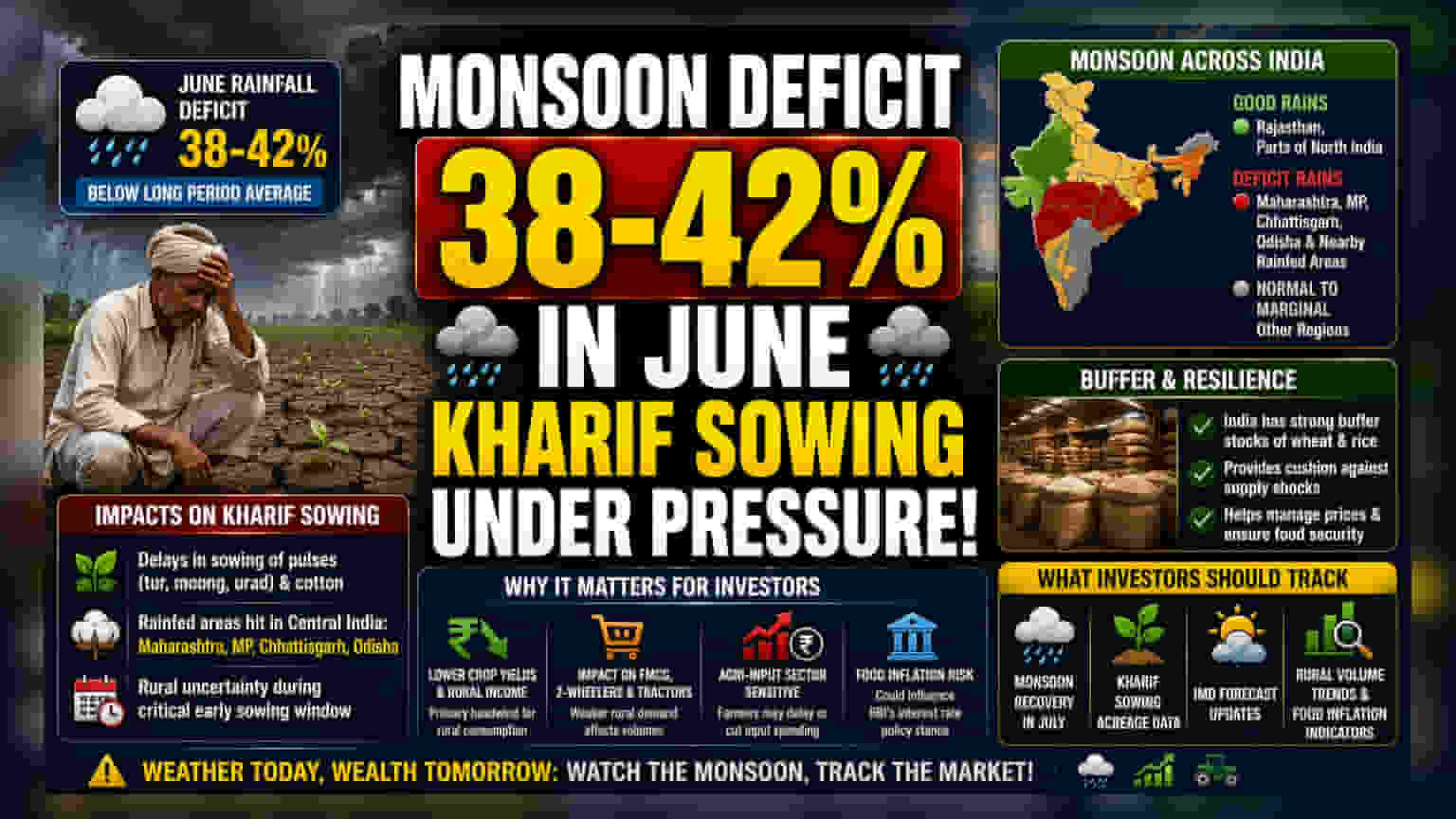
India's monsoon has seen a 38-42% deficit in June, causing a slow start to Kharif sowing in key agricultural states like Maharashtra and Madhya Pradesh. Investors are monitoring this trend as it could impact rural consumption, agri-input sales, and food inflation. While government buffer stocks offer a safety net, the intensity and timing of rainfall in July will be critical for crop yields and market sentiment.
What Happened
The southwest monsoon, crucial for India's Kharif cropping season, has recorded a significant rainfall deficit of approximately 38-42% in June. This sluggish start has particularly impacted rainfed regions across Central India, including Maharashtra, Madhya Pradesh, Chhattisgarh, and Odisha, where sowing for key crops like pulses (tur, moong, urad) and cotton has been delayed. While states like Rajasthan and parts of the North have seen more consistent rains, the overall national trend is behind the long-period average, creating uncertainty for farmers during the vital early sowing window.
Why This Matters For Investors
For the Indian stock market, the monsoon is a key macro indicator that influences several sectors beyond just agriculture. A significant delay in sowing can lead to lower crop yields and reduced rural income, which acts as a primary headwind for rural-centric businesses. When farm incomes face pressure, companies in sectors such as Fast-Moving Consumer Goods (FMCG), two-wheelers, and tractors often report weaker demand. Additionally, persistent food inflation remains a broader economic risk that could influence the Reserve Bank of India’s (RBI) policy decisions regarding interest rates.
Business And Sector Impact
Investors typically view the monsoon as a barometer for rural consumption. The agri-input sector, including fertilizer and pesticide companies, remains directly sensitive to the intensity and timing of rainfall. While these companies often see strong demand as farmers prepare fields, a prolonged deficit may force farmers to reduce or delay their input spending to mitigate risk. On the other hand, the FMCG sector, which relies heavily on rural volume growth, may face volume pressure if rural purchasing power does not recover. Companies with high exposure to these regions are now operating in a period of heightened caution.
The Buffer And Resilience Factor
The current situation is distinct from past agricultural crises due to robust government-held reserves. India maintains significant buffer stocks of food grains, including wheat and rice, which provide a cushion against immediate supply shocks. This inventory helps the government manage potential supply-side disruptions and maintain price stability. However, the market impact is often driven by sentiment and the expectation of future output, meaning that even with sufficient buffers, the progress of the monsoon remains a high-priority data point.
What Investors Should Track
Moving forward, the primary monitorable for investors is the recovery of monsoon rainfall in July. A revival could help bridge the current sowing gap and stabilize rural economic sentiment. Investors should track official data on Kharif sowing acreage and the India Meteorological Department’s (IMD) updated forecasts. Other key triggers include management commentary from rural-focused companies on volume trends and any updates on food inflation indices that could signal broader economic stress.