

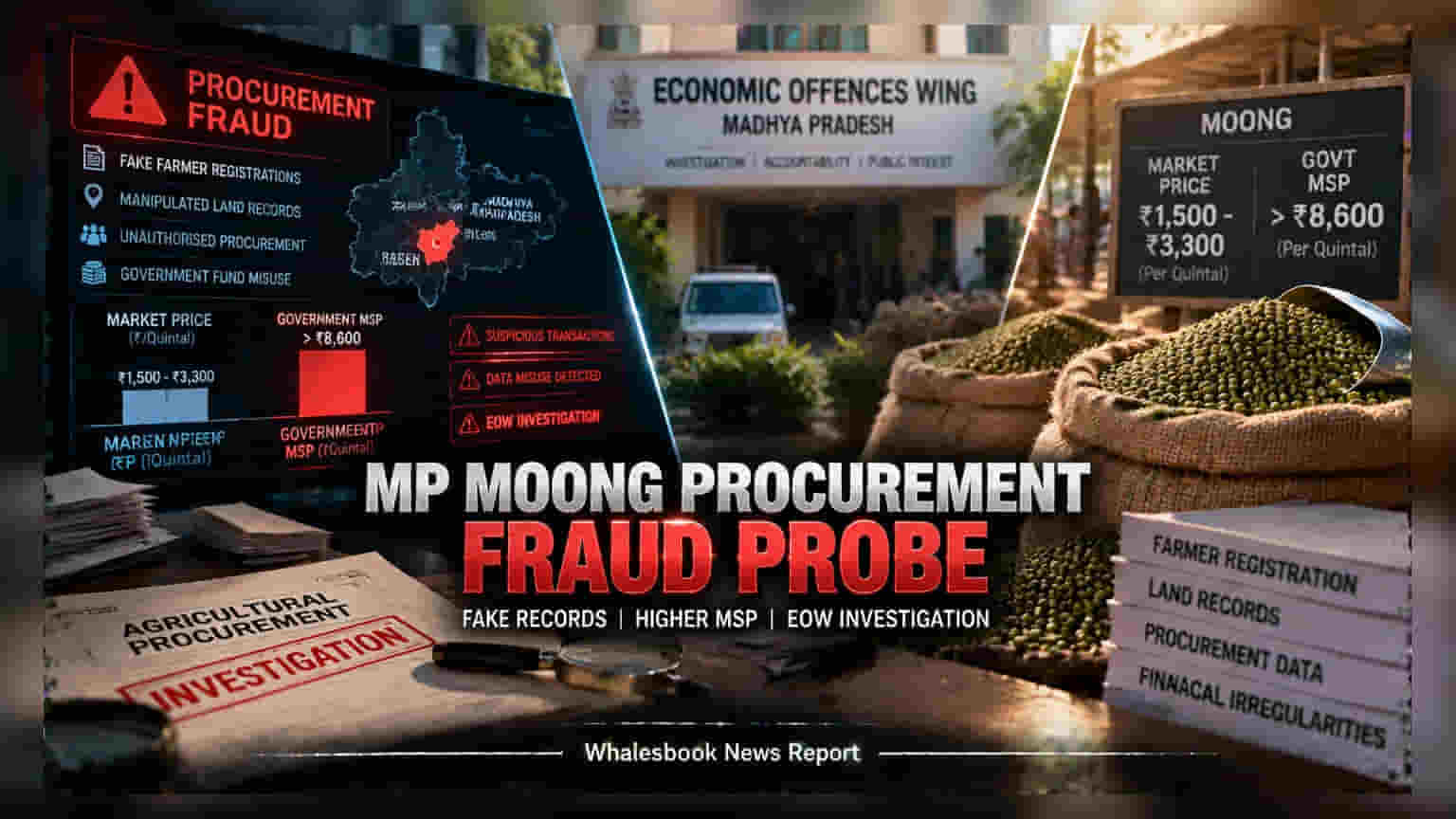
The Madhya Pradesh Economic Offences Wing has registered a case regarding a procurement fraud in Raisen district. Perpetrators allegedly used land records of unsuspecting farmers to sell market-purchased green gram at government Minimum Support Price rates, causing a loss of approximately ₹13.35 lakh to the state exchequer.
The Economic Offences Wing (EOW) of Madhya Pradesh has initiated a criminal investigation into a procurement fraud discovered within the state’s agricultural distribution framework. The case centers on alleged financial irregularities at Krishak Seva Sahakari Samitis located in the Raisen district, specifically within the Badi branch of the District Cooperative Bank.
Authorities have registered a case against three individuals, identified as Shriram Thakur, Ranjit Thakur, and Gaurav Thakur. The investigation reveals that the accused reportedly manipulated administrative systems to bypass procurement safeguards. By accessing land records through local procurement center operators, they allegedly identified farmers who had not registered their produce for government support. The perpetrators then used these records to register their own inventory as if it were harvested by the unsuspecting farmers.
The core of the fraud involved taking advantage of the price difference between open market rates and the government’s Minimum Support Price (MSP). During the 2024-25 and 2025-26 procurement seasons, market rates for moong (green gram) were reportedly significantly lower, ranging between ₹1,500 and ₹3,300 per quintal. In contrast, the government procurement price was fixed at over ₹8,600 per quintal. By purchasing moong from local traders and offloading it at government procurement centers, the accused created an artificial profit margin at the expense of the state.
This incident highlights ongoing challenges in agricultural procurement, particularly regarding the verification of land ownership and farmer registration data. The misuse of land records to siphon funds indicates a breakdown in administrative oversight, which can lead to fiscal leakage and undermine the intended benefits of price support programs for genuine cultivators. The EOW is currently examining the role of administrative staff at the involved centers to determine if the fraudulent activity was enabled by internal collusion.
For the broader agricultural sector, this case emphasizes the critical need for robust digital verification processes in government procurement. As authorities expand the probe, the focus remains on closing potential loopholes in land record integration and farmer verification systems to prevent similar arbitrage schemes in the future. The next important update for observers will be the findings of the EOW’s investigation into the systemic failures that allowed these transactions to proceed unnoticed.