

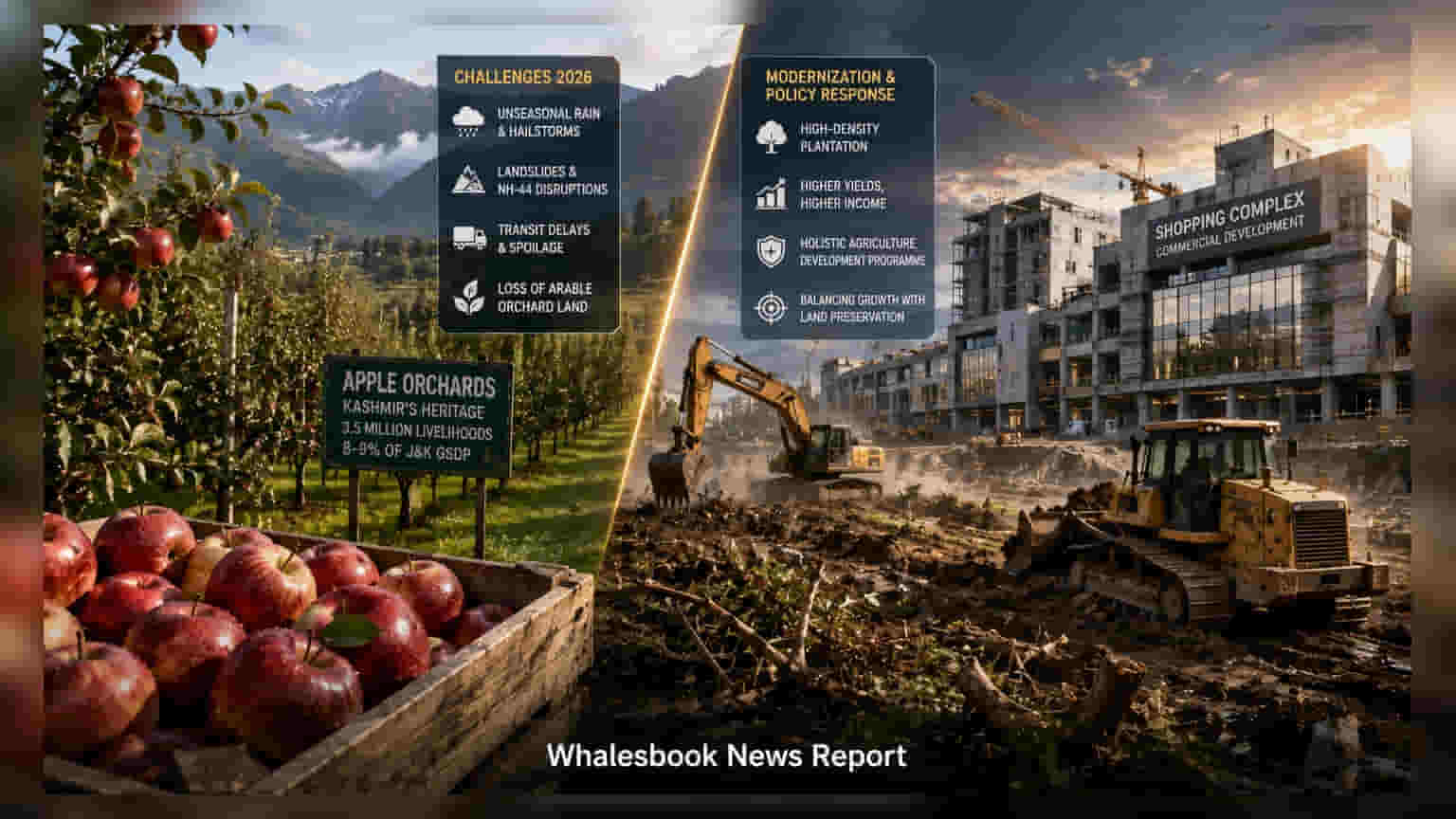
Kashmir’s vital horticulture sector, which supports millions, is seeing a shift as fertile apple orchards are converted into commercial developments. This trend, combined with climate challenges and transport bottlenecks, is putting pressure on the region's agricultural output. Stakeholders tracking the Indian food economy should watch how land use policy and infrastructure projects impact long-term supply stability.
Kashmir’s agricultural landscape is undergoing a structural change as high-density apple plantations are increasingly replaced by commercial and urban construction projects. This shift is notable because horticulture acts as a primary economic engine for the region, contributing approximately 8-9% to the Jammu and Kashmir Gross State Domestic Product (GSDP). The conversion of fertile orchard land into non-agricultural real estate has raised concerns about the long-term sustainability of the state's most significant export industry.
While urban expansion around major centers like Srinagar is a primary driver, the phenomenon is also linked to regulatory frameworks that allow for land conversion, albeit with certain limits. As landowners seek higher returns from commercial real estate, the total area available for traditional fruit cultivation is effectively shrinking. This reduction in arable land is occurring despite the region's historical reputation for premium fruit production, which supports the livelihoods of over 3.5 million people in the valley.
Challenges to Sector Stability
For those monitoring the Indian agricultural and food-processing sectors, the challenges go beyond land conversion. The apple industry in 2026 has been heavily impacted by external logistical and environmental risks. The sector relies on a single arterial road, the Srinagar-Jammu National Highway (NH-44), for transport. Frequent disruptions on this route due to landslides, road construction, and traffic congestion have historically led to significant transit delays, often resulting in spoilage and financial losses for growers and traders.
Furthermore, climate volatility has become a major recurring risk. Unseasonal weather, including heavy rains and hailstorms in mid-2026, has already caused substantial damage to crops, impacting both yield and quality. These climatic factors, when combined with the loss of land to development, create a challenging environment for maintaining the consistent supply chains required by modern food retail and processing companies.
Modernization and Policy Response
The narrative is not entirely one of decline. The local administration has been actively promoting schemes such as the 'High-Density Plantation' initiative and the 'Holistic Agriculture Development Programme' (HADP). These programs aim to modernize the industry by encouraging farmers to convert older, low-yield orchards into scientific, high-density farms. The goal is to improve per-hectare productivity and income, theoretically making smaller plots of land more economically viable than they were under traditional farming methods.
For investors and industry observers, the key monitorable will be the net impact of these competing forces. While urban encroachment removes land from the agricultural pool, government efforts to increase density aim to offset these losses with higher efficiency. The sustainability of the region's horticultural output will likely depend on the balance between land preservation policies, the effectiveness of the modernization programs, and the ability of the government to resolve the critical logistics bottlenecks that currently hinder the efficient movement of produce to major national markets.