

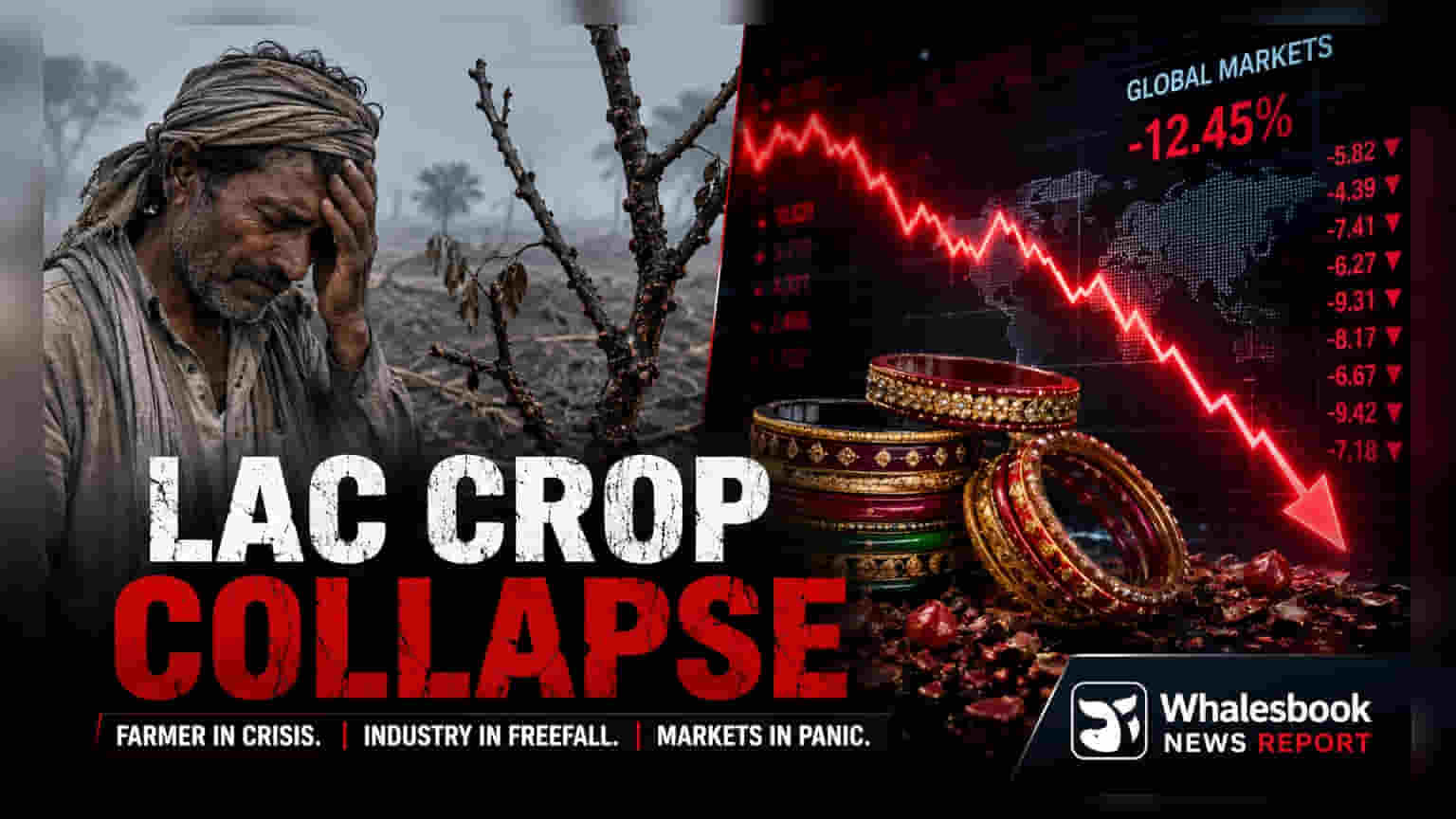
Unpredictable weather in Jharkhand’s Khunti district has triggered significant lac crop losses, with local market supplies reportedly falling by 20-30%. As the region is a central hub for India’s lac production—a key raw material for the global pharmaceutical, food, and cosmetic industries—this supply disruption may create pricing pressure in the niche shellac value chain.
What Happened
Farmers in Jharkhand’s Khunti district are facing sharp declines in lac production due to adverse weather conditions, including excessive fog, mist, and rainfall. These climate-related challenges have severely damaged yields for both major lac varieties, Kusmi and Baisakhi. Reports indicate that farmers, who rely on lac as a supplementary income source, are seeing harvest levels fall significantly short of expectations. With a 20-30% drop in supplies arriving at local markets, the disruption highlights the vulnerability of this agricultural niche to changing weather patterns.
Why the Supply Disruption Matters
India is a leading producer of lac, a natural resin harvested from host trees like Palash, Kusum, and Ber. Jharkhand alone contributes approximately 60% of the nation’s total lac production. While often considered a secondary income source for tribal and rural communities, lac is a critical raw material for various specialized global industries. Processed lac, known as shellac, is widely used in pharmaceutical tablet coatings, food glazing (such as confectionery and fruit coatings), cosmetics, wood finishes, and even defense applications. A significant contraction in supply from the primary production hub can lead to price volatility for these downstream manufacturing sectors, which rely on consistent quality and volume.
The Industry Reality Check
The lac sector in India remains largely unorganized and fragmented. Most production occurs on small-scale farms rather than large, industrial-scale plantations, making the output highly susceptible to local weather events, pest attacks, and the lack of scientific crop management. Farmers typically sell their raw produce to primary collectors or traders at local markets, who then supply processing units. This unorganized chain often lacks the structural insulation—such as irrigation or climate-controlled farming technology—that might protect other commercial crops, meaning that production cycles are heavily dictated by environmental stability.
Export and Economic Impact
India exports a vast majority of its lac production, serving markets in countries including the USA, Germany, and Bangladesh. Because the industry is export-oriented, international price fluctuations directly impact domestic price trends. While lac production does not dominate India's foreign exchange earnings, it serves as a vital economic lifeline for millions of rural families. The reliance on a single geographic region—the Chhota Nagpur plateau—for the bulk of production means that localized weather events can have a disproportionate impact on national supply figures.
What Investors Should Track
For those monitoring the commodities or specialty chemicals space, the key monitorable is the price trend of seedlac and shellac in wholesale markets. Investors and market watchers may look for updates on production estimates from regional agricultural bodies and export data from the Shellac Export Promotion Council. Additionally, as downstream industries like pharmaceuticals and processed food continue to grow, the ability of the lac industry to stabilize supply through better processing or diversified cultivation methods will be the long-term factor determining the sector's cost stability.