 Whalesbook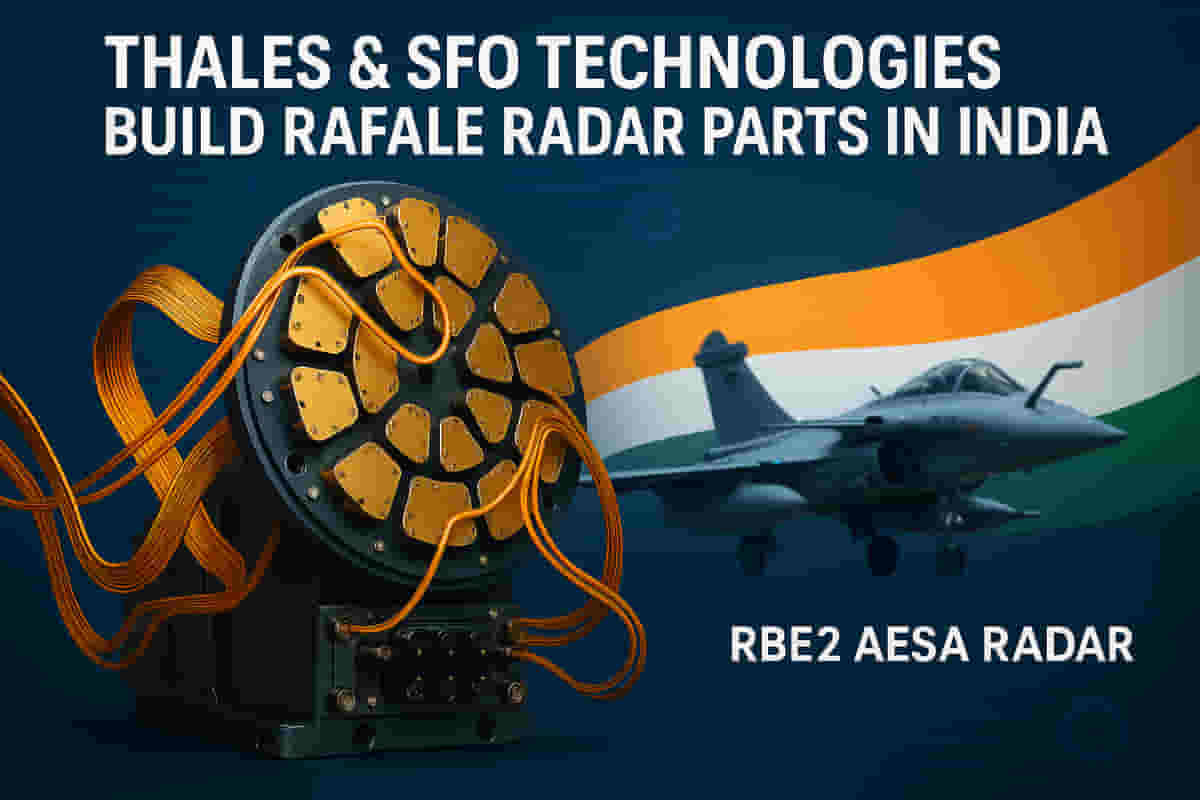
Thales Awards Critical Rafale Radar Component Contract to SFO Technologies
French aerospace and defence giant Thales has awarded Indian firm SFO Technologies a significant contract to manufacture complex wired structures for the RBE2 active electronically scanned array (AESA) radar. This radar is a critical component of the Rafale fighter aircraft. The agreement marks a substantial advancement for India's 'Make in India' initiative, aiming to deepen the localisation of advanced defence technologies.
This deal is particularly noteworthy as it represents the first major contract for high-value, technologically complex wired structures for the Rafale programme to be produced within India. It underscores a growing trend of integrating Indian companies into sophisticated global defence supply chains.
The Core Issue
The contract involves SFO Technologies producing sophisticated wired structures designed to withstand demanding environmental conditions. These components are integral to the performance of the RBE2 radar, which serves as one of the Rafale fighter's core mission systems. Thales highlighted that the deal strengthens their long-term partnership with SFO Technologies.
Financial Implications
While the financial terms of the contract, including its value and the total number of radars or components to be manufactured locally, were not disclosed by either company, the agreement is expected to significantly bolster SFO Technologies' order book. It also represents a strategic win for India's defence manufacturing sector, driving revenue and potentially leading to further technological development within the country.
Market Reaction
The direct market reaction to this news is not immediately quantifiable as SFO Technologies is a privately held company. However, the announcement is likely to be viewed positively by investors in the broader Indian defence manufacturing and aerospace sectors. It validates the government's 'Make in India' policy and signals potential growth opportunities for Indian companies involved in the defence ecosystem.
Official Statements and Responses
Philippe Knoche, senior executive vice-president for operations and performance at Thales, expressed optimism about the partnership. He stated that the move aligns with Thales' strategy to localise advanced radar and avionics production in India for platforms supplied to the Indian armed forces. Knoche commended SFO Technologies for its demonstrated innovation and reliability.
N Jehangir, CMD of SFO Technologies, conveyed his honour and pride regarding the contract. He emphasised that the partnership reflects a steadfast commitment to the 'Make in India' initiative and will help deploy new technical expertise within India, integrating the local industry into a global combat aircraft supply chain. He assured quality and punctuality would remain priorities.
Historical Context
This contract builds upon an existing relationship between Thales and SFO Technologies. Thales, as part of the Dassault Aviation Rafale industrial team, is executing a comprehensive localisation roadmap. This involves deeper engagement with Indian companies across the aeronautics and defence sectors, aiming to foster indigenous capabilities.
Future Outlook
The agreement is poised to enhance India's indigenous defence manufacturing capabilities, particularly in high-precision and systems-intensive domains. It promises to integrate local industry into a global combat aircraft supply chain, potentially paving the way for more such collaborations and strengthening India's position as a key player in defence production.
Impact
This development has a significant positive impact on the 'Make in India' initiative, promoting self-reliance in advanced defence technologies. It is expected to foster job creation, drive technological adoption, and enhance the export potential of Indian defence manufacturing. The localisation of such complex components reduces reliance on foreign suppliers and builds strategic autonomy for India.
Impact rating: 8/10.
Difficult Terms Explained
- Active Electronically Scanned Array (AESA) Radar: An advanced type of radar system where the beam is electronically steered rather than mechanically. This allows for faster scanning, greater reliability, and multiple functions simultaneously.
- Localisation: The process of transferring the production or manufacturing of a product, technology, or service from a foreign country to the domestic market.
- Indigenous Defence Manufacturing Capabilities: The ability of a country to design, develop, and produce its own defence equipment and systems without relying on imports.
- Avionics: The electronic systems used on aircraft, spacecraft, and satellites, including navigation, communication, display systems, and flight control.
- Precision Machining: A manufacturing process that uses computer-controlled machines to shape materials with very high accuracy and tight tolerances.
- Assembly: The process of putting together different manufactured parts or components to create a finished product.
- Wiring: The process of connecting electrical components using wires, cables, and connectors, often forming intricate harnesses.
- Electronics: Devices and systems that control the flow of electrons, used in computing, communication, and control systems.
- Microelectronics: Extremely small electronic components and circuits, typically integrated onto semiconductor chips.
- Complex System Integration: The process of bringing together different subsystems and components of a complex system to ensure they work together correctly and efficiently.