

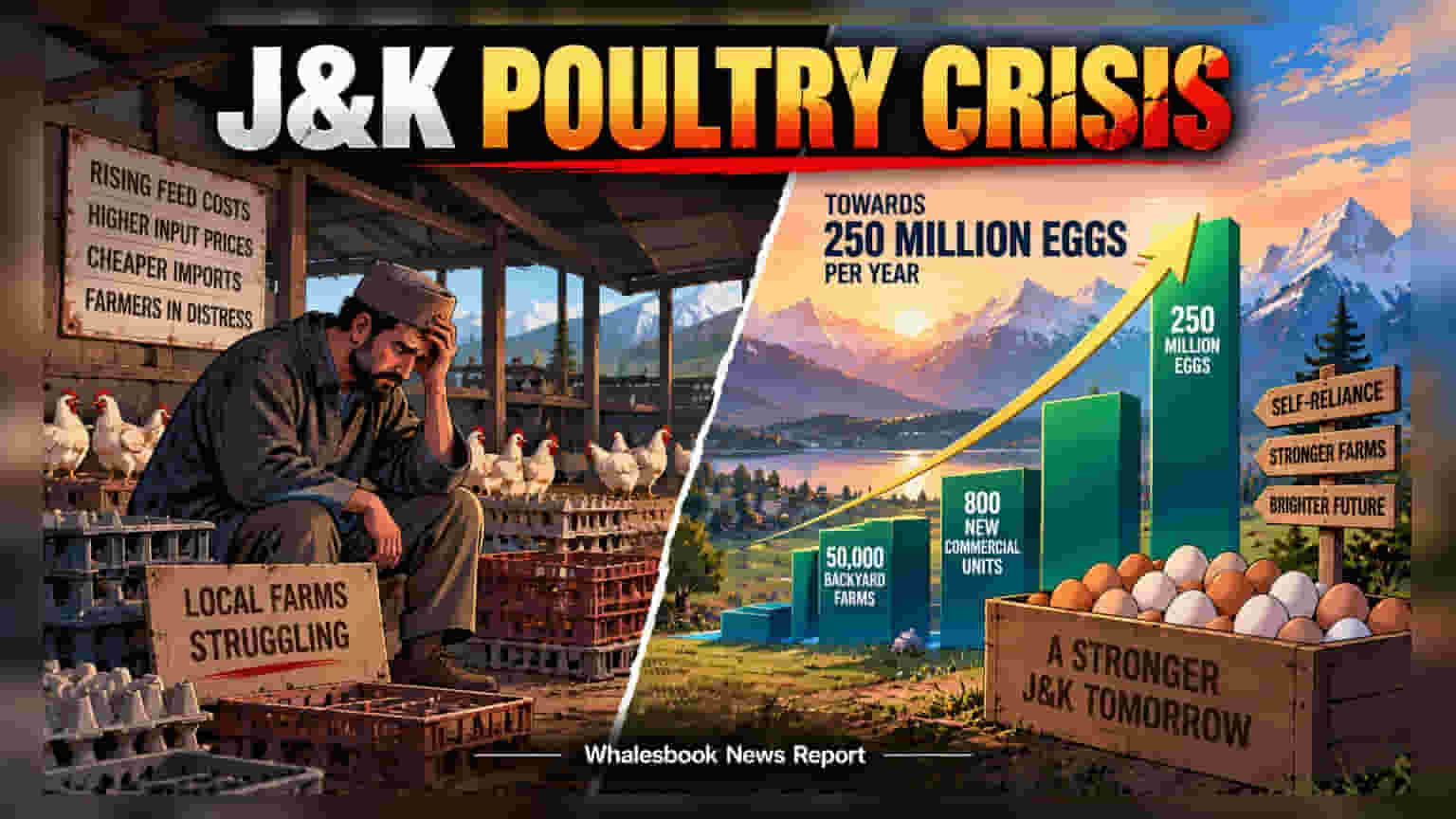
The Jammu and Kashmir government has announced a plan to set up 800 commercial poultry units and 50,000 backyard farms to increase local production. However, local farmers are raising concerns, stating that the Rs 1,500 crore industry is struggling to compete with cheaper imports following the removal of previous trade protections.
The Jammu and Kashmir administration has launched a strategy to increase local poultry production, aiming for a goal of 250 million eggs per year. The plan includes the establishment of 800 new commercial poultry units and the support of 50,000 backyard farming operations. This initiative is designed to help the region become more self-reliant and reduce its dependence on poultry supplied from other parts of India.
Challenges for Local Producers
While the government focuses on expanding production capacity, the local poultry sector is facing significant financial pressure. Industry participants, including the Kashmir Valley Poultry Farmers Association, argue that many existing farms are currently struggling to survive. The regional poultry industry, valued at Rs 1,500 crore, has seen its competitiveness decline over the past few years.
Farmers point to rising operational expenses as a major issue. Costs related to poultry feed, labor, and transportation have increased, making it more expensive to produce eggs and chicken locally. At the same time, these farms must compete with a large supply of lower-priced poultry that flows into the region from other states.
The Impact of Trade Policy Changes
Before 2019, the local industry was able to meet approximately 85 percent of the regional demand. Industry representatives attribute this stability to a protective tax of Rs 9 per kilogram that was previously applied to incoming poultry. This levy helped shield local farmers from volatile prices in larger, more efficient markets. After this protective measure was removed, the influx of cheaper poultry from external suppliers forced a sharp reversal in the market share held by local producers.
Critics of the government’s new expansion plan argue that adding hundreds of new commercial units may not be the right solution without first addressing these underlying issues. They suggest that establishing new farms while the existing infrastructure remains financially unviable could lead to a waste of resources. The concern is that new operators may face the same difficulty in turning a profit against cheaper external competition unless the broader business environment changes.
The success of this initiative will likely depend on whether the government can balance the push for more capacity with the need for a sustainable business model for farmers. Moving forward, the key factor to watch will be how the local industry manages its production costs and whether there are any policy adjustments to address the current pricing pressure from outside supplies.