

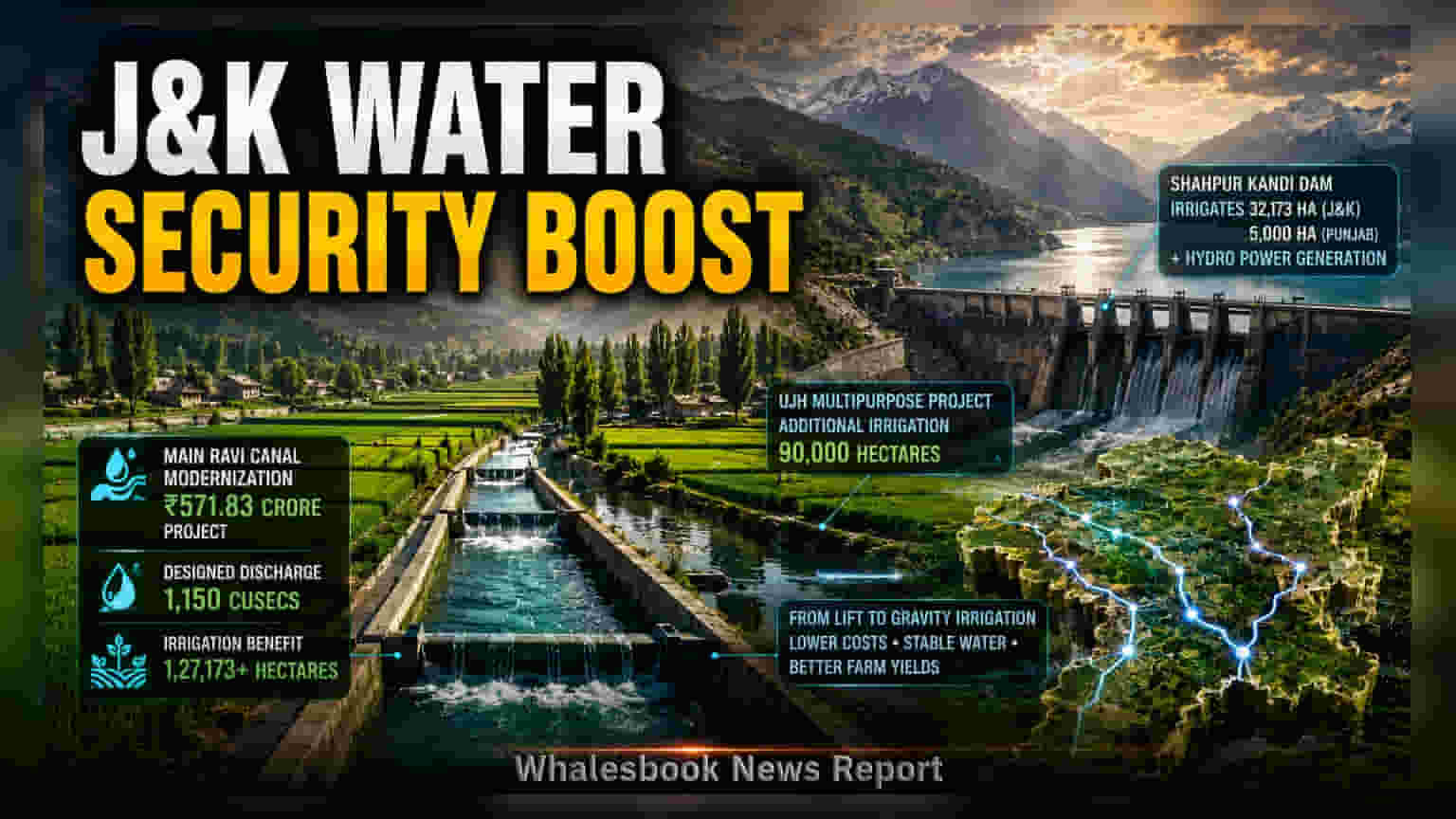
The Jammu and Kashmir administration is investing ₹571.83 crore to modernize the Main Ravi Canal and expand irrigation infrastructure. These projects, including the Shahpur Kandi and Ujh dams, aim to transition the region from lift irrigation to gravity-based systems, increasing water efficiency and potential for the agricultural sector.
The Jammu and Kashmir administration has intensified its focus on upgrading irrigation infrastructure across the Ravi basin, marking a major effort to improve water access for the region's agricultural sector. A central component of this strategy is a ₹571.83 crore project dedicated to the modernization of the Main Ravi Canal and its distribution network. The objective is to restore the canal’s designed discharge capacity to 1,150 cusecs, addressing decades of inefficiency that have left significant irrigation potential untapped.
For the past 40 years, parts of the region relied on energy-intensive lift irrigation. The integration of the Shahpur Kandi dam project, which is nearing completion, has allowed for a transition to gravity-based irrigation in certain areas. This shift is expected to reduce operational costs and stabilize water availability, which is critical for farmers in the region.
Strategic Irrigation Expansion
The ongoing projects are part of a broader push to fully utilize India’s water allocation under the Indus Waters Treaty. The Shahpur Kandi project alone is designed to irrigate 32,173 hectares in Jammu and Kashmir and 5,000 hectares in Punjab, while also contributing to hydroelectric power generation. Additionally, the Ujh Multipurpose Project, which is being executed in phases, is set to further boost irrigation coverage by approximately 90,000 hectares. WAPCOS Ltd is playing a key role in the technical implementation of these water resource projects.
While these projects are government-led initiatives, they hold significance for the broader North Indian infrastructure and engineering sector. Large-scale water management and hydroelectric projects often involve numerous private-sector engineering, procurement, and construction (EPC) firms as contractors. The government's continued spending on these assets creates a steady pipeline of work for companies specialized in irrigation, canal lining, and hydro-mechanical equipment.
Challenges and Risks
Despite the clear objectives, the successful execution of these projects faces inherent risks. Inter-state water-sharing dynamics between Jammu and Kashmir and Punjab remain a complex factor, as these projects often require high levels of cross-border administrative cooperation. Historical data indicates that project delays—often stemming from land acquisition hurdles or inter-state disputes—can stall the translation of designed capacity into actual farmer benefits. Furthermore, aging canal networks in the region are susceptible to damage from environmental factors such as flooding in the Ravi River, which requires ongoing maintenance investment.
Investors and stakeholders tracking the infrastructure space may observe that the effective utilization of these new water resources depends heavily on the maintenance of the distribution networks. If the canal modernization is completed effectively, it may lead to better water reliability for local crops, potentially supporting regional agricultural productivity. The key monitorable for the coming quarters will be the pace of project commissioning and the ability of the administration to resolve coordination issues between the involved states, which is essential to ensure the projects deliver their projected utility.