 Whalesbook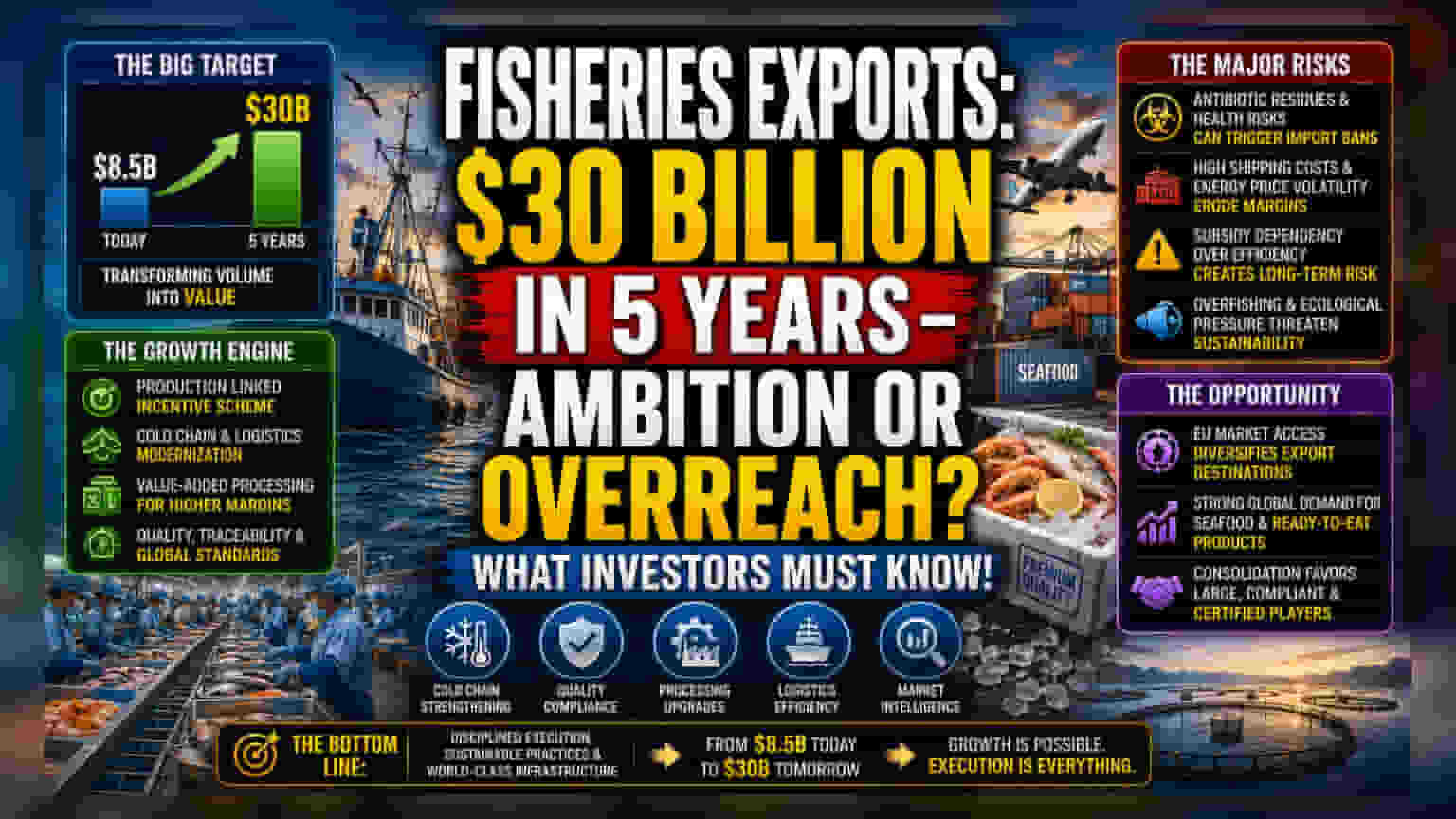


The Scaling Challenge
The ambition to push fisheries exports from approximately $8.5 billion to $30 billion within five years requires a fundamental transition from volume-based commodity trading to high-margin, value-added processing. While export statistics have shown impressive relative growth over the last decade, the sheer scale of this target implies a compound annual growth rate that drastically exceeds historical performance. Success depends heavily on the government’s ability to operationalize a Production Linked Incentive scheme, which must move beyond basic financial subsidies to solve systemic bottlenecks in cold-chain logistics and maritime quality control systems.
The Infrastructure and Regulatory Gap
Expansion of this magnitude is frequently constrained by the limitations of domestic processing infrastructure. Despite recent successes in securing access to European Union markets, which serves as a vital pivot point against volatile U.S. tariff regimes, Indian exporters continue to grapple with stringent phytosanitary standards. Competitor nations, particularly in Southeast Asia, have invested heavily in automation and traceability software, creating a competitive environment where India’s labor-intensive model may struggle to maintain price parity without significant technological integration. The proposed PLI scheme aims to bridge this gap, yet the effectiveness of such incentives is often diluted by the fragmented nature of the MSME sector, which currently lacks the capital reserves for rapid technological scaling.
The Forensic Bear Case
The push for aggressive production targets inherently carries the risk of ecological degradation, despite official assurances of sustainable management. Fisheries experts frequently warn that rapid expansion in intensive aquaculture—often necessary to meet such high export goals—can lead to antibiotic residue issues, which serve as a common trigger for sudden import bans by both the EU and the FDA. Furthermore, the volatility of global shipping costs and energy prices for cold storage facilities represents a permanent margin risk. Relying on government-backed incentives to drive market competitiveness is a double-edged sword, as it can foster a culture of subsidy dependency rather than structural efficiency. Historically, sectors relying on state-led export targets have occasionally faced 'inventory overhang' when international demand fails to meet the artificially stimulated supply increases.
Future Market Outlook
Moving forward, market participants will watch for concrete legislative timelines regarding the Department of Fisheries' incentive rollout. The sector is moving toward a consolidation phase, where larger firms with existing international certifications will likely capture a disproportionate share of the growth. While the export diversification into European markets remains a positive signal for long-term stability, the immediate focus remains on whether domestic infrastructure can scale without sacrificing quality standards and triggering global regulatory pushback.