

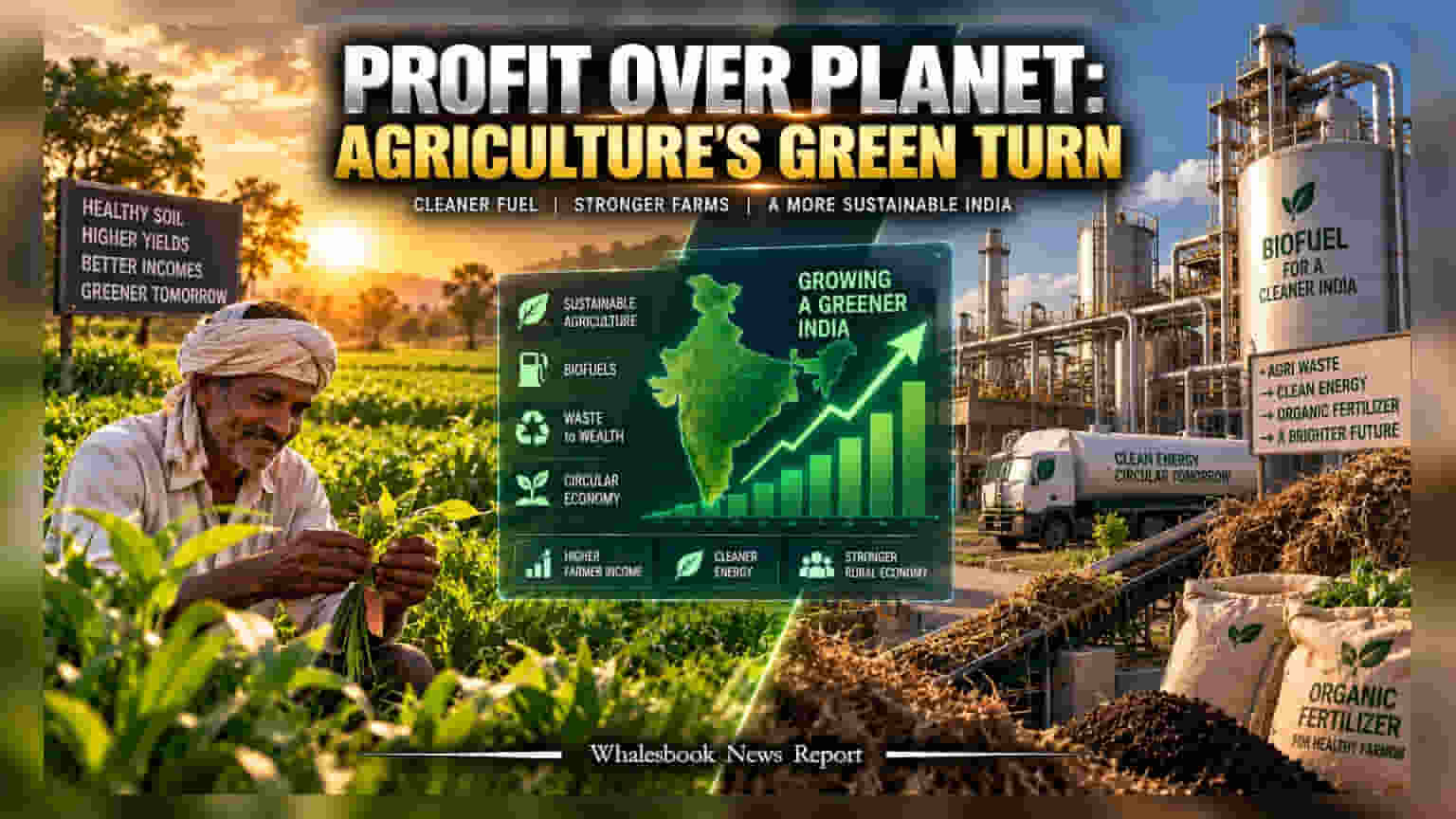
The Indian agricultural sector is moving away from subsidy-reliant green initiatives toward commercially viable, circular economy models. While private players like the unlisted CEF Group are raising capital to turn waste into bio-fuel and farm inputs, the success of these ventures depends on beating synthetic fertilizers on price and yield. This shift highlights the need for sustainable practices to prove their financial strength to scale.
The Indian agricultural landscape is reaching a turning point. For years, green and sustainable farming initiatives have relied heavily on government subsidies, grants, or corporate social responsibility (CSR) funds. This approach often restricted projects to small, isolated pilots that struggled to reach a wider market. Now, a growing number of industry participants are pivoting toward a model that prioritizes immediate financial returns for farmers and operators, signaling a move toward a truly circular economy.
One example of this shift is the private company CEF Group. While the company is not listed on public stock exchanges like the NSE or BSE, its operational strategy offers a look at how the sector is evolving. In August 2025, the company secured approximately €38 million—or roughly ₹345 crore—in a mix of equity and debt funding from a German Export Finance bank. This capital is earmarked to scale its operations under the government’s SATAT (Sustainable Alternative Towards Affordable Transportation) scheme, focusing on building 22 large-scale facilities to convert municipal and agricultural waste into bio-compressed natural gas and organic fertilizers.
For the average investor, this represents a broader trend: the sector is attempting to solve multiple economic problems at once. By converting waste into fuel and farm inputs, these companies aim to create a commercial loop. However, the true test for these models is not environmental impact, but cost efficiency. In the Indian market, green agricultural inputs face the stiffest competition imaginable: heavily subsidized synthetic fertilizers.
New bio-based inputs must prove they can reduce costs or increase yields per acre. Farmers operate on thin margins; if a new bio-product is more expensive than traditional urea, adoption will remain slow. The survival of this entire industry hinges on measurable performance metrics rather than green promises. If these products cannot deliver on yield and price, they will struggle to scale, regardless of external funding.
Investors and observers should be aware of the inherent risks in this capital-intensive model. First, there is significant execution risk. Setting up and running large-scale waste-to-energy plants involves long-term contracts with municipal bodies—sometimes spanning up to 25 years—which are operationally complex and can face delays or cost overruns. Second, the reliance on a consistent supply of waste feedstock is a major operational challenge. If waste quality varies or the supply chain breaks, plant efficiency drops. Finally, the business model often depends heavily on the policy stability of government schemes like SATAT. Any shift in government policy regarding pricing, subsidies, or bio-fuel mandates could fundamentally alter the profitability of these projects.
The most important factor to monitor in this evolving sector is the ability of these companies to deliver consistent, scalable unit economics. Future updates on plant commissioning dates, the successful execution of municipal contracts, and, crucially, data on yield improvements for farmers using these bio-inputs will determine whether this sector becomes a sustainable commercial industry or remains a collection of disconnected projects.