

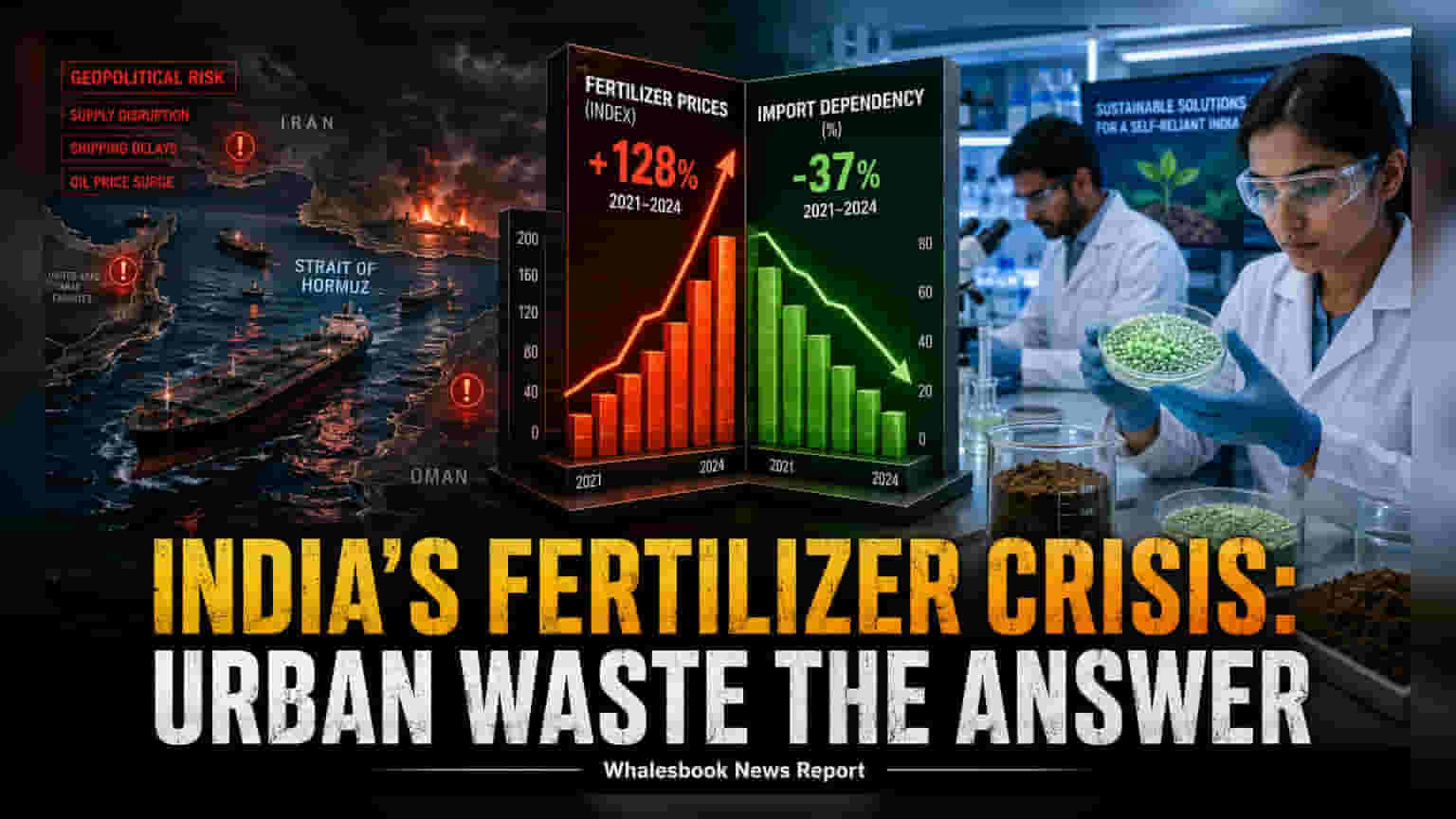
With fertilizer and energy supply chains facing persistent geopolitical pressure in the Strait of Hormuz, India is fast-tracking domestic circular economy solutions. Government schemes like GOBARdhan and PM-PRANAM are incentivizing the conversion of urban sewage and agricultural waste into nutrient-rich organic fertilizers. For investors, this marks a strategic shift in the fertilizer sector toward localized production, though scaling these operations remains a long-term infrastructure challenge.
India’s agricultural sector, a cornerstone of its economy, is navigating a significant strategic challenge. A major portion of the raw materials for nitrogen-based fertilizers, as well as finished nutrient products, transit through the Strait of Hormuz—a maritime chokepoint that has faced recurring geopolitical instability throughout 2026. This dependency creates a persistent risk to India’s food security, as any disruption in this corridor can lead to sudden supply shortages and price volatility for essential agricultural inputs.
To mitigate this reliance, policymakers are accelerating a transition toward domestic nutrient self-sufficiency. The government’s strategy is two-pronged: optimizing current fertilizer use and creating a 'circular bio-economy' that transforms urban and agricultural waste into viable organic fertilizers. Key initiatives such as the PM-PRANAM scheme, which incentivizes states to reduce chemical fertilizer consumption, and the recently approved GOBARdhan (Galvanizing Organic Bio-Agro Resources Dhan) National Circular Bioenergy Scheme, are now at the center of this transition.
Scaling the Circular Bio-Economy
The GOBARdhan initiative, with a significant financial outlay, is designed to mobilize large-scale private investment for converting cattle dung, crop residue, and municipal organic waste into compressed biogas (CBG) and organic manure. By establishing a national framework for stable pricing and demand, the government aims to increase domestic bio-energy production ten-fold over the coming decade. For the fertilizer industry, this is not just an environmental initiative but a business pivot. Processing urban sewage sludge—often referred to as 'urban nutrient mining'—could theoretically recover nitrogen, phosphorus, and potassium, effectively turning a waste management burden into an asset.
Leading players in the fertilizer sector, such as Coromandel International, have been increasing their focus on organic and specialty nutrients. These companies are exploring partnerships and R&D to address soil health and reduce dependency on traditional chemical imports. This shift toward 'soil-enhancing' products and organic manures represents a long-term hedge against the volatility of imported raw materials and fluctuating global energy prices.
The Infrastructure and Execution Gap
While the economic logic is compelling, the path to replacing chemical fertilizers with waste-derived products faces substantial hurdles. Converting sewage and municipal waste into safe, high-quality fertilizer requires rigorous processing to remove pathogens and contaminants—a challenge that has historically limited the scale of such operations in India. Most existing sewage treatment plants are not yet equipped to produce high-grade agricultural inputs at a commercial scale, meaning substantial capital expenditure is required to upgrade this infrastructure.
Furthermore, the success of these initiatives depends on the 'last mile' integration—connecting urban waste centers to fertilizer manufacturing hubs. Investors should monitor the implementation of these government-backed waste-to-wealth plants. Success will be determined not by policy announcements, but by the actual commissioning of operational plants, the cost-effectiveness of these new organic products, and their acceptance by farmers who are accustomed to conventional chemical fertilizers.
For investors, the sector monitorable is the pace at which fertilizer companies integrate these circular economy models into their core operations. Future earnings resilience for fertilizer manufacturers may increasingly depend on their ability to diversify away from imported feedstock and embrace these government-incentivized, domestically-sourced nutrient streams.