

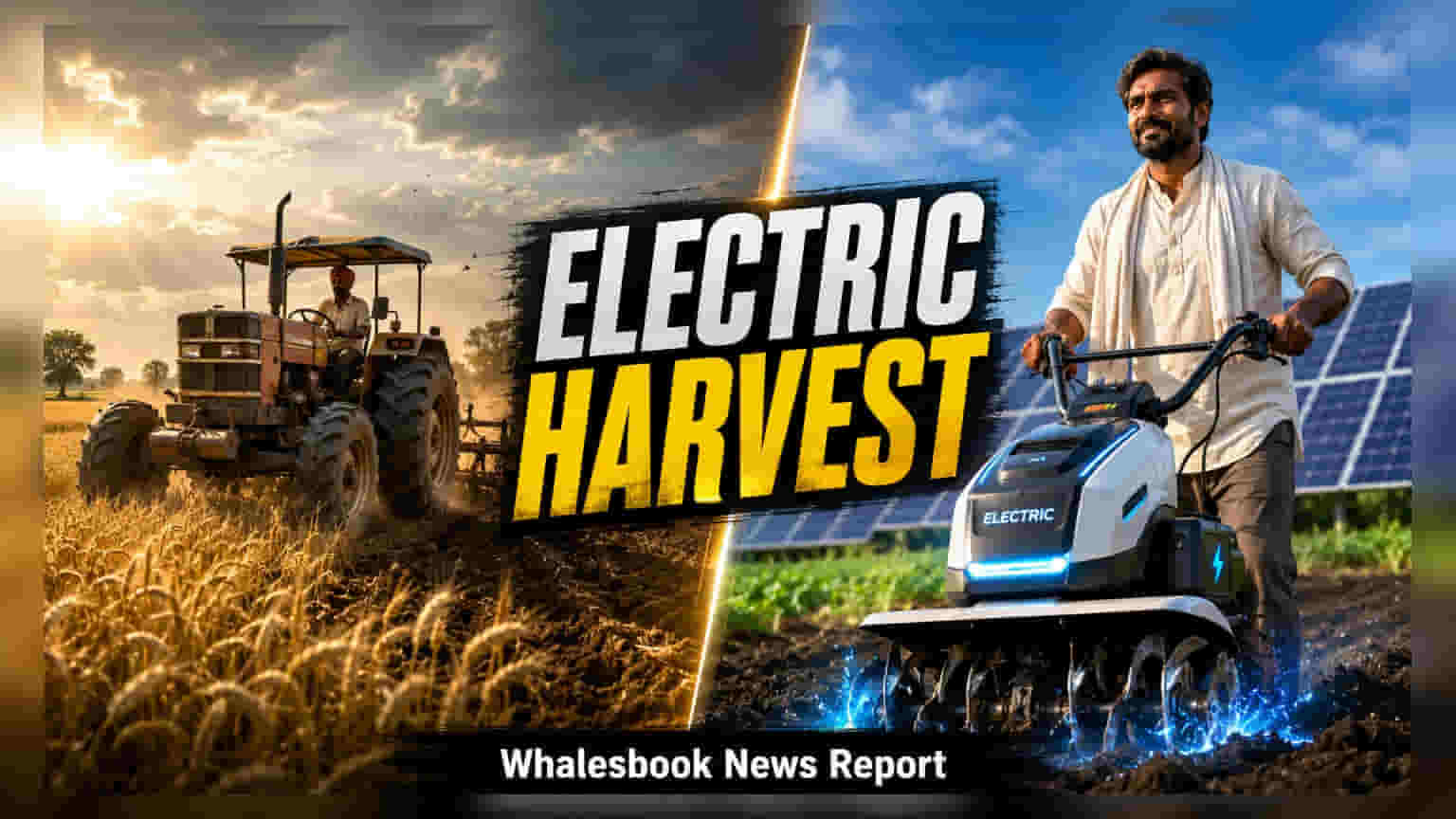
India’s agricultural mechanization is moving beyond big tractors, with smaller electric machinery like power weeders gaining ground. With 86% of landholdings being small, this transition offers efficiency for marginal farmers. However, investors should monitor risks such as high upfront costs, the need for rural service infrastructure, and operational reliability in harsh field conditions.
India's agricultural sector is undergoing a quiet, structural shift. While the country achieved record tractor sales in FY26—with domestic wholesales exceeding 1.1 million units—the broader mechanization story is moving into new territory: small, electric-powered machinery. Despite these high tractor numbers, overall farm mechanization in India remains at approximately 47%, significantly lower than levels seen in nations like China or Brazil. This gap highlights a mismatch between available technology and the reality of Indian farming.
Why Small Farms Need Different Tech
The core challenge in Indian agriculture is land size. Approximately 86% of landholdings in the country are smaller than two hectares. A large, high-horsepower tractor is often impractical for these small plots, making it difficult for marginal farmers to justify the high investment. This structural reality has created an opportunity for smaller equipment like power weeders, reapers, and tillers in the 1.5 to 7 kW power range.
Manufacturers are increasingly focusing on this segment, which has recently seen growth rates outpacing the traditional tractor market. Electric motors offer specific advantages for these smaller machines. They provide immediate torque—crucial for tasks like digging or weeding—and operate without the noise, exhaust fumes, or partial-load fuel inefficiency common in small diesel engines. This makes them particularly suitable for confined spaces like polyhouses.
Challenges for the Electric Pivot
For investors, it is important to balance this growth narrative with the reality of operational risks. The switch to electric machinery is not without hurdles. The primary challenge is the high upfront cost, which remains a significant barrier for small farmers who often rely on limited credit or government subsidies. Furthermore, India’s agricultural environment is demanding. Electric powertrains must be robust enough to handle high ambient temperatures, dusty conditions, and long, continuous use in fields where reliable electricity and charging infrastructure are still scarce.
Unlike diesel equipment, which has a well-established repair network in rural India, electric farm machinery requires an entirely new support ecosystem. If a battery or electronic controller fails during a critical planting or harvesting window, the lack of immediate local service could lead to significant downtime and losses for farmers. Manufacturers are also facing the challenge of moving beyond simple assembly to designing integrated cooling and power systems that can survive these extreme conditions.
What Investors Should Monitor
The future of this segment will likely depend on the development of affordable shared ownership or rental models, the expansion of rural repair networks, and the ability of manufacturers to deliver machine reliability at a competitive price point. Investors should track not just sales volume, but also company progress in building robust service networks and how these machines perform in the field over multiple seasons. While government policies like GST reductions on machinery and the promotion of custom hiring centers are providing support, the long-term success of this segment will ultimately rely on how effectively these machines prove their durability in the daily grind of an Indian farm.