

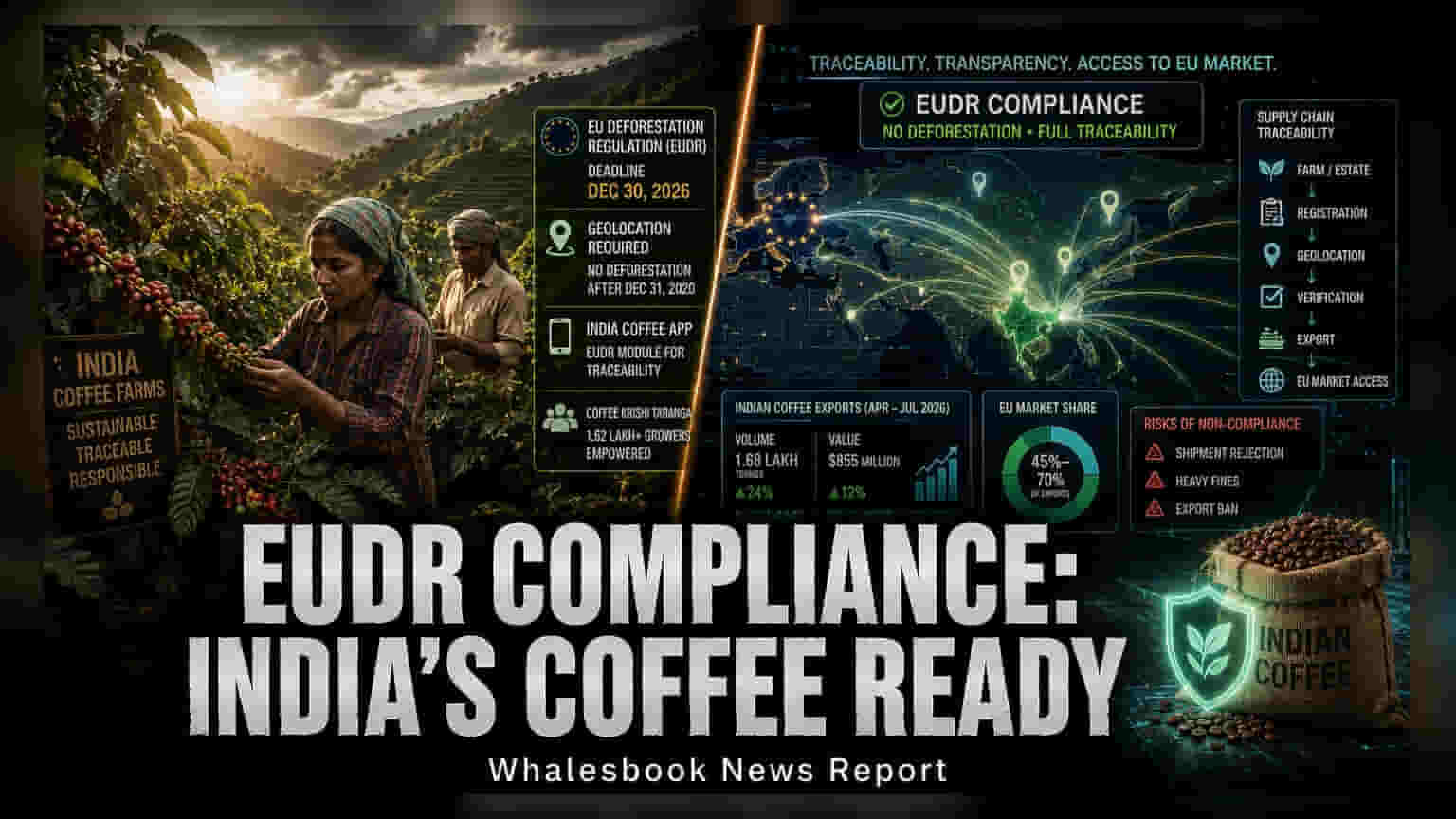
With nearly half of Indian coffee exports bound for Europe, growers and traders are rushing to meet the EU's new deforestation rules by December 30, 2026. To keep access to this premium market, the Coffee Board is deploying digital mapping tools to help farmers prove their beans are not grown on cleared forest land.
Indian coffee exporters and farmers are under pressure to comply with the European Union’s new Deforestation Regulation, known as EUDR, by the December 30, 2026, deadline. This regulation is critical for the Indian coffee sector because the European market accounts for approximately 45% to 70% of the country's total coffee exports. Failing to meet these new standards could lead to significant problems, including the rejection of shipments, heavy fines, or even a total ban from selling into European countries.
The core of the new rule is proof of origin. European importers now require documentation confirming that coffee was not grown on land that was deforested after December 31, 2020. For Indian exporters, this means every bag of coffee must be linked to precise geolocation data—a map showing exactly which farm or estate produced the beans. This level of tracking is a major shift from traditional supply chain methods.
To help the industry meet these requirements, the Coffee Board of India is actively scaling up its digital support. It has integrated a specialized module into the 'India Coffee App' to help stakeholders navigate the new rules. The Board is also using its 'Coffee Krishi Taranga' mobile advisory service, which reaches over 1.62 lakh registered growers, to share information and help farmers map their land. These digital tools are designed to streamline the gathering of farm-level data, which is necessary to create the traceability reports required by the EU.
This push for compliance comes at a time when export numbers are strong. In the four months from April to July 2026, Indian coffee exports increased by 24% in volume to over 1.68 lakh tonnes. In terms of money, exports grew by 12% to reach $855 million compared to the same period last year. Maintaining this growth momentum depends heavily on the industry's ability to smoothly transition to the new EU standards.
However, the transition involves significant challenges. The primary risk for the industry is the high operational and financial cost of implementing these new systems. For small and medium-sized growers, who make up a large part of India's coffee production, the cost of technology, digital mapping, and maintaining strict records can be burdensome. There is also the risk of creating a two-tier market where coffee that cannot be proven 'deforestation-free' might be excluded from premium European channels or sold at a sharp discount elsewhere.
Investors and stakeholders will be tracking how quickly the Coffee Board can complete the mapping of coffee estates. The next key step will be the ability of exporters to demonstrate full compliance for shipments as the year-end deadline approaches. For smaller farmers, the extended deadline of June 30, 2027, provides some breathing room, but the industry-wide focus remains on building the necessary digital infrastructure immediately.