

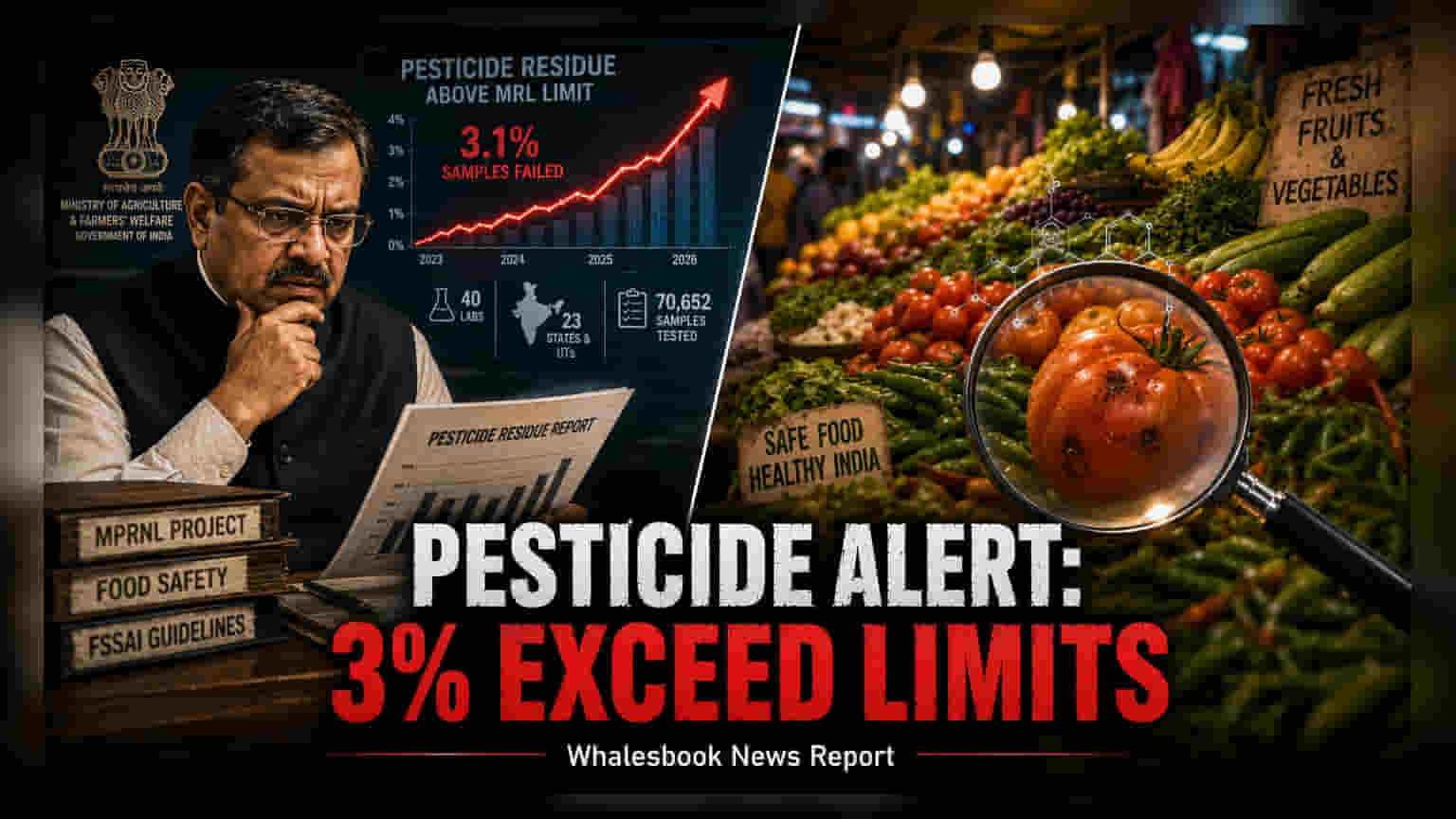
The Union Agriculture Ministry found that 3.1% of fruit and vegetable samples tested between 2023 and 2026 exceeded FSSAI safety limits. This data highlights the increasing importance of quality compliance in India's agricultural sector, which is essential for maintaining growth in exports and ensuring standards in the organized food retail space.
The Union Agriculture and Farmers’ Welfare Ministry has released data revealing that 3.1% of fruit and vegetable samples tested in India between 2023 and 2026 contained pesticide residues above the Maximum Residue Limit (MRL) set by the Food Safety and Standards Authority of India (FSSAI). Out of 70,652 samples collected across 23 states and union territories, 2,223 samples failed to meet these safety standards.
This data was collected under the 'Monitoring of Pesticide Residues at National Level' (MPRNL) project, a long-standing government initiative that tracks chemical residues in food products. The project uses a network of 40 laboratories across the country and has been extended through the 2028-29 fiscal year, signaling the government's continued focus on food safety monitoring. To manage the issue at the local level, 21 states have formed specific committees to oversee residue testing and promote the use of safer agricultural methods.
Impact on the Agricultural Sector
For investors and companies operating in the food processing, retail, and agricultural export sectors, these findings underscore the tightening regulatory landscape regarding food safety. As India aims to scale its agricultural exports—which grew to $3.93 billion in the 2025-26 fiscal year compared to $2.45 billion in 2016-17—maintaining strict quality control is becoming a core business requirement. Any failure to meet international or domestic safety standards can lead to shipment rejections and reputational risk for export-oriented firms.
Furthermore, the government's push for 'good agricultural practices' and Integrated Pest Management strategies suggests a shift in the farming ecosystem. Companies involved in providing modern, safer crop protection solutions may see changes in demand as farmers are encouraged to move away from excessive chemical use. For large retailers and food processors, the findings reinforce the necessity of building robust supply chain traceability. Tracking produce from the farm gate to the retail shelf is no longer just a logistical task but a critical compliance measure to ensure that products meet FSSAI guidelines.
Monitoring Regulatory Compliance
Investors may keep an eye on how state-level committees and the national project influence farming practices over the coming years. Stricter enforcement of residue limits may lead to higher compliance costs for aggregators and producers in the short term. However, it is also likely to favor organized players who have the infrastructure to implement systematic quality testing and sustainable sourcing practices. The next important update for the sector will be the effectiveness of these state-level committees in reducing residue violations and the impact of the Digital General Crop Estimation Survey on overall transparency in the farm supply chain.