 Whalesbook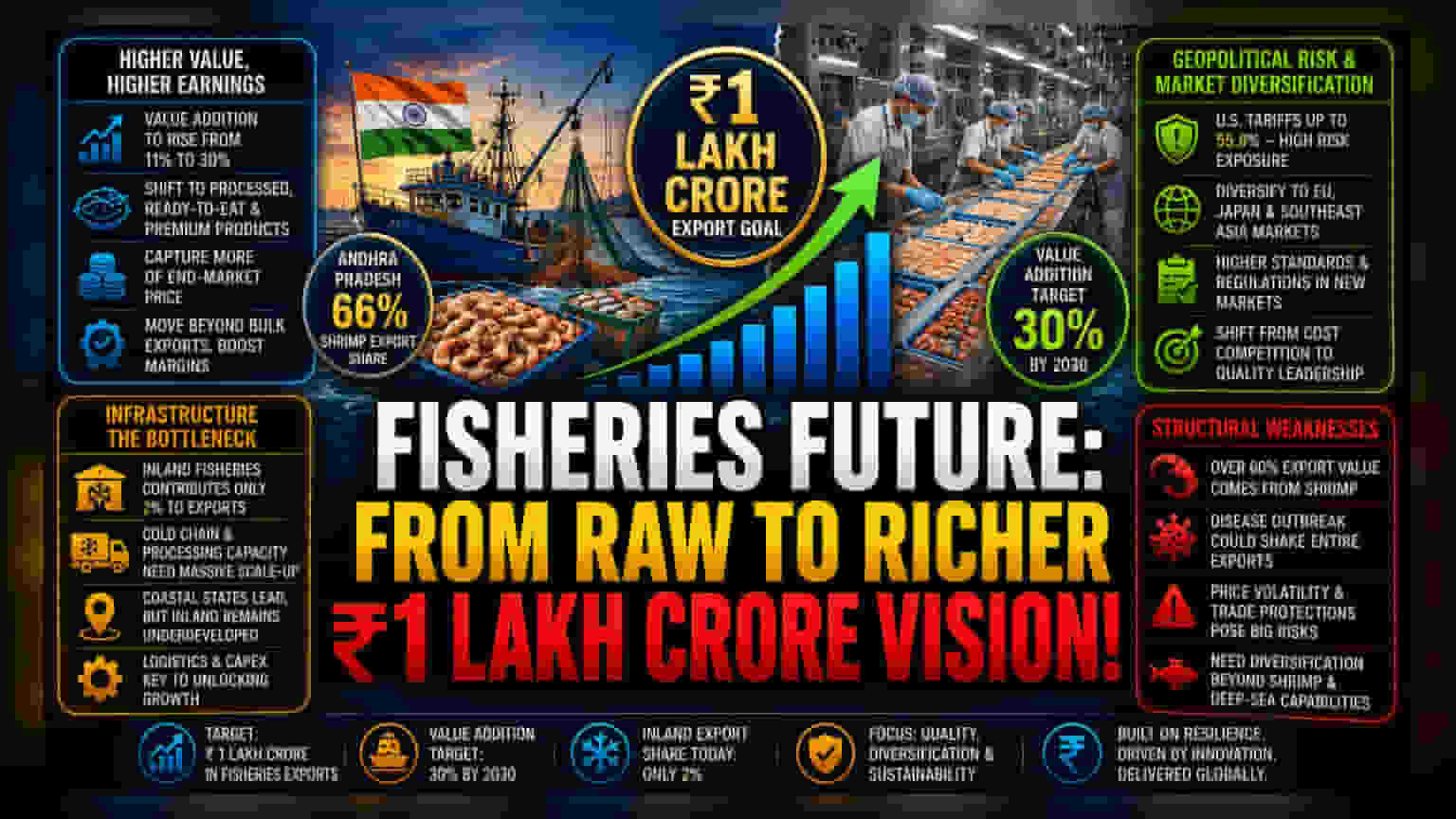


The Shift Toward Value-Added Margins
The mandate to push fisheries value addition from 11% to 30% marks a departure from India’s historical reliance on bulk raw seafood exports. By moving toward processed, ready-to-eat, or higher-tier marine products, the government intends to capture a larger share of the end-market price. This structural adjustment is not merely a production goal but a strategic reaction to margin compression caused by intense global price competition and logistics costs that have historically favored commodity-level throughput.
Infrastructure as the Bottleneck
While coastal states like Andhra Pradesh currently dominate the sector with a 66% share of shrimp exports, the inland fisheries sector remains severely underdeveloped, contributing only 2% to total export figures. Achieving the Rs 1 lakh crore target requires a fundamental transformation of the cold chain and processing facilities located away from the coast. Investors should monitor capital expenditure patterns in logistics, as the disparity between coastal processing efficiency and inland raw material extraction continues to create a significant supply-chain drag.
The Geopolitical Risk and Market Diversification
The reliance on the US market has become a high-risk proposition due to aggressive tariff structures reaching as high as 55.8%. Diversification into the European Union, Japan, and Southeast Asia acts as an essential hedge, yet these markets demand higher quality standards and stricter regulatory compliance. Success here will depend on whether domestic exporters can transition from cost-based competition to quality-based dominance. Unlike previous growth phases, where volume gains were easy to replicate, future expansion faces rigid sanitary and phytosanitary barriers in these new target regions.
The Structural Weakness: A Heavy Reliance on Shrimp
Analysts remain cautious regarding the industry's singular reliance on shrimp, which accounts for over 60% of total export value. A potential disease outbreak in shrimp farming or a sudden swing in global demand could destabilize the entire sector, given that the secondary species portfolios are not yet developed to a scale that could absorb a market shock. Furthermore, the sustainability of the Rs 1 lakh crore goal is heavily contingent on price stability in international markets, which remains volatile. Without significant breakthroughs in deep-sea fishing capabilities and a broader species-based export strategy, the current plan remains highly sensitive to both environmental risks and the arbitrary nature of international trade protections.