 Whalesbook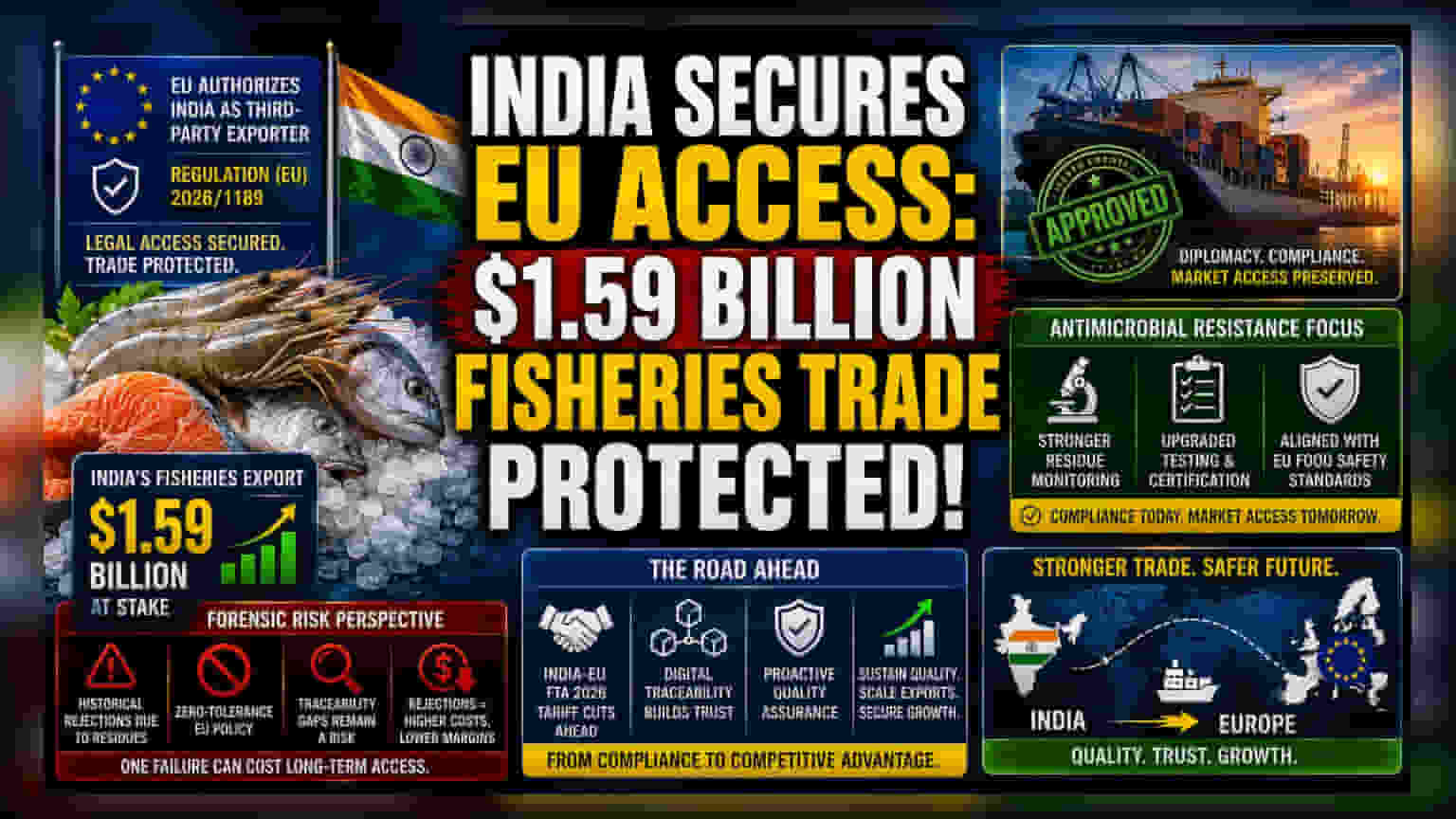


The Regulatory Preservation
India’s inclusion on the European Union’s list of authorized third-party exporters marks a successful conclusion to high-stakes diplomatic and technical negotiations. The amendment to Regulation (EU) 2021/405, codified through Commission Implementing Regulation (EU) 2026/1189, establishes the new legal baseline for animal-origin imports. While the narrative often focuses on trade expansion, this development is primarily a defensive victory, shielding India’s $1.59 billion fisheries trade from being sidelined by increasingly stringent EU food safety protocols.
The Antimicrobial Resistance Pivot
The core of the EU's recent regulatory hardening lies in its intensifying stance on antimicrobial resistance. European authorities now demand that any country exporting animal-origin goods—including aquaculture products and honey—must provide verifiable evidence of robust residue monitoring. Indian agencies, specifically the Export Inspection Council and the Marine Products Export Development Authority, have spent the last several months overhaulng official control systems. This includes upgrading testing and certification frameworks to align with European standards, as failing to meet these benchmarks would have effectively shuttered access to a premium consumer base.
The Forensic Risk Perspective
Despite the immediate relief, the path forward remains fraught with structural challenges. Historical precedent shows that Indian agricultural consignments frequently struggle with rejections in high-standard markets due to intermittent residue issues and traceability gaps. Recent parliamentary data confirms that shrimp exports have faced significant interception rates at international borders—not due to biological hazards, but because of traces of banned antibiotics. The EU’s zero-tolerance approach toward these residues means that securing legal market access is only half the battle; maintaining it requires an arduous, continuous commitment to farm-level hygiene and chemical oversight. Any backsliding in domestic compliance mechanisms could trigger rapid re-listing or heightened inspection frequencies, which would inflate logistics costs and erode profit margins for exporters.
The Future Outlook
This regulatory win coincides with broader trade optimism generated by the 2026 India-EU Free Trade Agreement. While the FTA aims to eliminate long-standing tariffs on seafood and processed foods, these trade gains are essentially contingent upon satisfying the EU’s non-negotiable health and safety criteria. Moving forward, the focus shifts toward digitizing supply chains—potentially utilizing blockchain-based traceability—to bolster confidence among European buyers who remain wary of potential contamination. For the sector to truly capitalize on the $1.59 billion export valuation, participants must transition from reactive compliance to proactive, systemic quality assurance.