

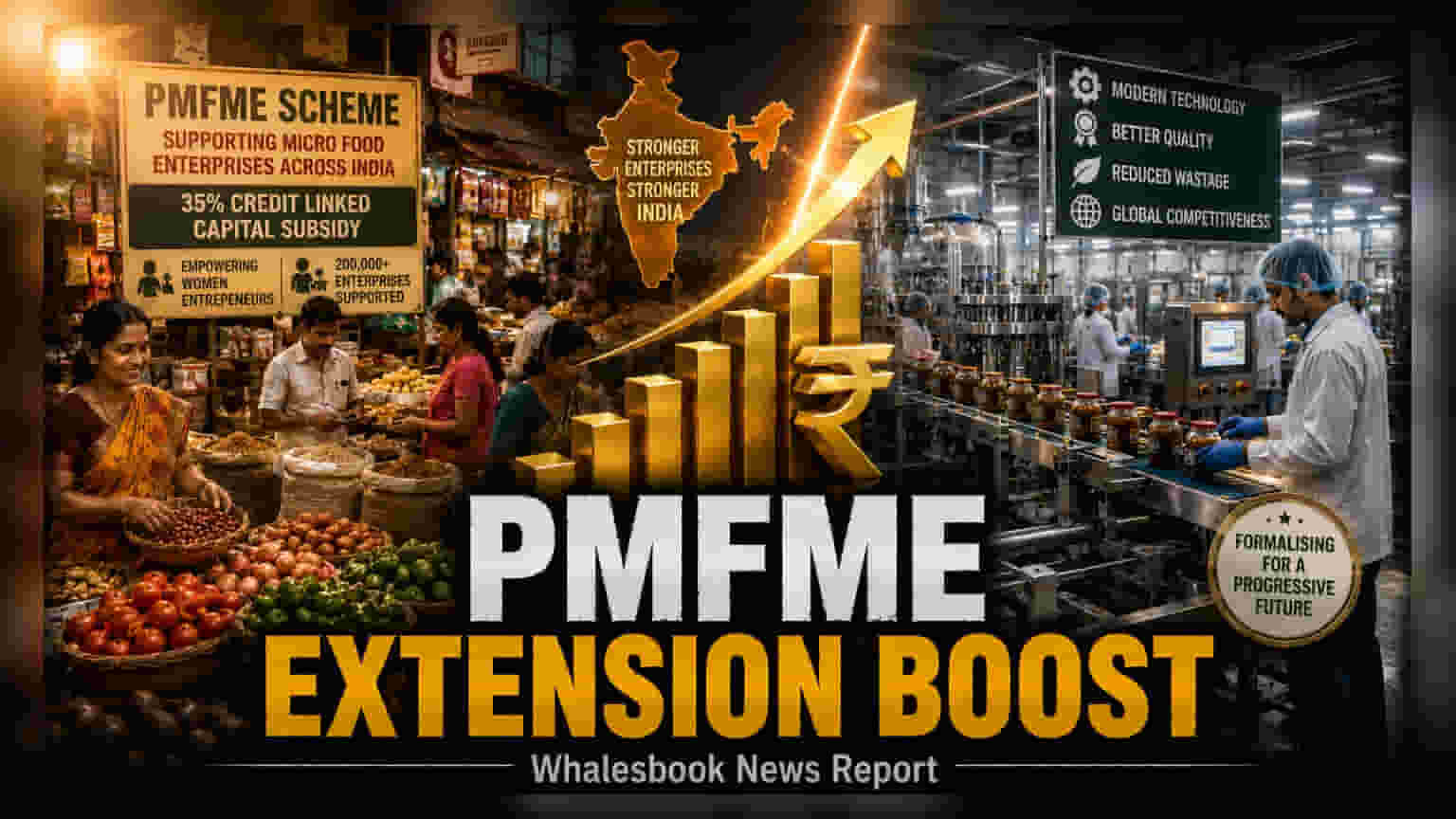
The Ministry of Food Processing Industries has proposed extending the PMFME scheme for another five years to support small food businesses. This initiative aims to improve access to technology and financing for micro-enterprises. Investors may track this for its potential to strengthen the supply chain within the broader Indian food processing and agricultural sector.
The Ministry of Food Processing Industries has formally proposed a five-year extension for the Pradhan Mantri Formalisation of Micro Food Processing Enterprises (PMFME) scheme. This initiative, designed to help small, unorganized food businesses transition into structured, formal enterprises, is currently valid until September 30, 2026. The proposed extension, often referred to as PMFME 2.0, seeks to continue this support, ensuring policy stability for small entrepreneurs across the country.
How the Scheme Works
Launched in 2020, the PMFME scheme acts as a bridge to help micro-food businesses modernize. The government provides a 35% credit-linked capital subsidy for eligible projects. This means if a small business takes a loan to buy better equipment, packaging machinery, or technology, the government subsidizes a significant portion of that investment. The funding model is a partnership between the Centre and the states, typically following a 60:40 ratio, with specific provisions for northeastern and Himalayan states to ensure widespread reach.
Since its inception, the scheme has made an impact by supporting over 200,000 micro-enterprises. A notable aspect of the program’s reach is that over 40% of the beneficiaries are women entrepreneurs. By helping these small units upgrade, the government aims to reduce post-harvest losses, which remain a major challenge in India's agricultural supply chain.
Implications for the Food Sector
While this is a government policy and not a direct corporate event, it carries indirect significance for the organized food and agricultural sector. India's food processing industry is heavily fragmented, with a vast unorganized sector. As micro-enterprises become more formal, they are better positioned to supply quality raw materials and processed goods to larger, organized players.
For investors and market observers, the formalization of these small units can lead to a more reliable and standardized supply chain. A more efficient processing sector can help reduce wastage, which is vital for the long-term profitability and raw material security of larger FMCG and food processing companies. If the unorganized sector becomes more efficient, it may eventually lead to better quality control and more consistent availability of products across the food industry.
Monitoring the Risks
Investors should note that the extension is currently a proposal and has not yet been officially notified as government policy. The success of such schemes relies heavily on implementation, which requires coordination between central and state authorities. Additionally, there are operational risks: the long-term sustainability of these micro-enterprises depends on their ability to survive in a competitive market once they are formalized. Access to capital is only the first step; these businesses must also successfully integrate into e-commerce and retail platforms to grow their operations. The key monitorable for the coming months will be the official approval of the extension and any potential revisions to the subsidy guidelines that may accompany the new phase of the scheme.