

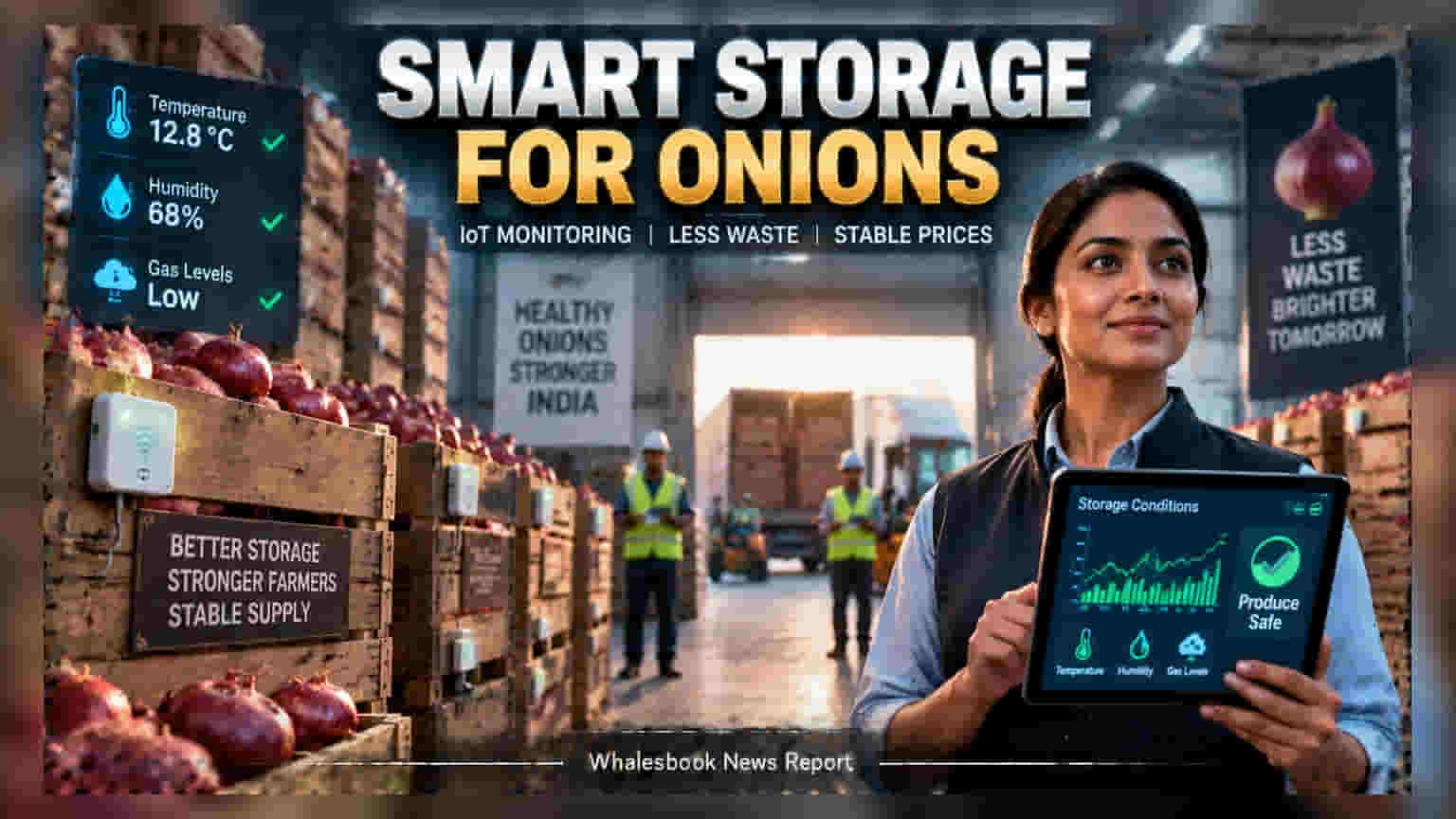
Pune-based startup Godaam Innovations has secured a government contract to deploy IoT-enabled surveillance in onion warehouses to curb spoilage. The initiative aims to reduce high post-harvest losses in India's agricultural supply chain. Investors should note that Godaam Innovations is a private, unlisted entity and is not available for trading on stock exchanges. Its operations carry typical risks associated with early-stage startups, including funding dependency and execution challenges.
The Union Ministry of Consumer Affairs has engaged Pune-based startup Godaam Innovations to modernize the surveillance of onion storage facilities. This partnership focuses on deploying proprietary IoT-enabled devices designed to track critical environmental metrics like temperature, humidity, and gas emissions. By identifying the signs of early-stage spoilage in real-time, the system aims to help farmers take preventive measures, thereby reducing the significant waste that often plagues the Indian onion supply chain.
Addressing Supply Chain Volatility
Onions are a crucial but volatile staple in the Indian consumer basket. Regional market dynamics, particularly in key hubs like Nashik, often influence prices across the country. Data indicates that farmers frequently lose a substantial portion of their stored produce—sometimes estimated at 25 percent—due to a lack of proper climate-controlled storage. The primary focus of this technology is the rabi crop, which constitutes a large share of annual production and serves as the primary inventory until the kharif harvest arrives. By attempting to reduce these losses, the initiative seeks to stabilize supply and potentially mitigate the sharp price spikes often seen between harvest cycles.
Important Clarification for Investors
It is important for market participants to understand the structure of the entity involved. Godaam Innovations is a private limited company and is not listed on the National Stock Exchange (NSE) or the Bombay Stock Exchange (BSE). Consequently, there is no public stock price, no market capitalization, and no exchange-mandated financial disclosure. The company does not have publicly traded shares, and retail investors cannot buy or sell its equity on public markets.
Risks and Operational Challenges
As with many early-stage agricultural technology startups, Godaam Innovations faces several inherent challenges. First, the business is in the seed stage of funding, which typically implies high cash burn and negative profit margins as the company invests in technology development and market entry. Its long-term survival depends heavily on securing further rounds of external funding.
Second, the operational risk is significant. Deploying complex IoT hardware across diverse and often remote warehouse environments requires high execution capability. If the technology fails to perform consistently at scale or if the cost of implementation proves prohibitive for smaller storage facilities, the company may struggle to achieve widespread adoption.
Finally, the agritech sector is highly dependent on seasonal factors and government policy. Changes in agricultural export rules, fluctuating commodity prices, or shifts in government procurement strategies could impact the company’s business model. For investors interested in the space, the key to tracking such companies is not through stock charts, but through developments in their operational scale, the success of their pilot projects, and their ability to sustain operations without relying solely on fresh capital infusions.