

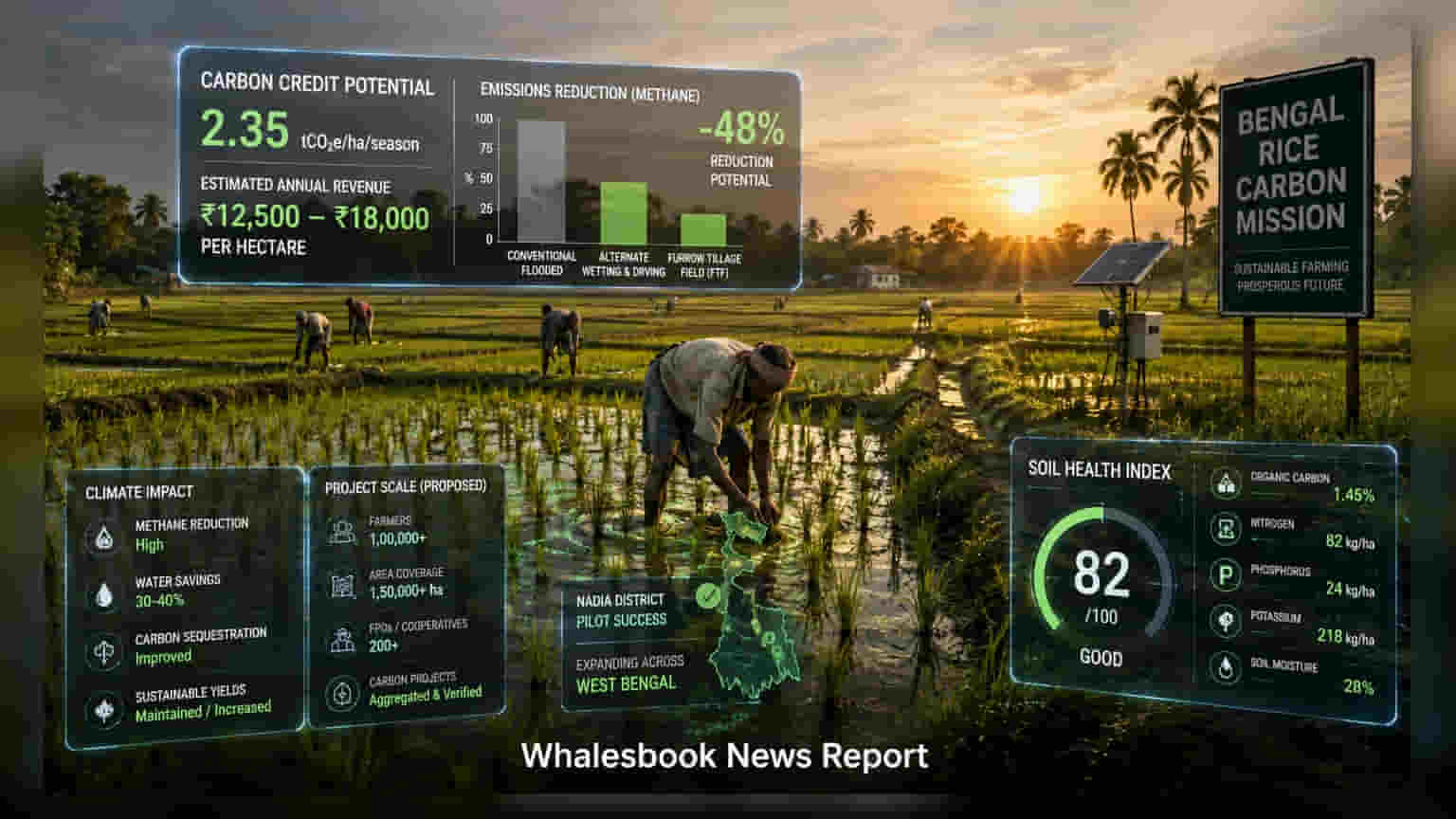
Experts are urging the West Bengal government to launch a 'Rice Carbon Mission' to help farmers earn extra income through carbon credits. This proposal aligns with new national carbon market rules aimed at encouraging sustainable farming practices that reduce methane emissions.
Experts are calling on the West Bengal administration to implement a state-led 'Bengal Rice Carbon Mission.' The initiative aims to transform the state’s massive paddy sector into a revenue-generating asset by using climate-friendly farming techniques that reduce methane emissions. This move would allow farmers to generate and sell carbon credits, providing a potential new income stream alongside their traditional harvest.
The proposal centers on moving away from traditional water-intensive farming toward methods like Alternate Wetting and Drying (AWD) and Furrow Tillage Field (FTF) techniques. These practices help farmers manage water levels in paddy fields, significantly lowering the methane gas released during cultivation. Recent field tests, such as those conducted in West Bengal's Nadia district in July 2026, have shown that these methods can reduce emissions while maintaining or improving crop yields.
This advocacy comes at a time when the national framework for carbon markets is becoming more defined. In June 2026, the Bureau of Energy Efficiency (BEE) published a formal methodology under the Indian Carbon Market. This development is crucial, as it provides a clear set of standards for crediting emission reductions from rice cultivation. Without such standards, it would be difficult for individual small-scale farmers to access global or national carbon markets.
However, shifting to this model involves significant economic and operational hurdles. The primary challenge is the high cost of project development and the complexity of Measurement, Reporting, and Verification (MRV) standards. Carbon markets require strict proof that emissions have been reduced. For an individual farmer with a small plot, the cost of verifying these reductions often exceeds the value of the credits generated. To make this viable, experts argue the state must act as an aggregator, grouping thousands of small plots through Farmer Producer Organisations (FPOs) and cooperatives to create larger, verified carbon projects.
Another critical area for the state to manage is the revenue-sharing model. If this mission is launched, the primary risk for smallholders is the potential for middleman interference. Transparent, contract-based distribution—where a majority of the carbon proceeds go directly to the farmers—is necessary to ensure the project remains equitable. Additionally, infrastructure upgrades, particularly for controlled irrigation, are essential to support the transition from traditional flooding techniques.
Investors and policymakers tracking the agricultural sector should monitor future state budget allocations and government announcements regarding the adoption of these carbon-credit-linked farming practices. The success of such a mission will depend on how effectively the government can bridge the gap between technical standards, local infrastructure, and the individual farmer’s ability to participate.