

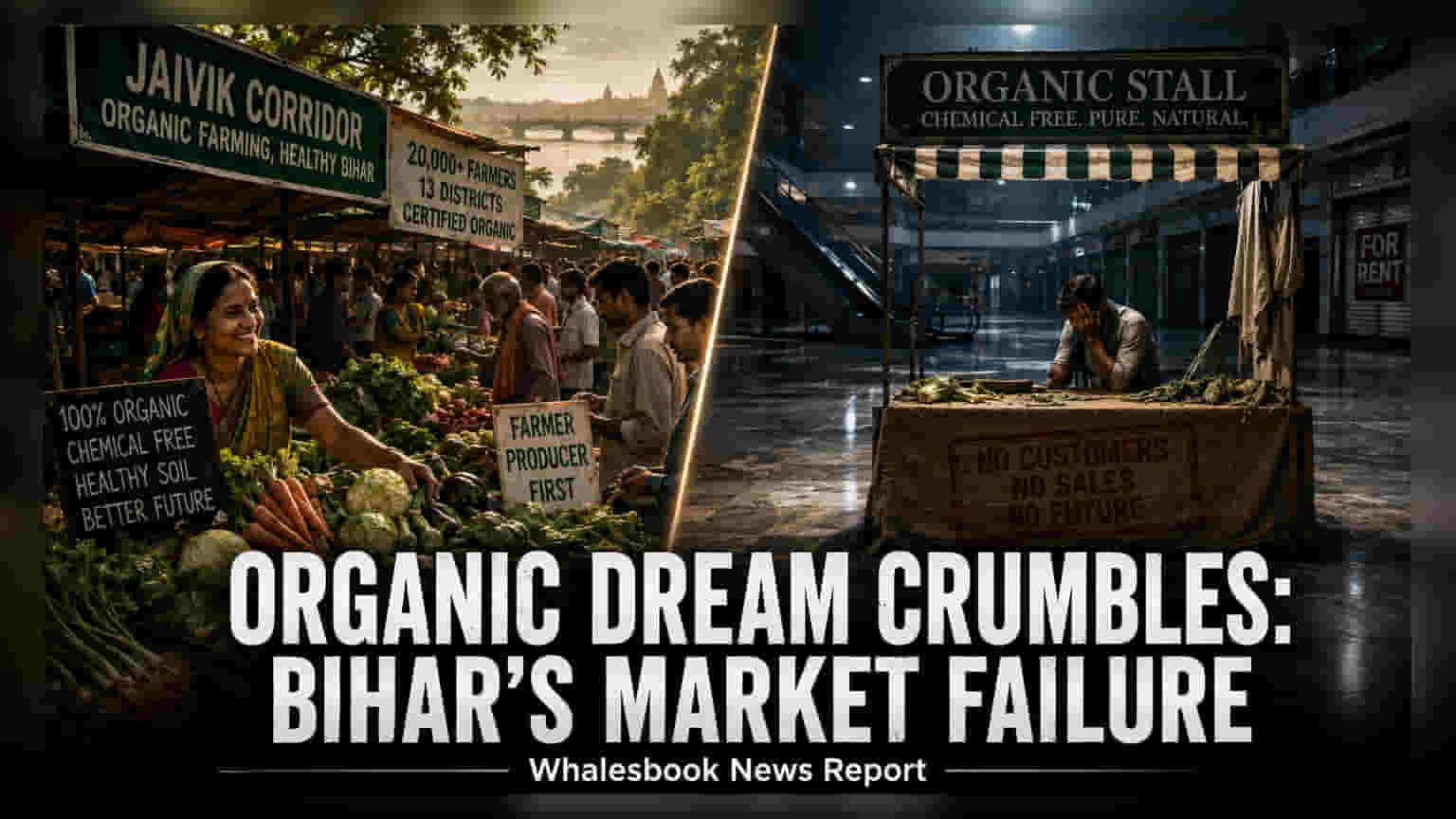
Bihar’s state-led 'Jaivik Corridor' initiative has successfully enrolled over 20,000 farmers into organic farming but struggles to connect them to higher-paying consumers. Despite financial subsidies, farmers face market access gaps that prevent them from earning a price premium. Stakeholders are now exploring direct-to-consumer models like periodic 'haats' to solve these persistent supply chain and demand challenges.
The 'Jaivik Corridor' (Organic Corridor) initiative in Bihar, a major state-run agricultural scheme, has made significant progress in transitioning farming practices along the Ganga river. Launched in 2020 and active through 2025, the project has successfully brought more than 20,000 farmers across 13 districts into certified organic cultivation. While the program provides financial support, including a subsidy of ₹24,500 per acre paid in installments, a critical economic challenge remains: the farmers are often unable to secure a premium price for their produce.
The Challenge of Market Linkage
For organic produce to be profitable, it must command a higher price than conventional crops. This 'premium' covers the often higher cost of organic fertilizers and the certification process. However, in the current setup, farmers frequently sell their produce through traditional channels where chemical-free quality is not always recognized or valued. This lack of differentiation means that despite the effort, the financial gain for the producer remains limited. Without a clear path to reach urban consumers who are willing to pay for quality, the economic incentive for farmers to maintain organic practices may weaken.
Potential Solutions Through Cooperative Models
Experts and policymakers are looking at successful alternative models, such as the 'Gorkha Haat' system. Originally from Kalimpong, this model uses a cooperative structure where local produce is sold in exclusive, farmer-run markets. Crucially, these markets include a risk-sharing mechanism, helping members cover sudden expenses like healthcare or education costs. Bihar already possesses a strong institutional foundation for such structures through Jeevika, the state’s rural livelihoods mission. Jeevika has mobilized millions of households into self-help groups and cluster-level federations. Integrating this existing network with a new, periodic market system could potentially bridge the gap between rural supply and urban demand.
The Role of Consumer Engagement
Beyond just setting up markets, there is a recognized need to build demand through 'storytelling.' The recent Himalayan Orange Festival in Patna illustrated this clearly. When farmers directly engaged with consumers—sharing stories about their mountain orchards, labor, and farming methods—the buyers showed a greater willingness to pay a premium. This suggests that a marketplace alone is not enough; it requires an active, narrative-driven approach to justify higher prices for organic goods.
Risks and Future Monitorables
Several structural risks continue to affect the project's success. High input costs for NPOP-certified organic fertilizers can sometimes exceed the benefits provided by government grants. Additionally, the lack of sufficient cold chain and storage infrastructure means that produce often has to be sold quickly, limiting the farmer's bargaining power. Investors and agricultural stakeholders may track whether the Agriculture Department and the Jeevika network successfully launch pilot 'haats' in cities like Patna, Bhagalpur, and Vaishali. The next critical update will be the development of these urban-focused market linkages, which are essential for ensuring that organic farming remains a sustainable and profitable livelihood for the state's farmers.