

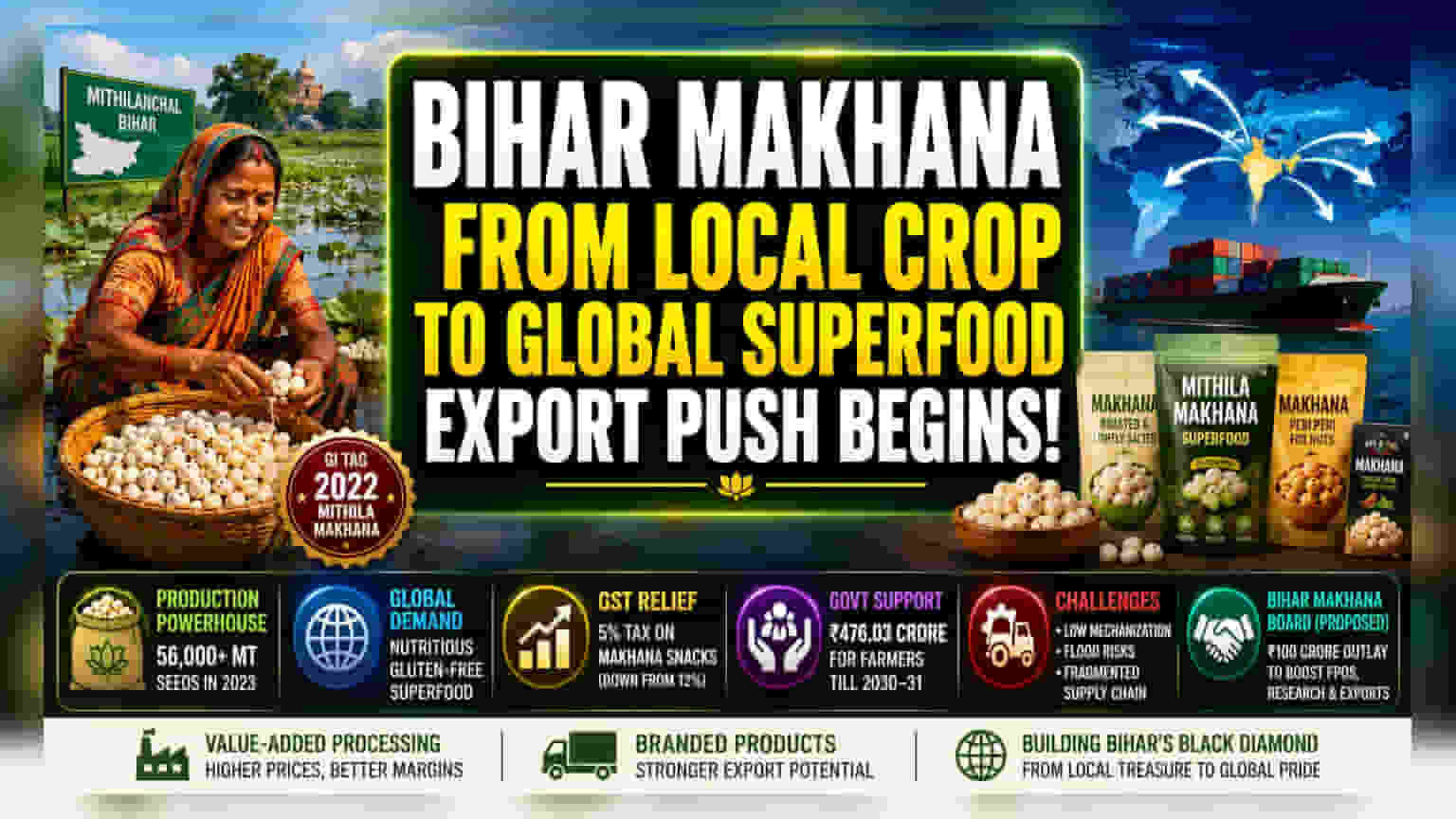
Bihar produces the vast majority of India’s makhana, yet most of it stays within domestic markets. With a new push to increase exports, policymakers are focusing on processing infrastructure and a proposed Makhana Board. The recent reduction in GST to 5% provides a cost advantage for processors, potentially signaling a shift toward more value-added exports.
What Happened
Bihar, which accounts for the vast majority of India's makhana (fox nut) production, is working to move beyond local consumption and tap into the global export market. Often called the "black diamond" of the region, this crop is grown extensively in the wetlands of northern Bihar, particularly in the Mithilanchal area. Despite the region producing over 56,000 metric tonnes of seeds in 2023, the industry remains largely unorganized, relying on traditional farming and harvesting methods that are labor-intensive.
The Shift Toward Value-Added Exports
For years, makhana was seen primarily as a local snack. However, its nutritional profile—high in protein and fiber, gluten-free, and low in fat—has made it a sought-after superfood in international markets. The 2022 Geographical Indication (GI) tag for Mithila Makhana was a major step in branding the product, helping distinguish it from lower-quality varieties. Policymakers are now aiming to move the industry from selling raw seeds to exporting branded, processed products, which generally fetch higher prices and provide better margins for the entire supply chain.
GST Changes And Policy Support
The government has introduced several measures to make the industry more competitive. A significant change is the GST Council's reduction of tax on makhana-based snacks to 5% from 12%. For processors, this effectively lowers the cost structure by roughly 6-7%, which can improve profit margins or allow for more competitive pricing in the global market. Furthermore, the Union government has set aside ₹476.03 crore in support for small and marginal farmers, covering the period up to 2030-31, aimed at improving livelihood stability in the region.
Challenges In Scaling Up
While the export potential is high, the industry faces structural hurdles. The primary challenge is the lack of mechanization; traditional hand-harvesting is slow and limits the ability to scale up quickly. Additionally, the Mithilanchal region is flood-prone, which creates uncertainty in crop output and quality from year to year. The supply chain is also fragmented, with many small farming families lacking direct access to international buyers. The proposed Bihar Makhana Board, with a suggested outlay of ₹100 crore, is envisioned to address these gaps by supporting Farmer Producer Organizations (FPOs), research, and building formal market linkages.
The Investment And Business Perspective
For those observing the agro-processing sector, the professionalization of the makhana industry is a monitorable trend. Increased formalization could lead to more stable supply chains for snack companies that use makhana as a key ingredient. If the industry can successfully standardize processing and improve quality control, it could open the door for more organized, large-scale players to enter the space. Currently, however, the industry is still in the early stages of transitioning from a localized, informal market to an export-oriented sector.
What To Watch Next
The key factor to track will be the progress of the proposed Bihar Makhana Board. If established, it could serve as a central point for coordinating research, branding, and export logistics. Investors and observers should also monitor the development of decentralized processing facilities in the region, which are essential to reducing waste and improving the shelf life of processed makhana for the export market.