 Whalesbook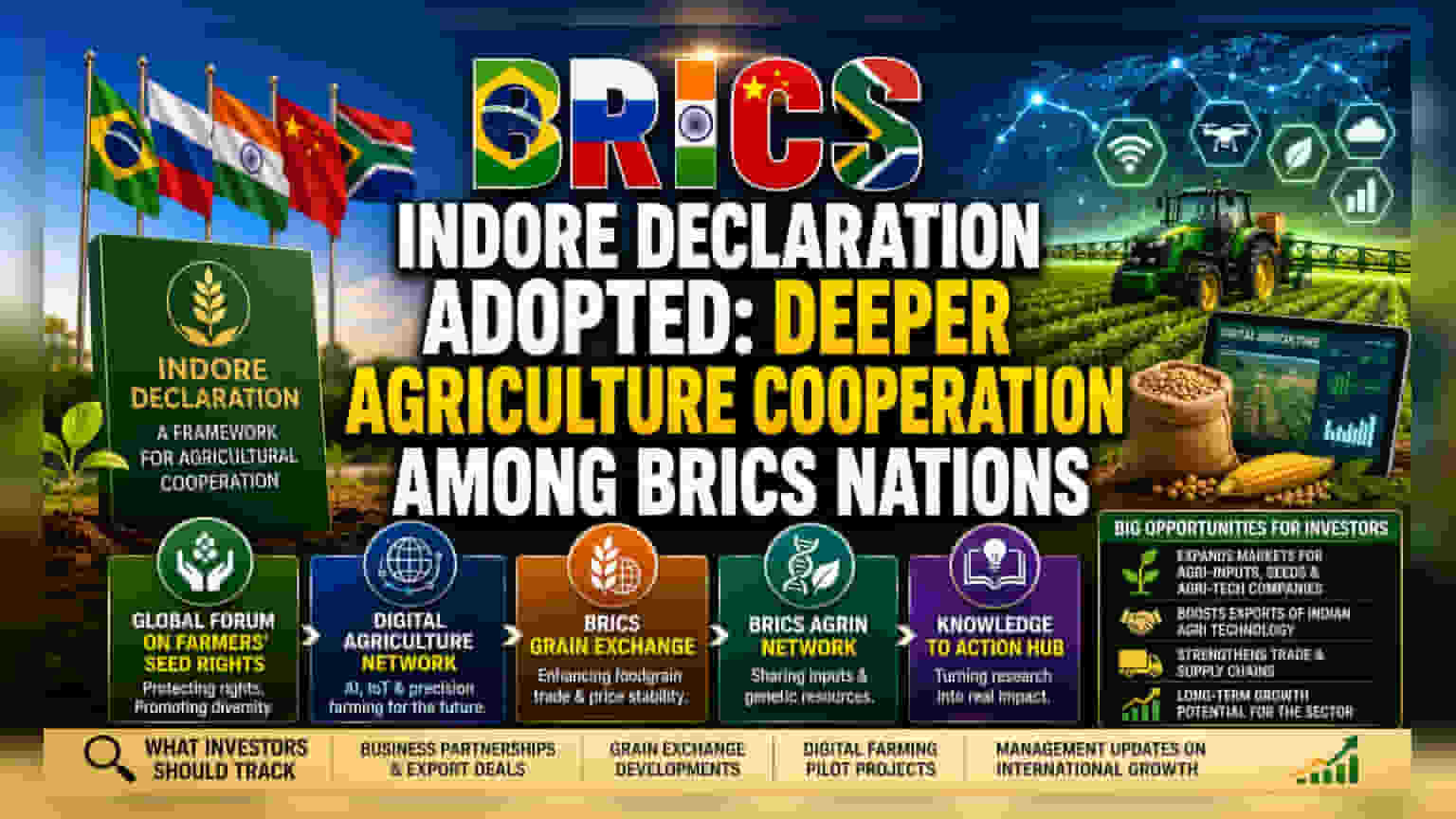


BRICS nations have signed the 'Indore Declaration' to boost agriculture, seed rights, and digital farming. With India leading these initiatives, the move could create opportunities for Indian agri-tech, seed, and fertilizer firms to expand their footprint across member countries. Investors may watch how companies in these sectors leverage these new cross-border frameworks for growth.
What Happened
BRICS nations have officially adopted the 'Indore Declaration' following a five-day summit of agriculture ministers and officials. This agreement establishes a framework for deeper agricultural cooperation among member countries. As part of this, India will lead several key initiatives, including a global forum on farmers' seed rights and a digital agriculture network. The declaration also aims to set up a 'BRICS Grain Exchange' to improve foodgrain trade, create a 'BRICS AGRIN Network' for input and genetic resource sharing, and build a 'Knowledge to Action Hub' to deliver research outcomes to farmers.
Why This Matters For Investors
This policy-level shift suggests potential long-term benefits for the Indian agricultural sector, particularly for companies focused on agri-inputs, seeds, and digital farming technology. By facilitating the exchange of best practices, genetic resources, and digital solutions, this framework could lower barriers for Indian companies looking to export their agricultural technology, hybrid seeds, and precision farming tools to other BRICS nations. For investors, the significance lies in the potential for these companies to expand their total addressable market beyond India’s borders, supported by government-backed cooperation channels.
The Digital and Seed Push
The focus on 'Digital Agriculture'—specifically the integration of AI, IoT, and precision farming—is a major growth area. With institutions like IIT Delhi leading coordination, there is a clear push to modernize farming techniques. Companies involved in the agri-tech space, which provide farm management software, sensors, and data analytics, could find new business avenues as these technologies are promoted and adopted across the alliance. Similarly, the 'Global Forum on Farmers' Rights in Seed Systems' emphasizes the value of traditional and improved seed varieties, which may support growth for seed-tech companies that invest in high-yield, climate-resilient varieties.
The Grain Exchange Proposal
The proposed 'BRICS Grain Exchange' is designed to strengthen supply chains and trade in foodgrains. If fully operationalized, this could lead to more stable trade routes and transparent pricing mechanisms among the member countries. For commodity trading firms, logistics providers, and large-scale grain processors, a more integrated trade network could reduce volatility and open up new export or import corridors. Investors in the logistics and commodity trading space may watch for further announcements regarding the exchange's structure and regulatory framework.
What Could Go Wrong
While the scope for cooperation is broad, execution remains the primary risk. Aligning agricultural policies, trade standards, and regulatory requirements across diverse nations is complex and historically slow. There is a risk of delays in implementation due to differing national interests, geopolitical tensions, or bureaucratic hurdles. Additionally, any new trade frameworks must navigate existing international commitments. For investors, it is important to remember that these are inter-governmental agreements; the translation of these policies into actual revenue growth for private companies depends on the specific trade deals and business partnerships that follow.
What Investors Should Track
Investors may monitor the progress of these initiatives over the coming months and years. Key monitorables include specific business partnerships or export deals that emerge from the AGRIN Network, updates on the operational status of the Grain Exchange, and any government-led pilot projects for digital farming that involve private sector participation. Furthermore, tracking management commentary from companies in the seed, fertilizer, and agri-tech sectors will be essential to understand if and how these policy initiatives are positively impacting their international order books and expansion strategies.