 Whalesbook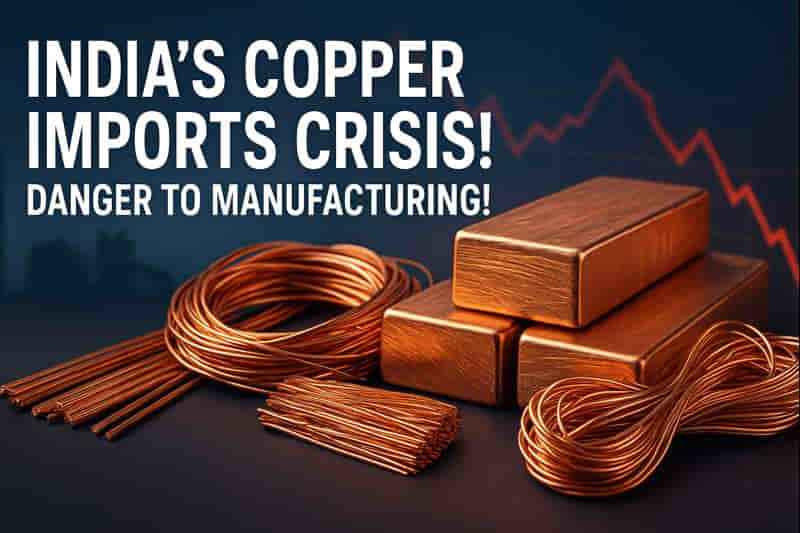
India's Copper Industry Faces Crisis Amidst Surge in Duty-Free Imports
The Indian Primary Copper Producers Association (IPCPA) has sounded a grave alarm over the state of the nation's copper manufacturing sector, stating that a significant influx of cheap, zero-duty copper imports is inflicting severe damage on domestic producers. The association highlights that substantial investments, exceeding ₹20,000 crore, made to achieve self-sufficiency in copper production, are now at risk. IPCPA is urging the government for immediate intervention through safeguard duties and quantitative restrictions on these inbound shipments.
The Core Issue: Free Trade Agreements and Duty-Free Imports
The crux of the problem, according to IPCPA, lies in the provisions of various Free Trade Agreements (FTAs) that allow copper products to enter India with minimal or no customs duties. This influx is directly undercutting domestic smelting and refining operations. IPCPA specifically pointed out the India-UAE Comprehensive Economic Partnership Agreement (CEPA), under which import duties on copper wire rods are slated to fall to a mere one percent by fiscal year 2026 and are expected to be completely eliminated by fiscal year 2027.
Furthermore, concerns were raised about an inflated Tariff Rate Quota (TRQ) mechanism within the India-UAE CEPA, set at 85,000 tonnes per annum (KTPA) instead of the intended 29 KTPA. This inflated quota has reportedly triggered a staggering 340 percent surge in copper imports from the UAE between FY22 and FY26. IPCPA is demanding that this TRQ be corrected and capped at its original, lower level.
Unfair Competition from ASEAN and Indonesia
The association also highlighted issues with the India-ASEAN CEPA. A cumulative value-addition rule within this agreement allows Indonesian copper cathodes, after minimal processing in countries like Thailand, Malaysia, or Vietnam, to be imported into India duty-free. This loophole has reportedly driven a significant increase in imports, with copper wire imports rising by 66 percent and copper tube imports by 103 percent from 2020 to 2024. This situation is exacerbated by Indonesia's substantial expansion in smelting capacity and Chinese investments in ASEAN copper operations, creating an uneven playing field for Indian manufacturers. IPCPA has called for copper wires, tubes, and foils to be added to the exclusion list during the current FTA review.
Financial Implications for the Sector
The global copper smelting industry is currently experiencing severe economic distress. A primary revenue source for the sector, Treatment and Refining Charges (TC/RC), has seen a drastic collapse of 80 percent. Projections indicate that TC/RC levels could fall to zero by 2026, rendering smelting and refining operations increasingly unviable for Indian producers. This precarious financial situation is compounded by the continuous stream of zero-duty imports from the UAE, ASEAN, and Japan, which are displacing domestic production and further straining the industry's profitability.
Demands for Government Intervention
In light of these critical challenges, the copper industry, represented by IPCPA, is seeking urgent government intervention. Their primary demands include the imposition of an additional three percent safeguard duty on imports of copper cathode, rod, wire, and tube, regardless of FTA status. They also request the implementation of quantitative restrictions on imports to effectively safeguard the domestic copper industry from the onslaught of cheap foreign products.
Impact
This news could significantly impact Indian companies involved in copper smelting, refining, and downstream manufacturing. If government interventions are not forthcoming, these companies may face further financial strain, reduced production, and potential closures, leading to job losses and reduced domestic capacity. Conversely, successful intervention could stabilize the market and protect domestic investments.
Impact rating: 7/10
Difficult Terms Explained
- Free Trade Agreement (FTA): An agreement between two or more countries to reduce or eliminate barriers to trade and investment among them.
- Safeguard Duty: An import duty imposed by a country on specific goods to protect domestic industries from a sudden surge of imports that are causing or threatening to cause serious injury.
- Quantitative Restrictions (QR): Limits on the quantity of a specific good that can be imported into a country over a certain period.
- Smelting: A process of applying heat to ore or concentrate in order to comminute or drive off volatile impurities so that a molten metal may be produced.
- Refining: The process of purifying a crude metal.
- Tariff Rate Quota (TRQ): A trade mechanism that allows a specified quantity of a product to be imported at a lower tariff rate, while quantities exceeding this limit are subject to a higher tariff rate.
- Cumulative Value Addition: A rule often found in trade agreements requiring a certain percentage of a product's value to be added within the signatory countries to qualify for preferential tariff treatment.
- TC/RC (Treatment and Refining Charges): Fees paid by a copper concentrate producer to a smelter/refiner for processing the concentrate into refined copper metal.