

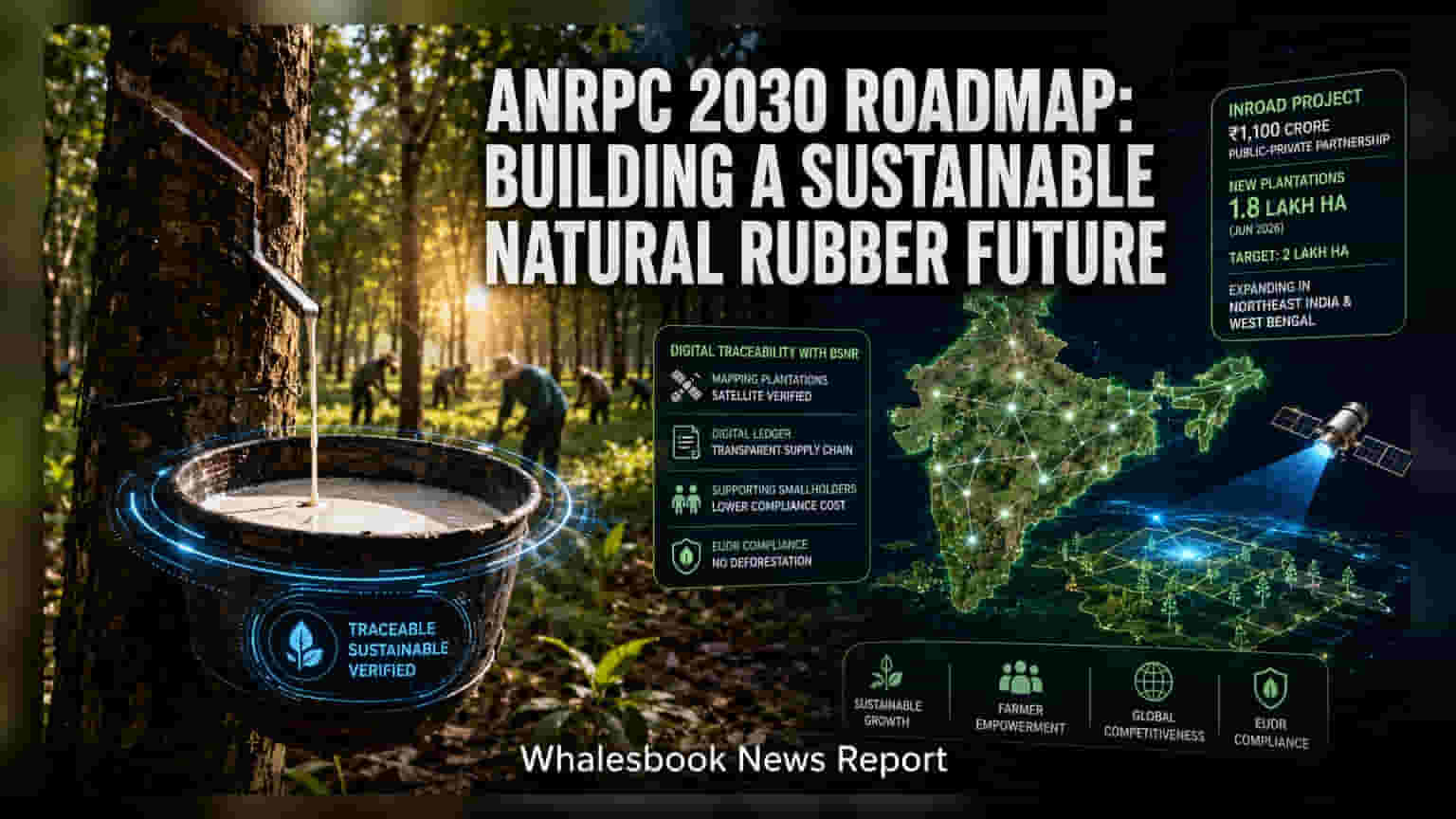
The Association of Natural Rubber Producing Countries (ANRPC) has launched a 2030 strategy to improve supply chain transparency and meet strict EU environmental rules. Backed by India's ₹1,100 crore INROAD project, the plan aims to stabilize production and support small farmers. This shift is critical for major tyre and plantation companies navigating new export barriers and sustainability requirements.
The Association of Natural Rubber Producing Countries (ANRPC) has unveiled a 2030 roadmap aimed at transforming the natural rubber industry. The initiative, announced at the recent Sustainable Natural Rubber Forum in Kochi, focuses on modernizing the sector through digital traceability and support for smallholder farmers. The move comes as global producers face pressure from the European Union Deforestation Regulation (EUDR), which requires strict proof that raw materials are not sourced from deforested land. Without such certification, producers risk being locked out of the European market.
At the center of India's contribution to this goal is the INROAD project, a ₹1,100 crore public-private partnership. This project involves the Rubber Board of India and major domestic tyre manufacturers, including Apollo Tyres, CEAT, JK Tyre, and MRF. The primary objective of INROAD is to increase domestic rubber production by expanding plantation areas in Northeast India and West Bengal. As of mid-2026, the project has successfully facilitated nearly 1.8 lakh hectares of new plantations, moving closer to its target of 2 lakh hectares. This expansion is designed to reduce the domestic industry's reliance on imports, shielding manufacturers from global supply shocks.
To meet the stringent data requirements of international regulators, the industry is increasingly adopting digital tools like the Bharat Sustainable Natural Rubber (BSNR) platform. This system acts as a digital ledger, mapping plantations to verify the origin of the rubber. By automating this process, the industry hopes to lower the cost of compliance for small farmers, who produce the vast majority of the world's rubber but often struggle with the expenses associated with modern documentation and certification.
While this roadmap aims to provide long-term stability, the rubber sector continues to face significant operational risks. Weather patterns, particularly the impact of phenomena like El Niño, can severely affect crop yields, leading to price volatility. Furthermore, natural rubber producers are in constant competition with synthetic rubber manufacturers. Synthetic rubber prices are linked to crude oil costs, meaning that a drop in oil prices can make the synthetic alternative more attractive to tyre makers, putting pressure on natural rubber demand. Additionally, while the industry is investing in modernization, the cost of implementing these new standards across millions of small farms remains a major challenge. Investors may track the project's ability to maintain high-quality supply at competitive costs, as well as the progress of digital platform adoption by farmers to ensure compliance with global environmental regulations.