

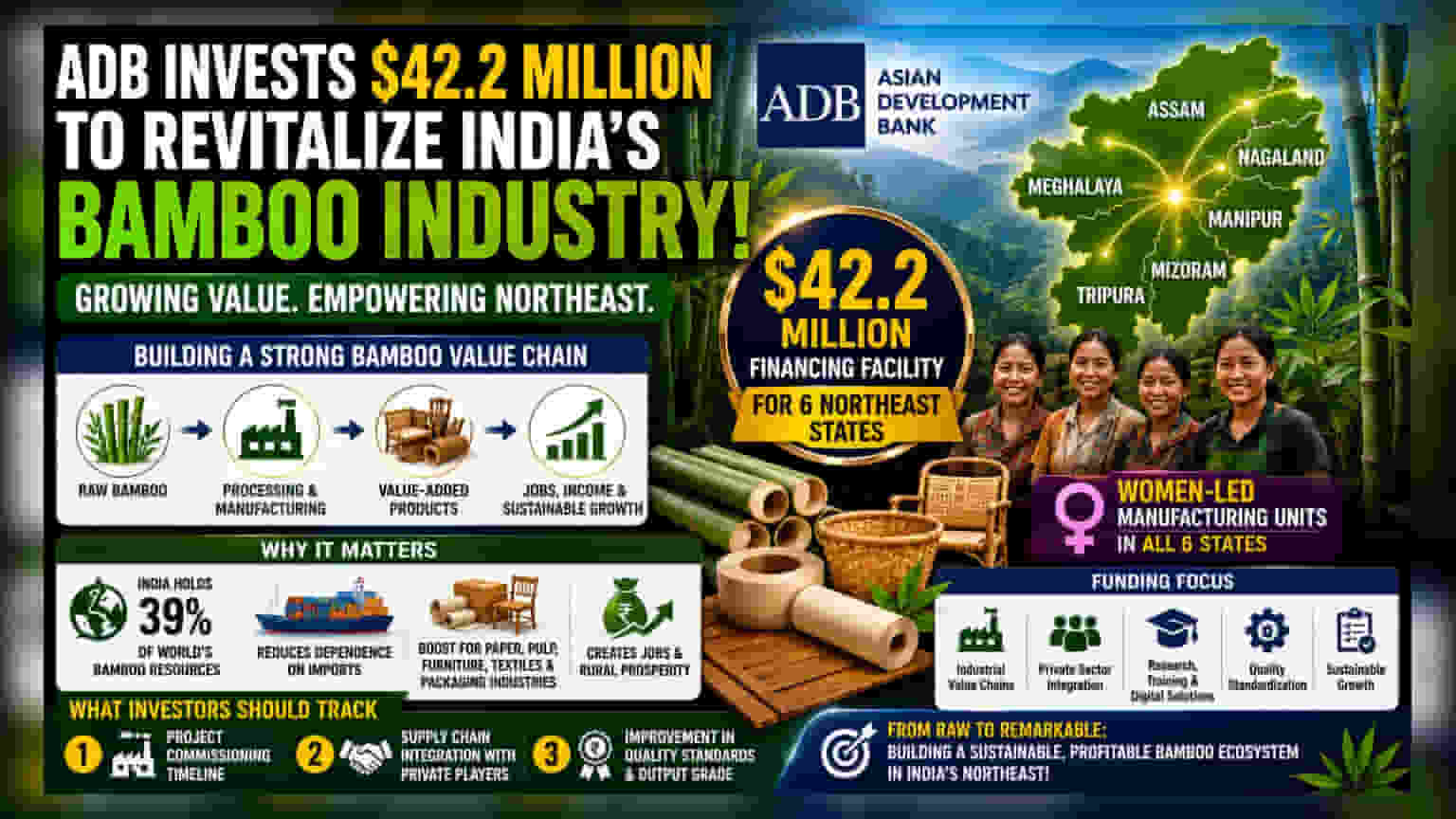
The Asian Development Bank (ADB) has sanctioned a $42.2 million loan to modernize the bamboo sector across six northeastern states. This project aims to transition from raw material supply to manufacturing, targeting import reduction and rural livelihood development. Investors may track how this shapes the long-term supply chain for paper, furniture, and textile companies.
What Happened
The Asian Development Bank (ADB) has approved a $42.2 million financing facility to revitalize the bamboo industry in India's northeastern region. The program covers six states—Assam, Manipur, Meghalaya, Mizoram, Nagaland, and Tripura. This investment focuses on moving beyond basic raw material production and developing formal industrial value chains.
The initiative is designed to increase agricultural productivity and create local manufacturing hubs. A key component of the plan is to establish at least one women-led manufacturing unit in each of the six states. This move is part of a broader push to align local activities with the National Bamboo Mission, shifting the region from being just a supplier of raw bamboo to a producer of value-added goods.
Why The Bamboo Value Chain Matters
India holds roughly 39% of the world’s bamboo resources, yet the economic output from this sector has remained low compared to its potential. Much of the bamboo harvested in India has historically been sold as a raw commodity or used in unorganized cottage industries. Meanwhile, India has relied on imports for processed bamboo products, such as specialized flooring, furniture, and paper pulp, often sourcing these from markets like China and Vietnam.
By focusing on processing and manufacturing, this project aims to create import substitution. If successful, this could stabilize the supply of bamboo-based raw materials for industries like paper and pulp, handicrafts, and emerging sustainable textiles. A more organized domestic supply chain could reduce volatility in raw material costs for listed companies in these sectors.
The Business Strategy
The ADB’s funding is not just for planting; it is for industrialization. The project aims to integrate private sector players into the ecosystem, which is essential for scaling up production. By building capacity at both national and state levels, the program intends to create a bridge between rural cultivators and industrial demand.
The inclusion of digital solutions and research training suggests an attempt to standardize quality, which has historically been a challenge in the Indian bamboo sector. Standardized, high-quality output is a prerequisite for any large-scale industrial adoption, whether in construction, flooring, or packaging materials.
Execution and Logistics Risks
While the objective is to build a robust value chain, investors should be aware of the inherent risks in such large-scale development projects, particularly in the Northeast. The region faces significant logistical hurdles, including difficult topography that can increase transport and supply chain costs.
Furthermore, the bamboo industry is highly fragmented. Consolidating thousands of small, community-based growers to ensure a consistent, high-quality supply of raw material for industrial factories is a complex task. Demand aggregation—ensuring that there are enough buyers for the finished products produced by these new units—will also be critical for the long-term viability of the project. Cost overruns or delays in setting up the manufacturing facilities could also impact the timeline of the expected benefits.
What Investors Should Track
The long-term impact on listed companies remains indirect but worth monitoring. Investors interested in sectors like paper, pulp, and home furnishings may look for updates on:
- Project commissioning: The speed at which the planned manufacturing facilities become operational.
- Supply chain integration: Whether private sector companies begin to source bamboo from these new clusters, potentially lowering their procurement costs.
- Quality standards: Data on whether the initiative successfully improves the grade of bamboo produced for industrial use.
As the project progresses, management commentaries from companies involved in forest-based raw materials or sustainable packaging may offer insights into whether domestic bamboo is becoming a viable alternative to imports.