

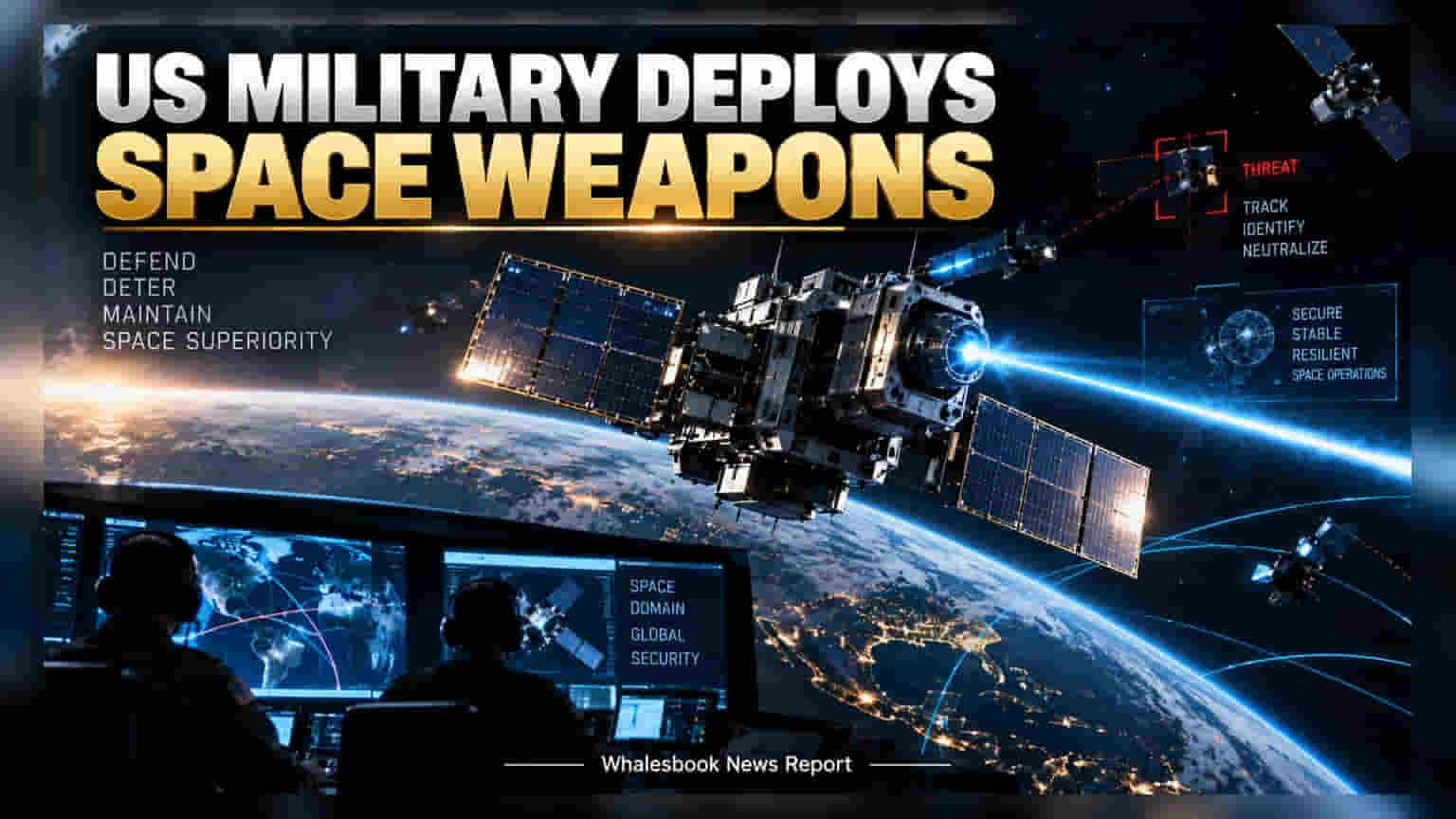
The United States has formally acknowledged deploying offensive space-based weapons to counter threats from rivals. This development marks a shift in global military doctrine, formally designating orbit as an active warfighting domain and raising concerns about international security.
The United States has officially confirmed the deployment of offensive space-based weapons, a move that marks a significant transition in global defense strategy. U.S. Secretary of the Air Force Troy Meink announced the deployment during the Air, Space and Cyber Conference, stating that these capabilities are essential to protect the nation's interests against evolving threats from countries like Russia and China.
Space as a Warfighting Domain
For decades, space was primarily a domain for surveillance, communication, and international scientific cooperation. The U.S. government’s acknowledgment of 'space control weapons' indicates that this perspective has changed. The U.S. Space Force described these new capabilities as having both kinetic and non-kinetic functions, designed to contest the orbital environment if necessary. While specific operational details remain classified, the mission is explicitly stated as defending the Joint Force and maintaining the integrity of U.S. orbital assets.
This shift effectively turns Earth's orbit into a new, active theater of military conflict. Modern global infrastructure, ranging from banking systems to navigation and communication networks, relies heavily on satellite technology. Consequently, the ability of any nation to disrupt or disable these systems in orbit creates a new layer of vulnerability.
Legal Context and Global Risks
The 1967 Outer Space Treaty continues to govern activities in the orbital environment, specifically prohibiting the placement of nuclear weapons or other weapons of mass destruction. The systems confirmed by the U.S. fall outside this classification, as they are conventional military technologies. However, the deployment of such systems introduces significant geopolitical and operational risks.
One primary concern for the international community is the potential for orbital collisions. Any military action involving kinetic weapons—systems designed to physically strike or destroy targets—risks generating massive amounts of space debris. Such debris can remain in orbit for years, endangering civilian, commercial, and government satellites, including those owned by other nations.
Impact on Aerospace and Defense Sectors
For global investors, this announcement highlights a clear acceleration in the space-defense sector. As major powers increase their focus on counter-space technologies, it is likely to influence long-term defense spending, research, and development. While no specific contracts were announced, the doctrine shift suggests that aerospace and defense companies involved in satellite technology, surveillance, and signal processing may see increased demand for security-hardened systems.
Investors tracking the aerospace and defense sector should monitor future government budget allocations and policy updates, as these often dictate the pace of new technological developments. The core uncertainty remains the potential for an 'arms race' in space, where the development of defensive capabilities by one nation triggers a reciprocal, more aggressive response from others, potentially impacting the stability of the global space economy.