 Whalesbook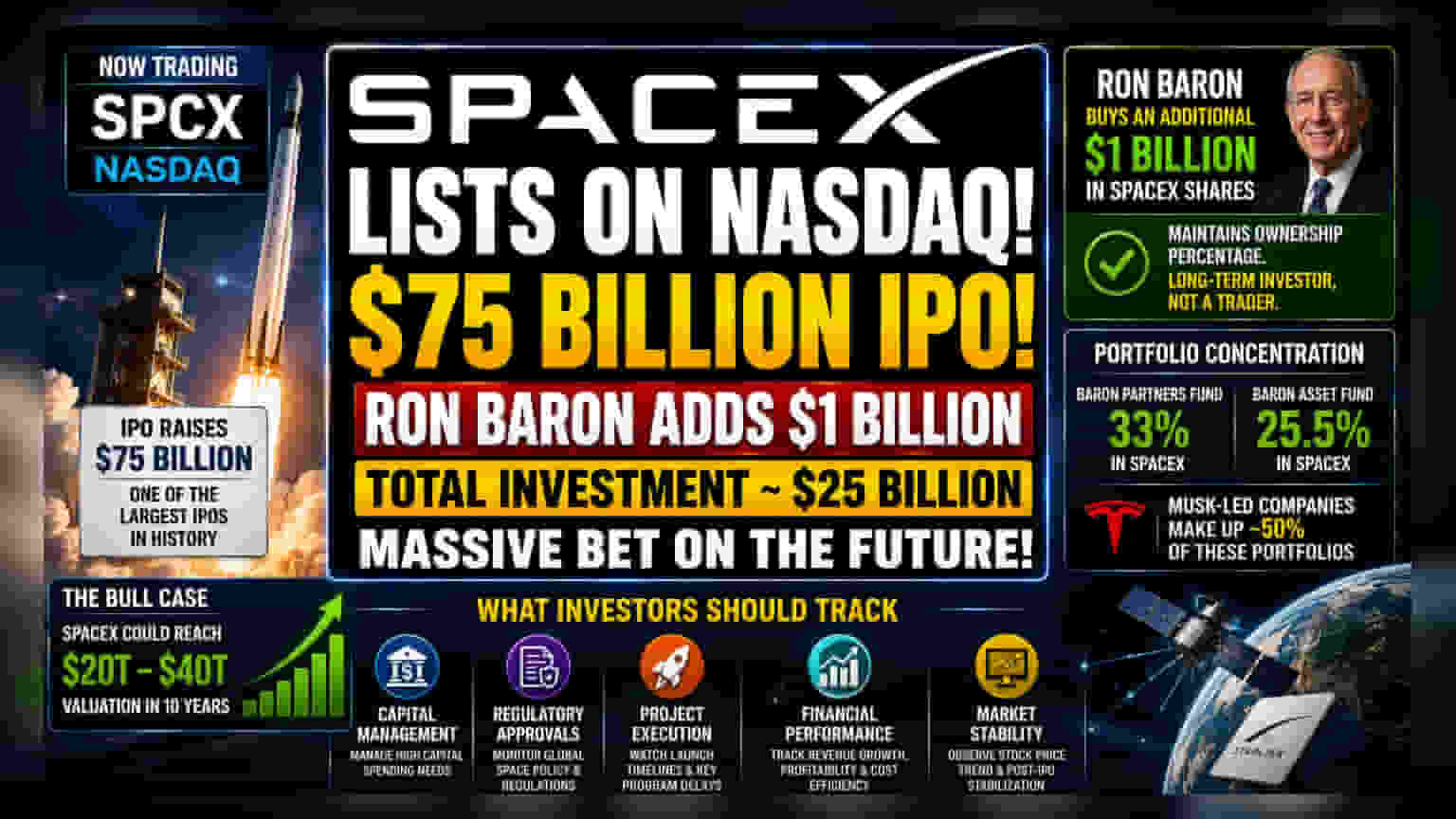


SpaceX has made its stock market debut with a record $75 billion IPO. Billionaire investor Ron Baron invested an extra $1 billion to maintain his ownership stake. While this reflects his long-term confidence in the company, the heavy concentration of SpaceX stock in his portfolios highlights a high-risk, high-reward strategy that investors should carefully evaluate.
What Happened
SpaceX, the space exploration company led by Elon Musk, has officially begun trading on the Nasdaq under the ticker symbol SPCX. The initial public offering (IPO) raised $75 billion, making it one of the largest market debuts in history. During the IPO, billionaire investor Ron Baron purchased an additional $1 billion worth of shares. This transaction brings the total value of Baron Capital’s investment in SpaceX to approximately $25 billion.
The Strategy Behind The Buy
Ron Baron’s decision to increase his investment was driven by a desire to avoid dilution. When a company issues new shares to the public, existing investors see their percentage ownership in the business decrease unless they purchase more shares to keep their stake stable. By investing another $1 billion, Baron was able to maintain his ownership percentage in SpaceX. This confirms that his goal was not short-term trading but rather holding his position as a long-term investor in the business.
Understanding Concentration Risk
For investors, it is important to look at how much of a portfolio is tied to a single company. According to the data, SpaceX accounts for 33% of the Baron Partners Fund and 25.5% of the Baron Asset Fund. Additionally, companies led by Elon Musk, including Tesla, make up about half of these portfolios.
This level of concentration is significant. It means that the performance of these funds is heavily dependent on the success of SpaceX and other Musk-led companies. While this can lead to high returns if the companies perform well, it also introduces substantial risk if the company faces operational delays, regulatory issues, or market corrections. A drop in the stock price of one or two key holdings could significantly impact the entire fund’s value.
The Valuation Question
Ron Baron has expressed a very bullish view, suggesting that SpaceX could reach a valuation of $20 trillion to $40 trillion over the next decade. To put this in perspective, this expectation implies growth far beyond current market standards for any existing company.
Investors must weigh this optimism against the reality of the business. SpaceX operates in a sector that is extremely capital-intensive, meaning it requires massive, constant spending to build rockets and infrastructure. Success depends on long-term project execution, which carries inherent risks such as technical failures, launch delays, and intense global competition. Future profit margins will depend on whether the company can successfully lower costs and scale its satellite and transport businesses as planned.
What Investors Should Track
Investors looking at the broader space sector and SpaceX specifically should monitor several key areas. First, watch the company’s ability to manage its high capital spending needs without needing excessive debt. Second, keep an eye on regulatory approvals and international space policy, which can impact operations. Third, monitor the execution timeline for major projects, as delays in this industry can be costly. Finally, as with any major IPO, observe how the stock price stabilizes over the coming months and whether the company meets its stated production and financial goals.