

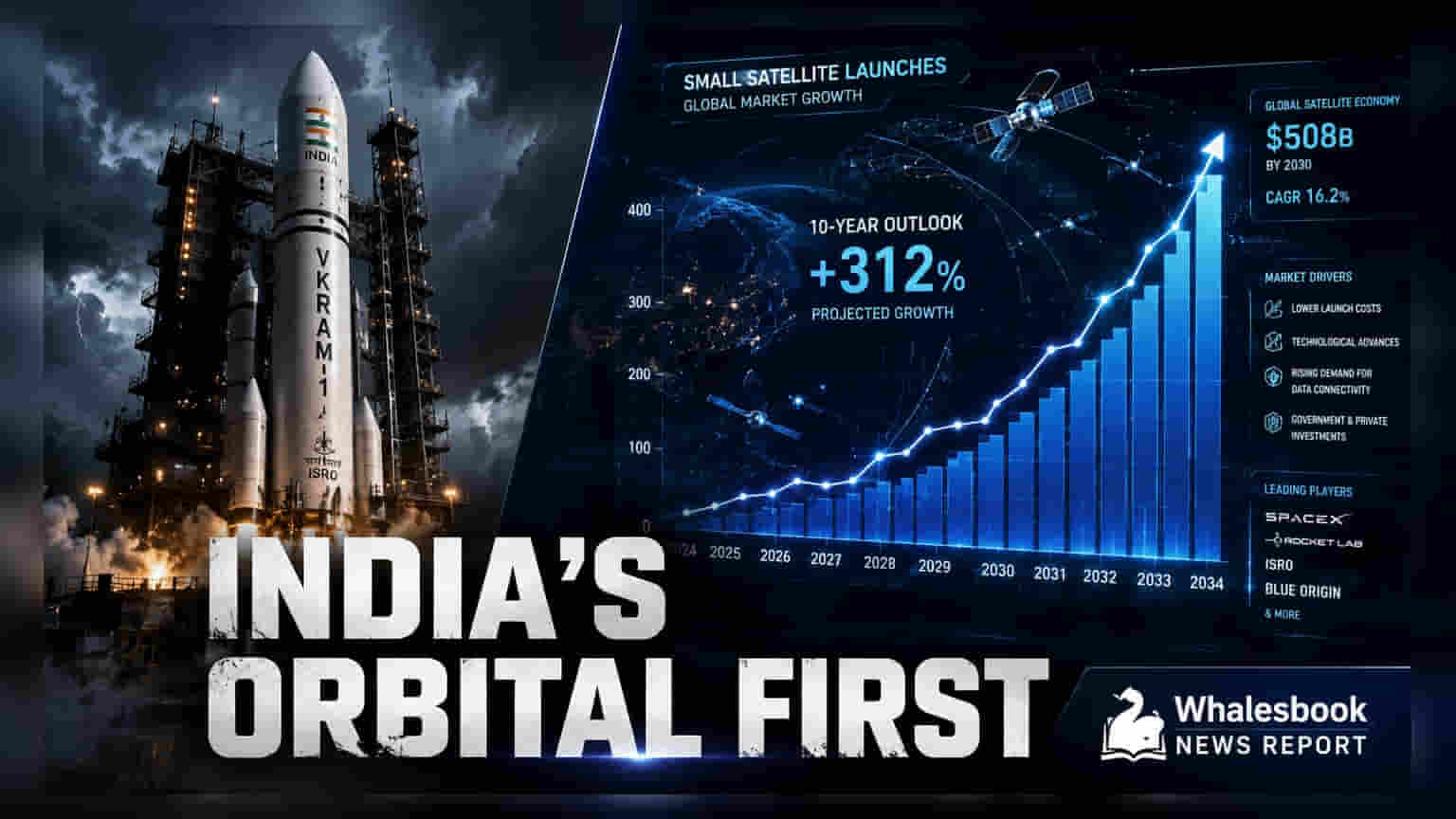
Skyroot Aerospace has announced a July 12–August 4 launch window for 'Mission Aagaman,' aiming to conduct India’s first private orbital rocket launch. The mission will test the Vikram-1 rocket, a key milestone for the company following its recent unicorn status, and highlights the rapid expansion of India's commercial space sector.
What Happened
Skyroot Aerospace is preparing to conduct its maiden orbital mission, dubbed 'Mission Aagaman,' from the Satish Dhawan Space Centre in Sriharikota. The Hyderabad-based space-tech startup has scheduled a launch window extending from July 12 to August 4, 2026. This mission marks a pivotal moment for the company, as it seeks to launch the Vikram-1 rocket, which is designed to carry payloads into low Earth orbit. Unlike the company’s previous suborbital test flight, this mission is a full orbital attempt, aiming to validate the rocket's propulsion, guidance, and stage separation systems in a real-world environment.
Why This Matters for the Space Sector
For India’s growing space economy, this launch represents a shift from government-led missions to private-sector capability. Skyroot, which recently achieved unicorn status with a $1.1 billion valuation, is positioning itself as a commercial service provider for the global small satellite market. The success of this mission is crucial for the company to transition from a developmental phase to full-scale commercial operations. It also serves as a test of the broader 'NewSpace' ecosystem in India, which has been facilitated by regulatory reforms and the role of IN-SPACe, the national space promotion agency.
The Business Reality: A Developmental Flight
While the market excitement is high, investors should note that 'Mission Aagaman' is explicitly categorized as a developmental flight. In the aerospace industry, the primary goal of such missions is to gather technical data rather than achieve commercial revenue immediately. A successful lift-off would validate the Vikram-1’s carbon composite structure and 3D-printed engine technology, but the flight is inherently subject to significant execution risks, including technical delays or aborts, which are common in first-time orbital attempts.
The Supply Chain and Investor Angle
While Skyroot itself is a private unicorn and not directly accessible to public market investors, the broader space ecosystem is becoming increasingly relevant for those tracking Indian stocks. Investors often monitor publicly listed defense and manufacturing companies—such as MTAR Technologies, Hindustan Aeronautics Ltd (HAL), and Bharat Electronics Ltd (BEL)—that act as key suppliers or partners in India’s space infrastructure. As startups like Skyroot and their competitor Agnikul Cosmos scale up, their demand for precision components, materials, and testing services can provide a long-term tailwind for the domestic aerospace manufacturing supply chain.
What Investors Should Track
Beyond the launch date, the key monitorable for the space sector is the ability of private players to maintain a high-cadence, cost-effective launch schedule. Investors watching this space should look for updates on launch success, the maturity of the private supply chain, and government policy updates regarding FDI and private participation. The industry is currently in a phase where technical milestones take precedence, and performance on these benchmarks will dictate future confidence in the sector’s long-term commercial viability.