

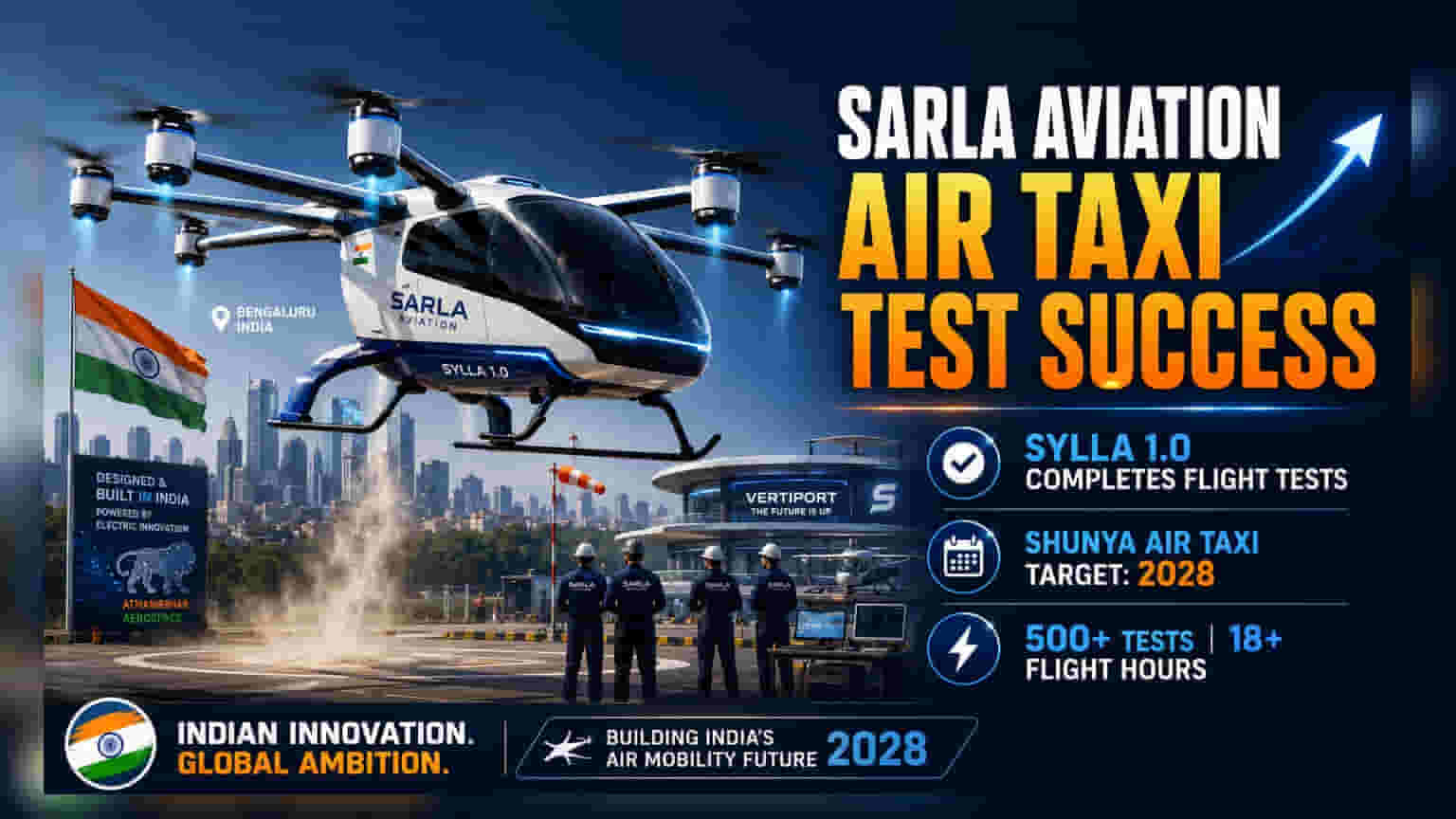
Bengaluru-based Sarla Aviation has successfully completed the flight test campaign for its 700kg-class electric aircraft, Sylla 1.0. This technical milestone, achieved in under 12 months, moves the startup closer to its target of launching the 'Shunya' air taxi service by 2028.
What Happened
Sarla Aviation, a Bengaluru-based aerospace startup, has announced the successful completion of flight tests for its Sylla 1.0 electric aircraft. This is a technical milestone for the company’s ambitious plan to introduce air taxi services, branded as 'Shunya', in India by 2028. The Sylla 1.0 demonstrator, a 700kg-class aircraft, logged over 500 tests and more than 18 hours of flight time. The company validated critical flight operations, including vertical take-off, hovering, and landing, alongside the performance of its 400-volt electric powertrain and distributed propulsion systems.
A Milestone in Indian Aerospace
This flight test campaign is notable because it marks the first time an Indian-designed electric aircraft in the 700kg-class has achieved vertical take-off and flight. The company completed the design, assembly, and testing of the Sylla 1.0 prototype in less than 12 months. By proving that its core flight systems—such as control software, airframe integrity, and battery integration—work under real-world conditions, Sarla Aviation is transitioning from laboratory simulations to actual aircraft-scale validation. This approach is similar to how global leaders in the electric vertical take-off and landing (eVTOL) sector prove their technology before building full-scale, passenger-ready aircraft.
The Long Road Ahead: Regulation and Infrastructure
While the successful flight is a positive technical step, building a viable air taxi business involves significant challenges that extend beyond the aircraft itself. In India, the Advanced Air Mobility (AAM) sector remains in an early stage. The technology must navigate rigorous safety and airworthiness certifications mandated by the Directorate General of Civil Aviation (DGCA). Unlike traditional aviation, eVTOLs require new regulatory frameworks for urban airspace management, noise levels, and battery safety. Additionally, the success of air taxis will depend on infrastructure, specifically 'vertiports'—dedicated take-off and landing sites in congested cities—which do not yet exist at the scale required for commercial operations.
Strategic Backing
Sarla Aviation is a private startup and is not listed on the stock exchanges. However, it has attracted significant interest from high-profile investors, including Accel and Nikhil Kamath, as well as strategic interest from IndiGo Ventures. These backers provide the company with the capital and credibility needed to pursue long-term R&D in a highly capital-intensive industry. The company has publicly stated its intent to use the data from Sylla 1.0 to develop the Sylla 2.0, which will aim to achieve the transition from hover to wing-borne flight, a crucial maneuver for efficient long-range travel.
What Investors Should Track Next
Because Sarla Aviation is a private entity, there is no direct way for public market investors to participate in this specific company. However, for those interested in the broader Aerospace and Defense sector in India, the progress of companies like this serves as a barometer for the ecosystem. Key developments to monitor include updates on India’s national regulatory framework for urban air mobility, the establishment of certification standards by the DGCA, and the development of commercial vertiport infrastructure. Any policy movement in these areas will directly impact how quickly the eVTOL industry can move from testing to commercial reality.