 Whalesbook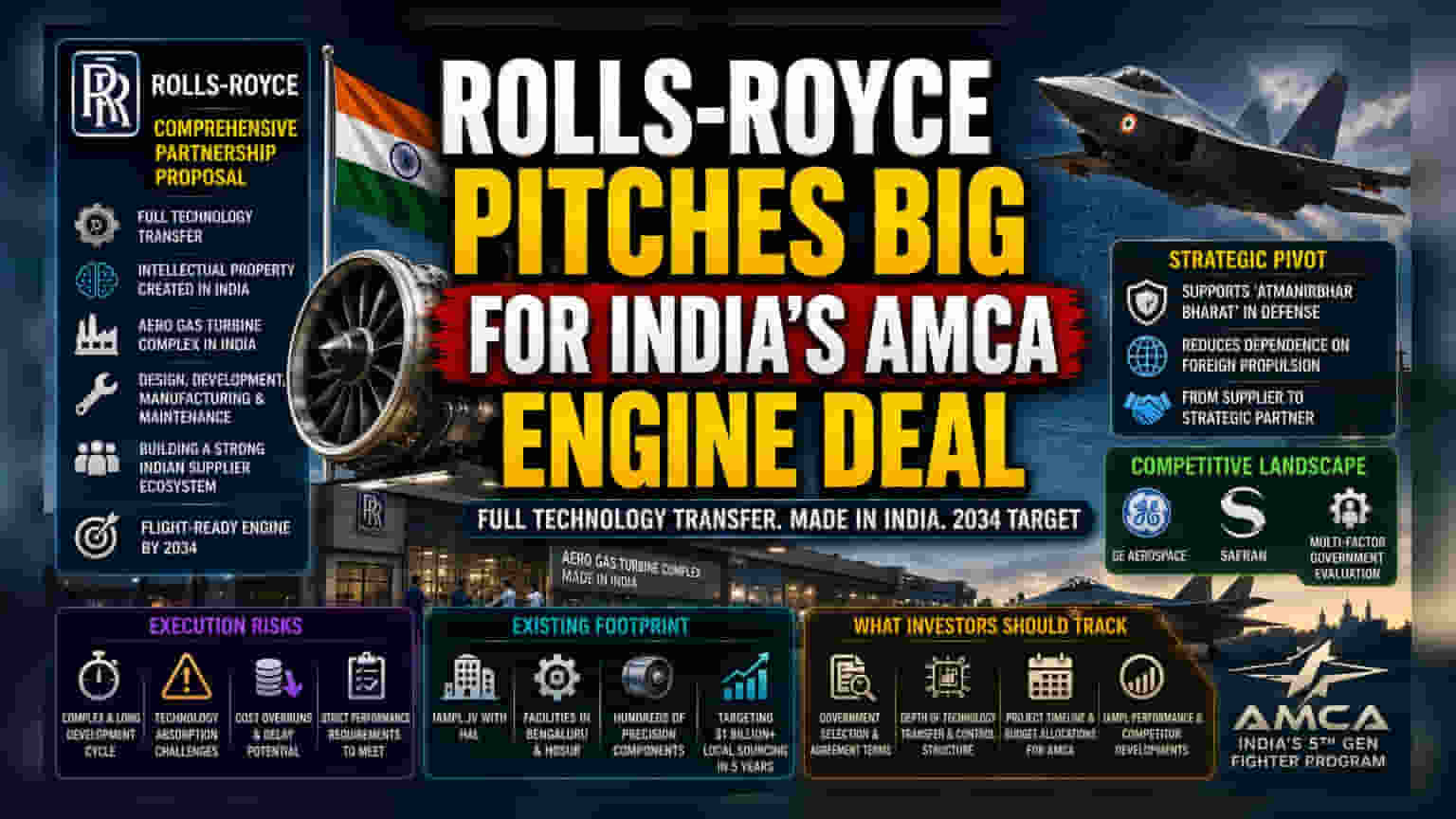


Rolls-Royce has promised full technology transfer and local intellectual property development for India’s Advanced Medium Combat Aircraft (AMCA) engine program. This move is a strategic bid to secure a high-value defense contract while deepening the company's manufacturing footprint in India. For investors, this marks a shift in how global defense firms are approaching the Indian market. Success remains subject to stiff competition from other global players, complex technological execution, and long-term project timelines, which investors should monitor closely alongside the company's broader expansion goals in the region.
What Happened
Rolls-Royce has formally proposed a comprehensive partnership for the engine requirements of India's Advanced Medium Combat Aircraft (AMCA) program. The proposal is notable for its promise of full technology transfer and the creation of intellectual property within India. Rather than acting merely as a supplier of engines, the company is aiming to build an "aero gas turbine complex" in the country. This plan includes local design, development, manufacturing, and long-term maintenance support, aiming to foster a broader network of Indian suppliers. The company has set an ambitious target to have a flight-ready engine by 2034.
The Strategic Pivot
This offer represents a significant shift in how global aerospace firms are engaging with the Indian defense sector. By offering full technology transfer, Rolls-Royce is aligning itself with India’s push for defense self-reliance, often referred to as 'Atmanirbhar Bharat.' The strategic goal is to reduce India’s reliance on foreign propulsion systems for its next-generation fighter jets. If the proposal is accepted, it could significantly alter the company's revenue and operational model in India, moving from a component supplier to an integral partner in one of the country's most complex defense programs.
The Competitive Landscape
Securing the AMCA engine contract is highly competitive. The jet engine market for advanced fighter aircraft is dominated by a few global players who have historically been protective of their technology. Companies like GE Aerospace and Safran are also active in the Indian market, and they have historically participated in various defense discussions. Investors should note that the Indian government is weighing these offers based on multiple factors, including the depth of technology transfer, cost, and the ability of the partner to integrate with local agencies like the Gas Turbine Research Establishment (GTRE). This makes the contract win a significant but uncertain catalyst for the company.
The Execution Risk
While the offer is attractive, developing a fighter jet engine is one of the most complex tasks in aerospace engineering. There is significant risk involved in transferring such sensitive and difficult-to-master technology. Even with a committed partner, the absorption of this technology by local industrial players takes time. Historically, defense projects of this magnitude often face challenges related to cost overruns, delays in development, and the difficulty of meeting strict performance requirements. Investors should view the 2034 timeline with caution, as defense projects frequently encounter unforeseen technical hurdles that can push back commissioning dates.
Existing Footprint
Rolls-Royce is not new to the Indian manufacturing landscape. Through its joint venture with Hindustan Aeronautics Limited (HAL), known as International Aerospace Manufacturing Pvt Ltd (IAMPL), the company already operates facilities in Bengaluru and Hosur. These facilities produce hundreds of precision aerospace components. The company has publicly stated its intent to increase sourcing from India, with a target of reaching over $1 billion in local sourcing within the next five years. This existing infrastructure provides a foundation, but scaling it to support the highly complex requirements of a fifth-generation fighter engine is a much larger leap.
What Investors Should Track
Investors should monitor the formal selection process by the Indian government. The key indicator will be the terms of the final agreement, particularly regarding the actual depth of technology transfer and how much control remains with the domestic partners versus the foreign entity. Additionally, tracking the performance of the existing IAMPL joint venture will provide insights into the company's ability to execute on its local manufacturing targets. Changes in the project timeline, government budget allocations for the AMCA program, and the progress of competitors will also be essential updates to watch.