 Whalesbook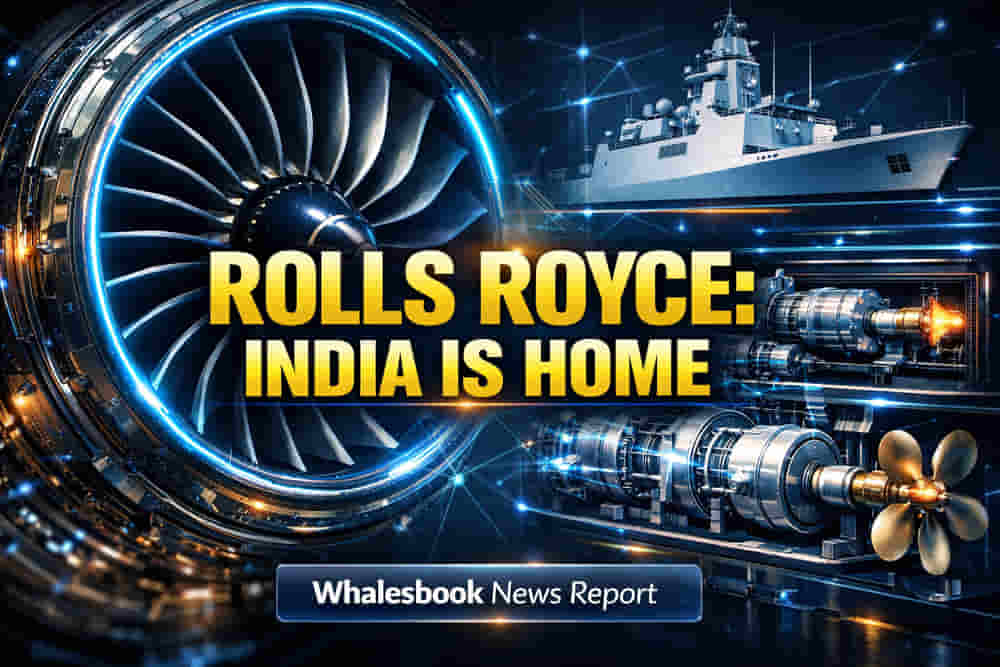


British engineering powerhouse Rolls-Royce has declared its ambition to establish India as its third "home market" outside the United Kingdom. This signals a major strategic shift and a commitment to substantial investment in the country's burgeoning defense and advanced engineering sectors. This move positions India alongside the United States and Germany as a critical hub for the company's global operations, with a sharp focus on future technologies including next-generation jet engines and naval propulsion systems.
The Core Issue
- Rolls-Royce is looking to deeply integrate its operations within India, with Sashi Mukundan, Executive Vice President of Rolls-Royce India, articulating the vision for significant capital investments.
- This strategy is driven by India's clear policy direction, expanding industrial ecosystem, and its growing emphasis on indigenous defense production, making it an attractive market for the company.
Future Outlook
- A primary focus for Rolls-Royce in India is the development of a next-generation aero engine crucial for India's Advanced Medium Combat Aircraft (AMCA) program.
- The company believes it possesses the unique capability to "marinize" its aero engines, adapting them for naval propulsion, which could significantly bolster the Indian Navy's capabilities. This technological synergy allows for shared supply chains, making the development of advanced marine propulsion more viable.
Financial Implications
- While specific investment figures were not disclosed, Mukundan indicated that the planned investment would be substantial and noticeable.
- The aim is not just market access but the development of an entire value chain and ecosystem across sectors where Rolls-Royce operates, including forging partnerships through two Memoranda of Understanding (MoUs) with Indian defense public sector undertakings (PSUs) for manufacturing engines for Arjun tanks and future combat vehicles.
Official Statements and Responses
- Prime Minister Narendra Modi was informed of India's critical future role for Rolls-Royce during a previous business roundtable.
- Mukundan emphasized that India offers a unique convergence of scale, policy clarity, and a robust industrial push, making it an ideal partner for the company's long-term strategic vision, aiming for joint ownership of intellectual property rights and co-design capabilities.
Impact
- This strategic alignment could catalyze India's defense manufacturing prowess, attract further foreign direct investment in high-tech sectors, and foster a more sophisticated indigenous industrial ecosystem.
- It positions India as a potential global supplier for advanced engineering components and systems, enhancing national security and reducing reliance on foreign suppliers for critical defense technologies.
- Impact Rating: 8/10
Difficult Terms Explained
- Home Market: Refers to countries where a company has significant presence, including manufacturing, R&D, and a substantial customer base, allowing for deep integration and strategic control.
- Naval Propulsion: The system used to move ships and other naval vessels, often involving complex engines and power transmission.
- Marinize: The process of adapting an aero engine (designed for aircraft) for use in marine applications (ships, boats).
- Aero Engine Core: The central part of a jet engine that generates most of the thrust.
- MoU (Memorandum of Understanding): A preliminary, non-binding agreement that outlines the terms and understanding between two or more parties.
- PSUs (Public Sector Undertakings): Companies owned wholly or partly by the government.
- AMCA (Advanced Medium Combat Aircraft): An Indian program to develop a fifth-generation stealth fighter jet.
- Intellectual Property (IP) Rights: Legal rights that protect creations of the mind, such as inventions, designs, and brand names.