

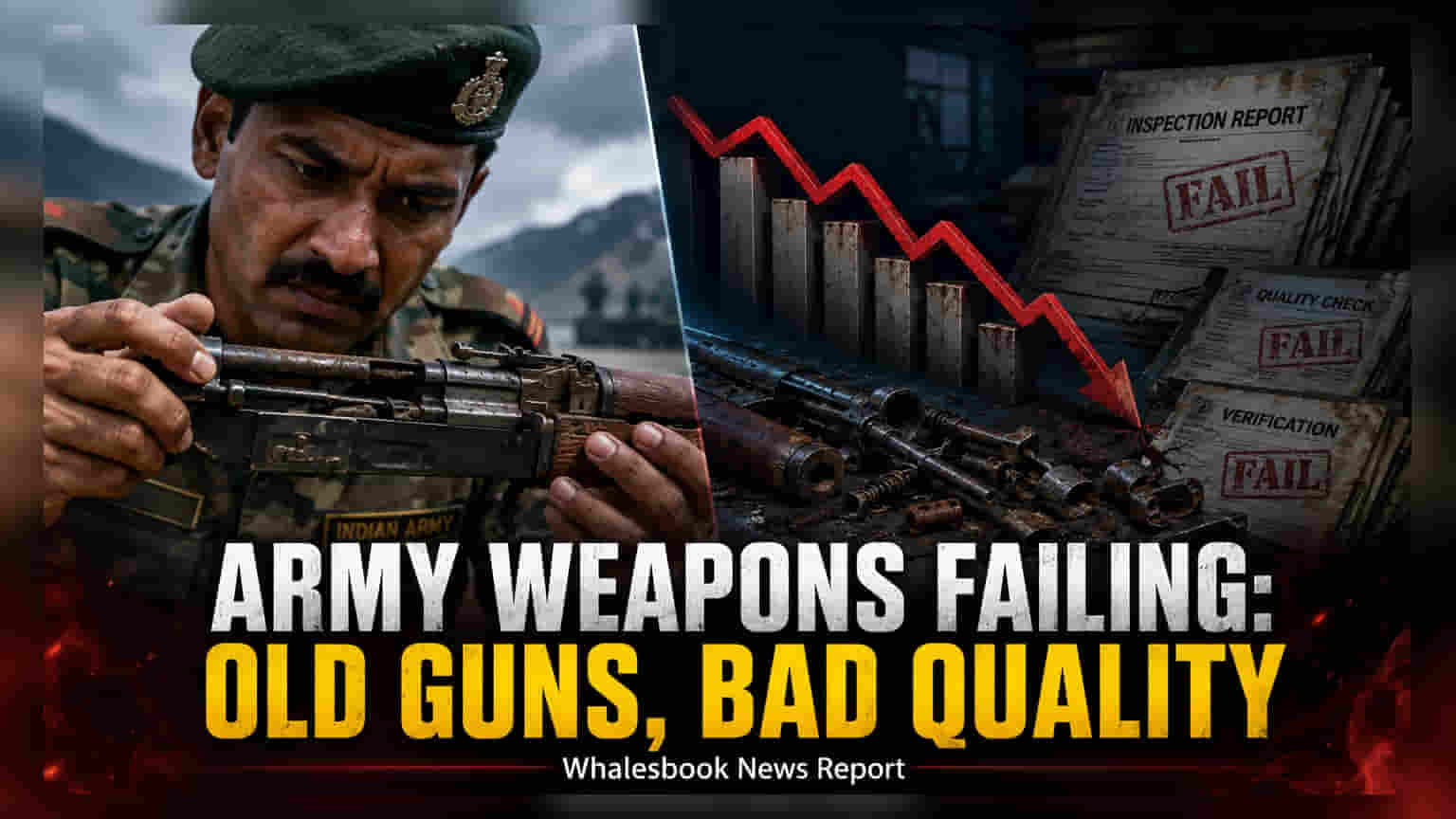
A Parliamentary Public Accounts Committee report has exposed significant quality lapses in small arms produced by state-owned AWEIL, linking the issues to 269 Army weapon accidents. The findings reveal systemic inefficiencies and low demand, raising questions about the operational readiness of India’s defence manufacturing base.
A new Parliamentary Public Accounts Committee (PAC) report presented on August 12, 2026, has brought to light deep-seated operational and quality challenges within India’s state-owned defence manufacturing sector. The report, which analyzed the performance of Advanced Weapons and Equipment India Ltd (AWEIL), identified 269 accidents involving small arms used by the Indian Army over a five-year period. These incidents were largely attributed to the use of outdated weaponry and poor quality control standards during production.
Quality Gaps and Safety Risks
The committee’s findings, based on data from the Comptroller and Auditor General (CAG), highlight that many of the faulty weapons were well past their service life. Key issues included substandard materials, incorrect hardness measurements in components, and manufacturing processes that failed to meet necessary specifications. The report suggests that AWEIL’s internal quality assurance procedures were not robust enough to prevent these defects from reaching the end-user.
For investors and sector observers, this report underscores the execution risks associated with public-sector defence manufacturing. The reliance on legacy production methods and the slow adoption of modern, in-process quality checks have hindered the goal of achieving high-quality indigenous defence output. The report recommends a shift toward real-time quality monitoring to address these defects earlier in the manufacturing cycle.
Impact on Operational Efficiency
A critical observation in the report is the struggle AWEIL faces regarding capacity utilization. Data indicates that between FY 2015-16 and 2019-20, small arms factories saw very little demand from the Indian Army, with the Army accounting for only 10% of the total issues from these facilities. This lack of a stable, long-term order pipeline forced a heavy reliance on smaller orders from the Ministry of Home Affairs, which was insufficient to effectively utilize the available manufacturing capacity.
From a sector perspective, this highlights a significant business challenge. When a manufacturing entity, even a state-owned one, lacks a consistent order book from its primary client, it faces pressure on margins and operational efficiency. The ongoing attempt to modernize these ordnance factories involves high capital spending, but the return on this investment will depend heavily on demand stability and the ability to compete with private sector players who are increasingly entering the defence manufacturing space.
What Lies Ahead for the Defence Sector
Advanced Weapons and Equipment India Ltd (AWEIL) is a government-owned enterprise and is not a publicly listed company; therefore, it has no share price or exchange-listed securities. However, this report is a crucial monitorable for investors in the broader Indian defence sector. It serves as a case study for the challenges inherent in scaling up indigenization, also known as 'Atmanirbhar Bharat' in defence.
Moving forward, the government is expected to focus on policy reforms to improve coordination between quality assurance agencies and manufacturing units. Investors tracking the defence sector should watch for updates on whether these findings lead to increased outsourcing of weapon production to private players or if they trigger a major overhaul of the existing ordnance factory structure to improve reliability and output.