

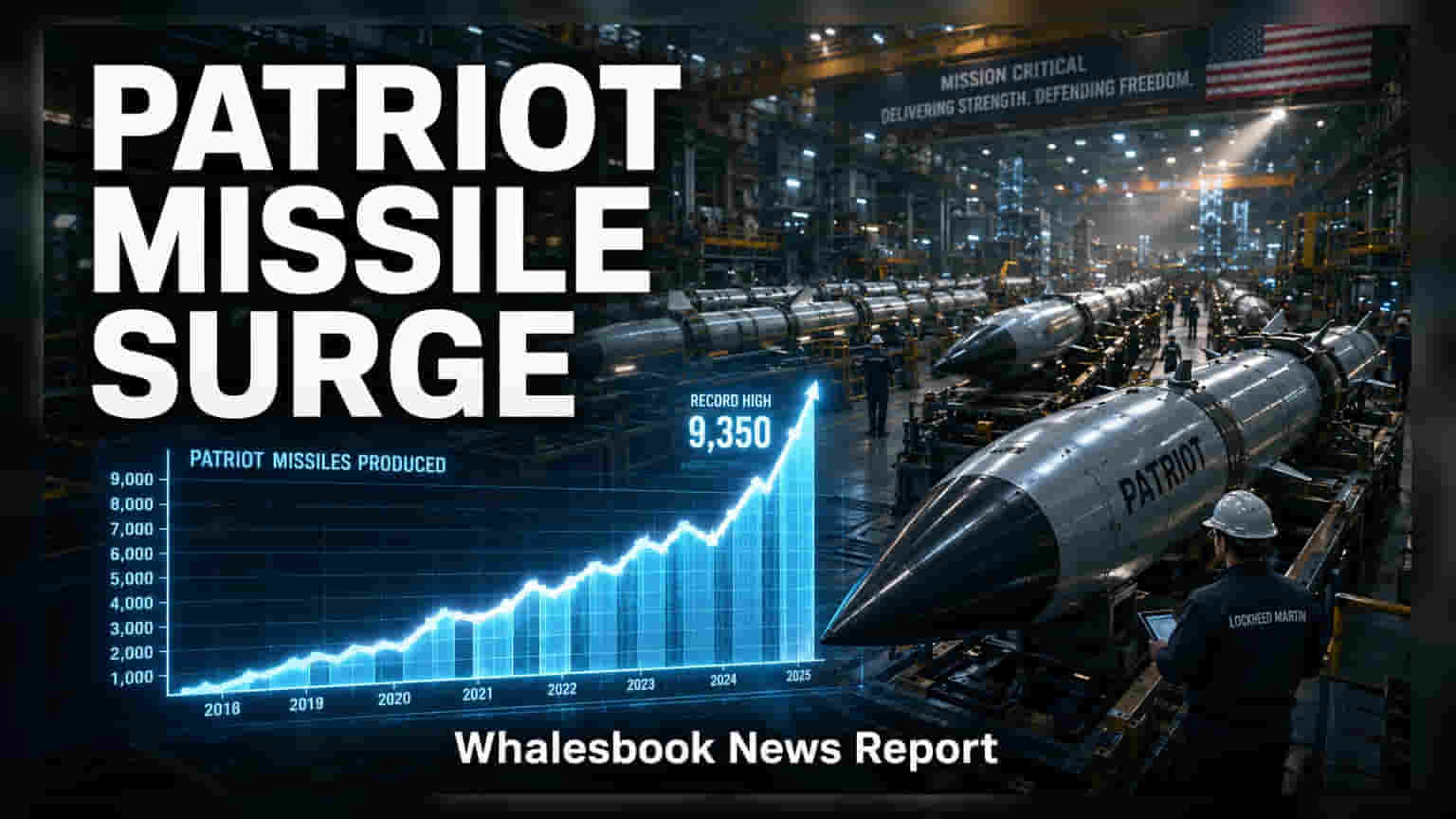
The U.S. Pentagon has awarded Lockheed Martin a $59 billion contract to scale Patriot missile production to 2,000 units annually by 2030. This major multi-year deal aims to replenish military stockpiles amid rising global tensions. Investors should track the firm's ability to scale its Arkansas facility workforce and manage the long-term project execution timeline.
Lockheed Martin Corporation has secured a landmark $59 billion contract from the U.S. Department of Defense to drastically ramp up its Patriot missile production. This seven-year initiative is designed to increase annual output of the Patriot Advanced Capability-3 Missile Segment Enhancement (PAC-3 MSE) interceptors from the current level of approximately 600 units to 2,000 by 2030. The agreement builds upon an earlier $4.7 billion contract awarded in April, with the new funding accounting for the majority of the total investment over the seven-year period.
Scaling Production and Infrastructure
To support this significant increase in output, Lockheed Martin intends to expand its workforce at its Camden, Arkansas, manufacturing facility. The company plans to hire an additional 650 employees, which will bring the site's total workforce dedicated to the Patriot program to 1,850 people. The move is part of a broader government effort, backed by the Defense Production Act, to strengthen the domestic defense industrial base and ensure a consistent supply of interceptors. The urgency of this expansion is reflected in the unit cost of the PAC-3 MSE interceptors, which are priced at approximately $4 million each.
Broader Defense Industrial Trends
This contract is not an isolated event for Lockheed Martin. Earlier this year, the company was involved in a potential $35 billion agreement aimed at quadrupling the production capacity of Terminal High Altitude Area Defense (THAAD) interceptors. These consecutive large-scale contracts reflect the current administration’s focus on long-term military readiness and the replenishment of munitions that have been utilized in various regions. Beyond Lockheed Martin, the supply chain for these defense systems is also seeing activity, with companies like L3Harris Technologies working to accelerate the production of essential components such as solid rocket motors.
Investor Monitorables and Risks
For investors, the primary monitorable remains the company's ability to execute this high-volume production plan without facing significant cost overruns or delays. While long-term government contracts provide revenue visibility, they also carry the risk of labor shortages, supply chain bottlenecks for specialized components, and the operational challenges of managing a massive workforce expansion. Investors may continue to track management commentary regarding the ramp-up progress, the impact of these projects on operating margins, and how the firm balances this heavy capital allocation alongside other defense obligations.